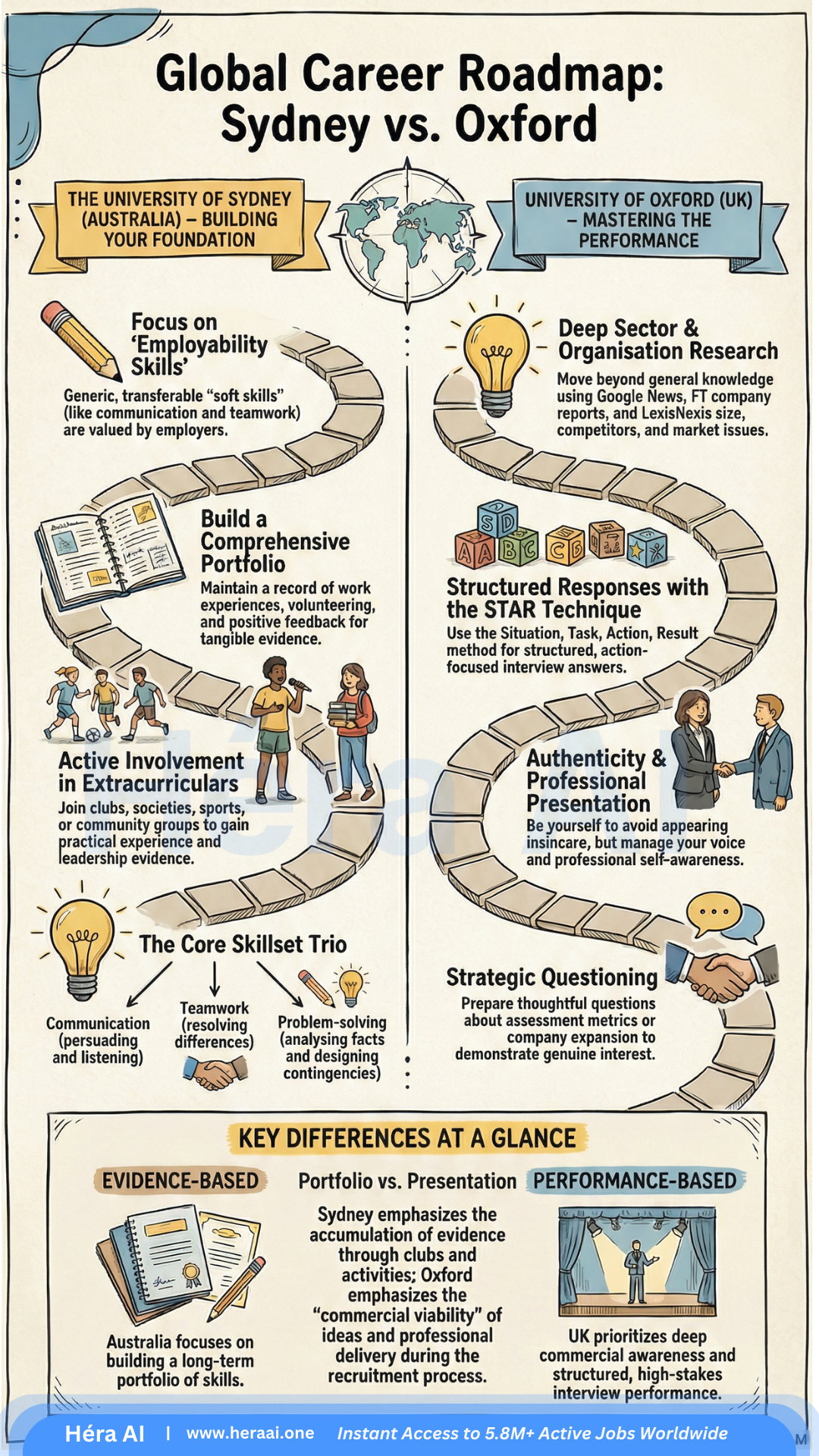
The Global Career Playbook: Bridging Sydney's Skills Framework and Oxford's Commercial Mindset
Two world-class institutions. Two distinct philosophies. One integrated strategy for candidates competing across the Australian and UK job markets.
Most career frameworks are built for a single market. The guidance that gets you noticed in Sydney isn't always the guidance that gets you hired in London — and vice versa. Understanding why that gap exists, and how to bridge it, is a strategic advantage available to any candidate who takes the time to look.
The University of Sydney and the University of Oxford represent two of the most sophisticated career development systems in the English-speaking world. Comparing them directly reveals something more useful than either institution provides alone: a composite framework that works across markets, across industries, and across experience levels.
Here's what each model contributes — and how to combine them into a strategy that travels.
1. Sydney: The Employability-First Framework
The University of Sydney's career development philosophy is built around a single concept: employability. Not job titles, not academic credentials — but the transferable, non-technical capabilities that allow a person to perform across roles, teams, and industries.
The operational model is a portfolio of skills — an evidence-based accumulation of demonstrated capabilities built across every domain of university life. The critical insight is that the evidence doesn't have to come from formal work experience. A team captain, a club treasurer, a volunteer coordinator, a research assistant — each of these roles generates evidence of the same underlying capabilities that employers actually hire for: leadership, communication, problem-solving, and collaborative judgment.
What Sydney demands in return is specificity. Vague claims — 'strong communication skills,' 'works well in teams' — are not evidence. They are assertions. The Sydney framework insists on exact responsibilities, specific contexts, and documented outcomes. The difference between an assertion and evidence is a number, a result, or a named scenario.
The Sydney standard: Don't claim you have communication skills. Describe the 'research reports, stakeholder briefings, and client-facing presentations' you've delivered. Specificity is the mechanism that turns a claim into a credential.
2. Oxford: The Commercial Sophistication Framework
Oxford's career guidance operates at a different layer. Where Sydney focuses on building the foundation, Oxford focuses on executing at the highest level — particularly in interview settings where commercial awareness and structured thinking are the primary evaluation criteria.
The Oxford approach to pre-interview preparation goes well beyond company research. Candidates are expected to understand the organisation's competitive position, the market forces shaping its sector, and the broader global context in which it operates. The tools Oxford recommends — LexisNexis, Financial Times company reports, sector-specific databases — reflect the depth of analysis expected.
In the interview room, Oxford champions the STAR technique as the structural architecture for every competency-based answer. And on the question of authenticity, Oxford is explicit: scripted, rote-learned answers are a red flag. Interviewers are trained to detect them. The ability to discuss a genuine weakness — with a specific, honest growth narrative — consistently outperforms a rehearsed answer designed to appear impressive.
The Oxford standard: Commercial awareness isn't demonstrated by saying 'I follow the industry.' It's demonstrated by naming a competitor's strategic move, explaining a recent market shift, and articulating what that means for the organisation you're interviewing with.
3. Head-to-Head: How the Two Frameworks Compare
Placed side by side, the Sydney and Oxford frameworks reveal a clear division of labour — not contradiction, but complementarity. Sydney builds the raw material; Oxford refines how it's presented.
The most significant structural difference is the UK-specific assessment landscape. The Watson-Glaser Critical Thinking Appraisal — a logical reasoning test widely used by UK law firms, financial institutions, and consulting practices — has no direct equivalent in Australian graduate hiring pipelines. Candidates targeting UK roles need to prepare for this specifically, as performance on the Watson-Glaser is often used as a first-round filter before interview invitations are issued.
Market navigation note: If you're targeting roles in the UK, treat the Watson-Glaser as a distinct skill set to develop — not an extension of your interview preparation. Practice materials are widely available, and performance improves significantly with structured preparation.
4. The STAR Technique: Oxford's Interview Architecture, Applied
The STAR method — Situation, Task, Action, Result — is the most widely recommended structured interview framework across global hiring markets. Oxford's guidance on its application is more precise than most candidates realise, particularly in what it says about the common failure modes at each step.
The STAR method works because it forces specificity at every stage. A candidate who can navigate all four steps without generalising, without defaulting to 'we,' and without ending on a vague positive impression has demonstrated exactly the structured thinking that interviewers are evaluating for.
One preparation principle: Build a library of 6–8 STAR stories before any interview, drawn from different domains — academic, extracurricular, work, volunteer. Each story should be genuinely yours, specific in detail, and adaptable to different competency questions. Rote learning a fixed set of answers defeats the purpose.
5. The Winning Combination: What to Take from Each Framework
The most effective strategy for candidates competing across either market — or both — is to integrate the two frameworks deliberately rather than choosing between them. Sydney provides the breadth of evidence; Oxford provides the analytical depth and structural precision to present it.
The integration principle: Use Sydney's portfolio approach to build the raw material — every experience, every extracurricular, every project documented with specific outcomes. Use Oxford's STAR structure and commercial awareness framework to present that material in the format each market rewards.
6. The Four Universal Principles That Apply Regardless of Market
Despite their differences, both frameworks converge on a set of principles that hold across every job market, every industry, and every career stage.
One Strategy, Two Markets
The Sydney and Oxford frameworks aren't competing approaches — they're two halves of a complete career strategy. Sydney teaches you what to build and how to document it. Oxford teaches you how to research, how to present, and how to perform under structured evaluation.
Candidates who understand both — and know when to deploy each — have a genuine edge in any competitive hiring process, whether the role is in Melbourne, London, or anywhere in between.
At HéraAI, that kind of cross-market strategic clarity is exactly what the Resume Architecture Lab and Interview Cheatsheet Vault are built to develop.