Resume Architecture Lab · Stanford RESUME Model · ATS & Cover Letter Strategy
Decoding the Stanford Blueprint: Why These 'Old School' Resume Rules Still Win in the AI Era
AI has transformed how resumes are screened. The principles Stanford built its career framework around have only become more important as a result.
A resume is not a biography. That's the foundational premise of Stanford's career development framework — and it's a premise that most candidates still get wrong.
The resume's only purpose is to secure an interview. Everything else — the chronology, the formatting, the choice of what to include or omit — should be evaluated against that single objective. Stanford's guide to resume and cover letter writing was built around this principle decades ago. In an era defined by AI screening tools and applicant tracking systems, it turns out to be more operationally relevant than ever.
This article breaks down the Stanford framework's core mechanisms, explains why they work in today's hiring environment, and shows how to apply them across both your resume and your cover letter.
1. The Resume's Only Job: Earn 30 More Seconds
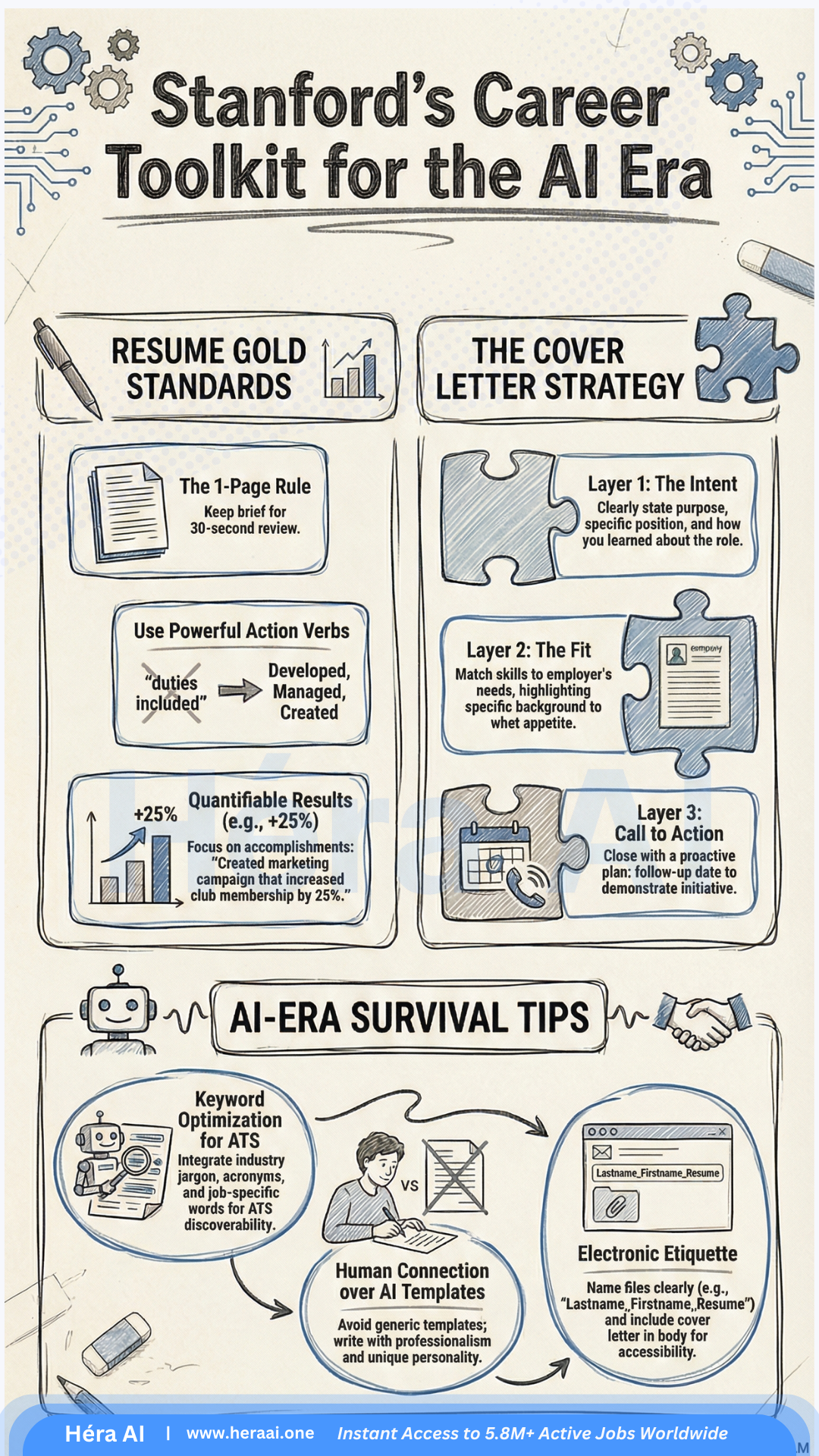
Stanford's framework opens with a clarifying constraint that most candidates underestimate: recruiters spend less than 30 seconds on an initial resume review. That's not a reason to oversimplify your resume — it's a reason to engineer it with precision.
In those 30 seconds, a recruiter is pattern-matching against a mental checklist: Does this person have the right background? Can I see their impact quickly? Does this document look like someone who pays attention to detail? The resume doesn't have to answer every question — it has to answer those three well enough to earn the next step.
That requires two things working simultaneously: a document that passes automated screening, and a document that earns human attention. These are related but distinct optimization problems.
The key insight: Most candidates optimize for one or the other. The Stanford standard optimizes for both — using clean, keyword-integrated language that satisfies ATS parsing while presenting a visually scannable, outcome-focused document that earns recruiter attention.
2. Action Verbs and Quantifiable Results: The Stanford Standard for Bullet Points
The most actionable element of Stanford's resume framework is its insistence on verifiable accomplishments over listed duties. This distinction — what you achieved versus what you were responsible for — is the single highest-leverage change most candidates can make to their resume.
The logic is straightforward: duty-based bullet points describe the job, not the person. Any candidate who held a similar role could write the same line. Accomplishment-based bullet points describe a specific outcome that this candidate produced — and that's the evidence a hiring manager is actually looking for.
Stanford's framework connects this directly to the ATS context: action verbs and quantified results also happen to be the format that keyword-matching algorithms reward. A bullet point that starts with 'Developed' and includes a percentage metric is more likely to match a job description's language patterns than one that starts with 'Responsible for.'
The standard to apply: For every bullet point on your resume, ask — 'Could any other candidate who held this role have written this line?' If the answer is yes, it needs a specific number, outcome, or scale that makes it uniquely yours.
3. The Cover Letter as a 'Notion of Fit' — Not a Resume Retelling
The cover letter is the most misunderstood document in the job application process. Most candidates use it to summarize their resume in paragraph form — which tells the hiring manager nothing they couldn't learn by reading the resume itself.
Stanford's framework reframes the cover letter's purpose entirely: it is a tool for creating a 'notion of fit' — a demonstration that you understand this specific organization, this specific role, and why the combination of those two things and your particular background creates a match that isn't generic.
That's a fundamentally different task than summarizing your experience. And it's one that AI-generated templates, by design, cannot execute — because demonstrating specific organizational knowledge requires actual research, not pattern completion.
Stanford's three-paragraph structure gives that argument a clear, professional architecture:
Why this matters in an AI era: A recruiter reading 200 cover letters can identify a generic AI-generated letter in seconds. A letter that mentions a specific product launch, names a relevant company initiative, and connects that directly to your background signals something AI can't replicate: that you actually want this job, not just a job.
4. Where the Stanford Model Fits in the Resume Architecture Series
Readers following the HéraAI Resume Architecture Lab series will recognize how the Stanford framework connects to the models we've examined from Princeton and MIT.
Together, the three models give you a complete resume strategy: Princeton tells you how to write each bullet, MIT tells you how to structure the document for your industry, and Stanford tells you how to ensure it survives automated screening and earns human attention — and how to extend that argument into a cover letter that actually differentiates you.
The Fundamentals Win — Especially When Everyone Else Is Cutting Corners
The irony of the AI era in hiring is this: as more candidates use AI tools to generate their application materials, the candidates who invest in understanding and applying foundational frameworks become more distinctive, not less.
A resume built on Stanford's action-verb, quantified-outcome standard, structured around MIT's industry-specific architecture, and refined through Princeton's ACE model is not a document that AI produces by default. It's a document that requires judgment, translation, and intentional design.
That's exactly the kind of thinking — from experience to evidence, from background to value proposition — that HéraAI's Resume Architecture Lab is built to develop.