Resume Architecture Lab · Frameworks & Strategy · Princeton RESUME Model
Beyond the Template: How to Engineer a Resume That Actually Gets Read
Your resume isn't a record of what you've done. It's a marketing document that answers one question: why should we hire you over everyone else?
Most candidates approach resume writing the wrong way. They treat it as a historical document — a chronological record of jobs and responsibilities. Recruiters don't read it that way. They're scanning for evidence that you can solve their specific problem.
The Princeton Center for Career Development frames this precisely: a resume is a dynamic marketing tool, not a static list of duties. And like any good marketing, it requires strategy — a framework for translating your experience into the language of business value.
This article breaks down that framework, including the specific structural decisions that separate a resume that gets a callback from one that gets archived in 15 seconds.
1. The ACE Framework: Stop Listing Duties, Start Proving Value
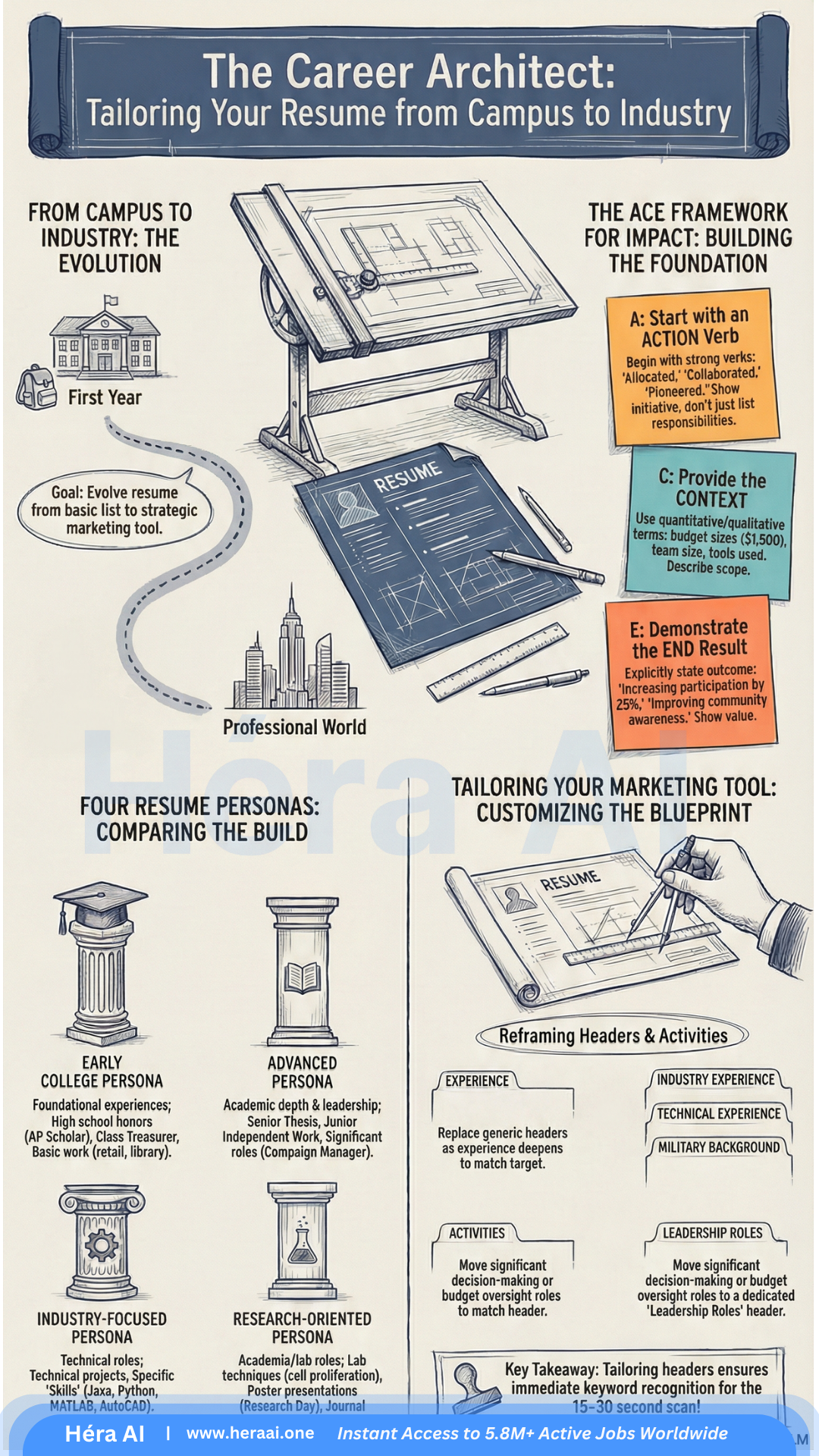
The single most effective structural change you can make to a resume is replacing duty-based bullet points with what Princeton's career framework calls Action-Oriented Accomplishment Statements — structured around three components.
The logic is simple: duty-based bullets describe what you were supposed to do. ACE-formatted bullets prove what you actually delivered. Recruiters are trying to predict your future performance — and demonstrated outcomes are a far more credible signal than a job description restated in first person.
The test: Read each bullet point and ask — 'Could this sentence appear on anyone's resume, or does it describe a specific, measurable thing I personally did?' If it's the former, rewrite it with ACE.
2. Industry vs. Research: Your Resume Structure Should Match Your Target Audience
One of the most common resume mistakes is using the same document structure for every application. The hierarchy of information that impresses a hiring manager at a tech company is fundamentally different from what impresses a research faculty committee.
Princeton's career framework is direct on this point: resume architecture should change based on your target audience. Here's how that plays out in practice.
The underlying principle: every section header and every piece of information on your resume is a signal about what you think the reader values most. Misaligning that signal — leading with research publications for an engineering role, or leading with technical tools for an academic position — tells the reader you don't understand their context.
Practical rule: Before finalizing any resume, identify the single most important credential for that specific role. That credential should appear in the top third of the first page. Everything else is supporting evidence.
3. Transferable Skills: The Answer to 'I Don't Have Enough Experience'
The most common concern among early-career candidates — and many career changers — is a perceived lack of relevant experience. The Princeton framework addresses this directly: the problem is rarely a lack of experience. It's a failure to translate existing experience into the language of the target role.
Transferable skills are the bridge. Leadership developed on a varsity rowing team, time management built through choreographing a dance production, cross-functional coordination from organizing a campus event — these are not filler content. They are evidence of capabilities that employers value and cannot easily test for in a technical interview.
The reframe: You don't need a longer resume. You need a more strategically translated one. Every experience you've had contains transferable evidence — the skill is learning to surface it in the right language for the right audience.
4. Final Polish: The Formatting Decisions That Affect the 15-Second Scan
Resume content is only half the equation. The way information is organized and presented determines whether a recruiter reads it at all. The research on recruiter behavior is consistent: the average initial scan lasts 15 to 30 seconds. In that window, they're not reading — they're pattern-matching against mental criteria.
The formatting decisions that most affect that scan:
The 15-second test: Print your resume, set a 20-second timer, and look away. When the timer goes off, look at the page and note what your eye lands on first. If it's not your strongest credential for that role, restructure the document until it is.
Your Resume Is a Work in Progress — Treat It That Way
The Princeton framework's most important insight isn't a formatting rule or a writing technique. It's a mindset: your resume is never finished. It evolves as your experience deepens, as your target roles shift, and as your understanding of what a specific employer values becomes more precise.
The candidates who consistently outperform in competitive hiring processes aren't the ones with the most impressive backgrounds. They're the ones who invest in translating their backgrounds with the most precision — who understand that a resume is not a record, it's an argument.
At HéraAI, building that argument is exactly what the Resume Architecture Lab is designed to help you do.