Resume Architecture Lab · Industry Blueprints · MIT Career Model
Strategic Resume Engineering: What MIT's Career Model Reveals About Standing Out
MIT's sample resumes aren't just polished documents — they're blueprints for how top candidates engineer their professional narrative for each target industry.
Most candidates write one resume and send it everywhere. MIT's approach to career development starts from the opposite premise: the layout, emphasis, and language of your resume should change based on who's reading it and what they're hiring for.
By analyzing the sample resumes published by MIT Career Advising & Professional Development, a clear pattern emerges. These documents aren't just records of experience — they're engineered arguments for why a specific candidate is the right fit for a specific role. Each industry has its own signal language, its own hierarchy of credibility, and its own standard for what 'impact' looks like on paper.
Here's what that looks like in practice — and how any candidate can apply the same logic to their own resume.
1. Industry-Specific Blueprints: What to Lead With and Why
The most important structural insight from the MIT model is that the content hierarchy of a resume — what appears first, what gets the most space, what metrics are featured — should be determined by the reader's priorities, not the writer's preferences.
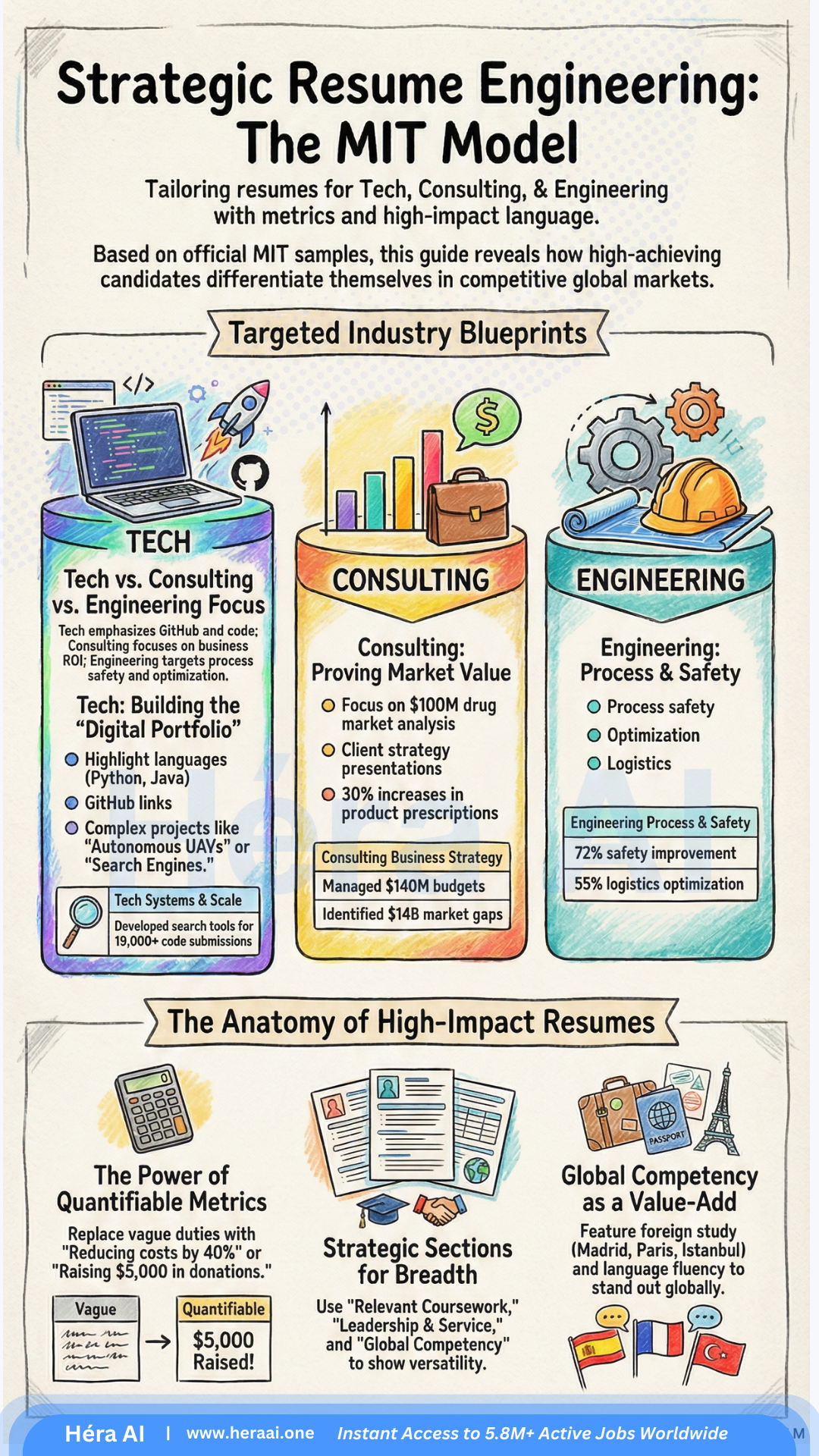
Each industry rewards a different kind of proof. Here's how MIT's samples map that out:
The pattern across all four: every resume leads with the type of evidence that matters most to that specific audience. Tech hiring managers scan for technical depth and real-world scale. Consulting interviewers look for quantified business impact. Engineering teams want process outcomes and tool fluency. Real estate and public sector evaluators weight budget authority and stakeholder management.
The core principle: Your resume doesn't have to list everything you've done. It has to lead with the evidence that is most credible to the specific person reading it. Everything else is secondary.
2. From Historical Record to Value Proposition
The MIT approach reframes the fundamental purpose of a resume. Most candidates treat it as a historical document — a backward-looking record of positions held and responsibilities carried. MIT's Career Advising framework treats it as a forward-looking value proposition: evidence that you will generate the outcomes this employer cares about.
That shift in framing has three concrete implications:
The reframe that changes everything: A resume that describes what you did is competing with every other candidate who held a similar role. A resume that proves what you delivered is competing in a much smaller pool.
3. Five Strategies Any Candidate Can Apply Today
The MIT model isn't exclusive to Ivy League graduates or candidates with exceptional work histories. The strategic logic is universally applicable. Here are the five highest-leverage tactics, translated into actionable steps.
On the Projects section specifically: A well-documented project — Sentiment Analysis Stock Prediction, an Autonomous UAV build, a LangChain conversational agent — demonstrates exactly what employers most struggle to assess in interviews: your ability to apply knowledge to an ambiguous, real-world problem. Build it, document it, and own it on your resume.
4. The MIT Model in Comparison: How It Extends the Princeton ACE Framework
Readers who followed our earlier breakdown of the Princeton Career Development framework will recognize a consistent throughline: both models treat the resume as an engineered argument, not a formatted biography.
Where Princeton's ACE model (Action → Context → End Result) gives you the micro-level tool for writing individual bullet points, the MIT model provides the macro-level blueprint for how to architect the entire document around a specific industry and audience.
The result is a resume that functions at two levels simultaneously: it passes the 15-second scan by surfacing the right signals in the right hierarchy, and it holds up under detailed review by demonstrating depth, specificity, and real-world judgment.
Engineering Your Resume Is a Learnable Skill
The candidates who land offers at highly competitive organizations aren't always the ones with the most impressive raw experience. They're the ones who've learned to translate their experience into the specific language of value that each employer is looking for.
The MIT model makes that translation systematic. It gives you a framework for reading the audience, selecting the right signals, and organizing your evidence in a hierarchy that earns attention in the first 15 seconds and justifies it in the next 15 minutes.
At HéraAI, the Resume Architecture Lab is built around exactly this kind of strategic translation — from what you've done, to why that makes you the right hire.