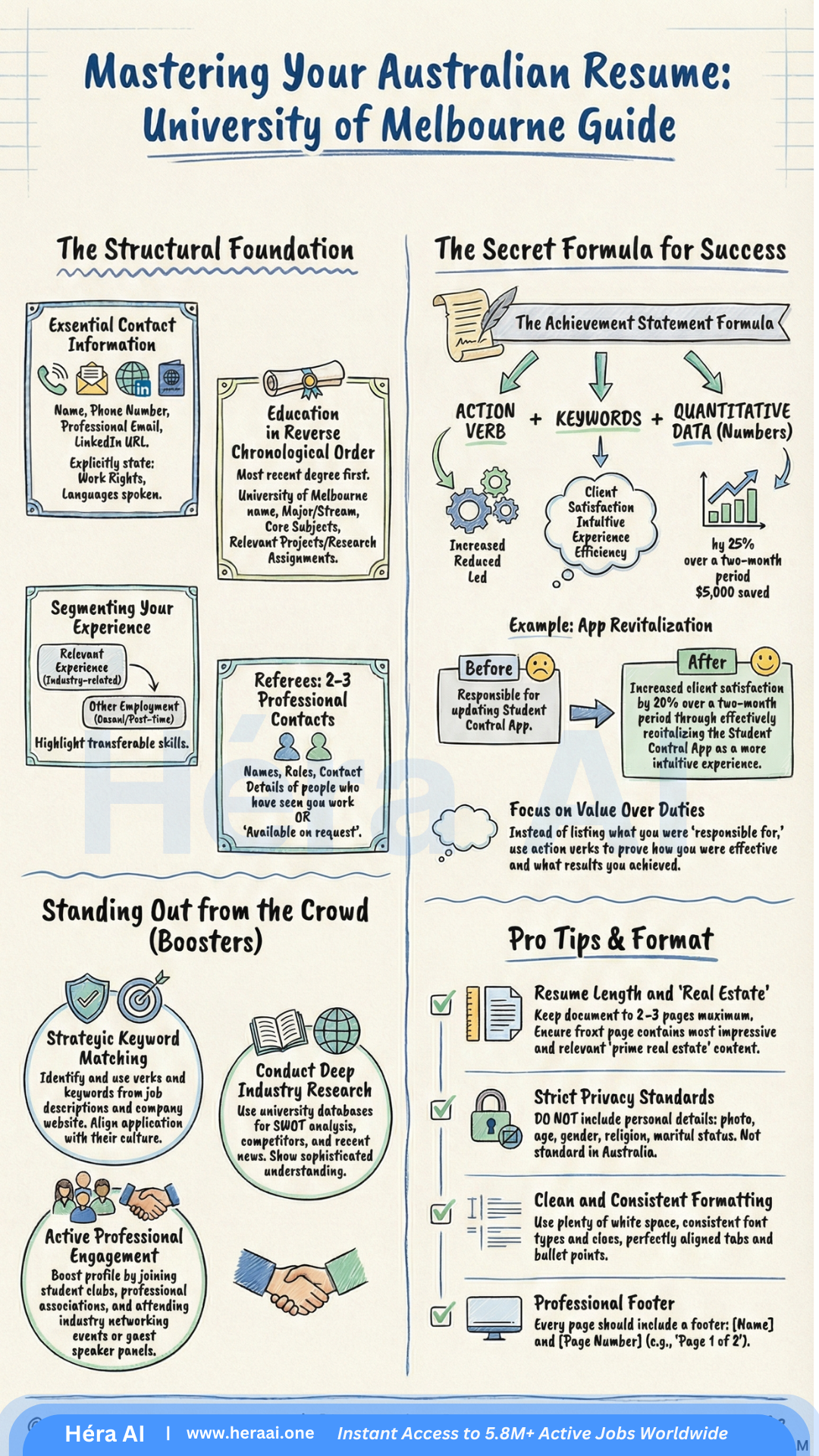
Resume Architecture Lab · Australian Market · University of Melbourne Framework
The Achievement-Based Resume: What the Australian Job Market Actually Rewards
54.1% of applicants walk into interviews without researching the company. The Melbourne framework is built around exactly that gap.
Writing a resume often feels like sending a carefully crafted document into a void. Most candidates follow a template, list their experience in reverse chronological order, and hope the content speaks for itself. The University of Melbourne's career development framework starts from a different premise: a resume is a marketing document, and like any marketing, it requires both a clear value proposition and evidence that the proposition is credible.
What makes Melbourne's approach particularly actionable — especially for the Australian market — is its emphasis on company research as a direct competitive advantage. The data point is striking: 45.9% of candidates walk into applications without a genuine understanding of the organisation they're targeting. That means demonstrating real market awareness immediately places you in the top half of any applicant pool, before the interview even begins.
This article breaks down Melbourne's framework into its four structural components and explains how to apply each one in practice.
1. The Mindset Shift: You Are a Product — Your Resume Is the Pitch
The framing that anchors Melbourne's framework is simple but consequential: stop thinking of your resume as a record of what you've done, and start thinking of it as a pitch for what you can do for a specific employer.
That shift has practical implications for every decision you make in drafting the document. A record-based resume asks: what did I do in each role? A pitch-based resume asks: what does this employer need, and which of my experiences most directly proves I can deliver it?
The operative concept is transferable skills — capabilities that cross role boundaries and industry lines. Leadership developed running a student association is as relevant to a graduate recruitment process as leadership developed in a paid management role, if it's framed with the same evidence standard: specific context, measurable outcome, demonstrated impact.
The filter to apply to every section: Before including any piece of information, ask — 'Does this prove I can deliver something this employer values?' If the answer is no, cut it. If the answer is yes, make sure it's supported by a number or a specific outcome.
2. The Gold Standard Structure: Four Sections, Precisely Sequenced
Melbourne's framework specifies not just what to include, but how to sequence and position each section for maximum impact. The architecture matters because recruiters scan in a predictable pattern — top-left to right, then down. What appears first and where it appears shapes what gets read and remembered.
On the Profile section specifically: This is the most underutilised section on most graduate resumes and the highest-leverage real estate on the page. Three to four lines, written specifically for this role, that immediately signal you understand what the employer is looking for — not a generic summary of your personality type.
3. Quantify Everything — And Then Quantify Again
The Melbourne framework's most direct instruction is also its most impactful: numbers provide immediate credibility. A bullet point with a percentage, a user count, a dollar figure, or a timeframe is processed differently by a recruiter's brain than one without. It signals not just that something happened, but that you were paying attention to whether it worked.
This is the mechanism behind the achievement-based approach: outcomes are inherently quantifiable, while duties are not. 'Managed the club's social media accounts' is a duty. 'Grew Instagram engagement by 40% over two semesters by introducing a weekly content calendar and partnerships with three campus societies' is an achievement.
The test: Read each bullet point and ask — 'How would I know this was successful?' The answer to that question is the number you're missing. Find it and add it.
4. The 45.9% Advantage: Company Research as a Resume Strategy
The statistic the Melbourne framework highlights — that fewer than half of applicants genuinely understand the company they're applying to — is one of the most actionable data points in career development. It means that demonstrating real market awareness is a differentiation strategy available to almost any candidate, regardless of their experience level.
In practice, this shows up in two ways on the resume: in the Profile section (where you can reference specific aspects of the organisation's direction or challenges) and in the cover letter (where you can demonstrate knowledge of their competitive landscape, recent news, or product strategy).
The practical application: in your Profile section, replace generic descriptors with language that reflects the organisation's own priorities. If a company's latest annual report emphasises 'operational efficiency' and 'digital transformation,' those phrases belong in your profile — because they're the recruiter's filter language.
5. Building Experience When You Don't Have 'Traditional' Experience
One of the most common concerns among graduate candidates and career changers is the perceived gap between their current background and the experience requirements in job postings. Melbourne's framework addresses this directly: the evidence standard is what matters, not the employment status of the experience.
Group assignments, independent research projects, case competitions, student society leadership, and volunteer roles all qualify — if they're presented with the same rigor as paid work: specific context, measurable outcome, transferable skill.
The reframe that matters: Employers aren't looking for a specific employment history. They're looking for evidence that you can do the work. Your job is to produce that evidence, whatever its source.
6. Where Melbourne Fits in the Resume Architecture Series
This article is the fourth installment in HéraAI's Resume Architecture Lab series. Each framework we've examined adds a distinct layer to a complete resume strategy.
The Melbourne framework's specific contribution is twofold: it provides the most actionable guidance for candidates without extensive work experience, and it adds the Australian market context that North American frameworks don't address — particularly the emphasis on company research as a direct differentiator in local hiring pipelines.
The Resume That Proves What You Can Do
The University of Melbourne's career framework closes with a deceptively simple standard: a great resume doesn't just say what you did. It proves what you can do for your future employer.
That distinction — between a record and a proof — is what separates the candidates who get called back from those who don't. It requires deliberate translation of your experience into evidence, and deliberate research into what each specific employer is actually looking for.
Neither of those things is easy. But both are learnable skills — and both are exactly what the HéraAI Resume Architecture Lab is built to develop.