Resume Architecture Lab · COMPUTER SCIENCE· CMU Career Framework
Beyond the Code: The CMU Blueprint for the AI-Powered Technical Job Search
Carnegie Mellon's career framework distilled into three pillars, one impact formula, and a four-part AI co-pilot strategy for CS students and software engineers.
Landing a top-tier software engineering offer requires more than technical ability. It requires a resume that communicates impact with precision, a job search strategy that uses available tools intelligently, and the discipline to distinguish between authentic self-presentation and AI-generated noise.
Carnegie Mellon University's career guidance for CS students is built around a deceptively simple insight: the difference between a resume that gets a callback and one that doesn't is usually not experience — it's evidence. Most CS resumes describe what students were responsible for. The strongest ones prove what those students delivered.
This article covers the full CMU framework: three core resume pillars, the XYZ impact formula, and a structured approach to using AI as a career co-pilot without losing the authenticity that wins at the interview stage.
1. The CMU Standard: Three Pillars of a Winning CS Resume
CMU's career framework for technical students is built around three non-negotiable pillars. Each addresses a distinct failure mode: the first corrects responsibility-based bullet points, the second addresses the common underutilisation of technical and project work, and the third targets the formatting and tailoring decisions that determine whether a resume gets read at all.
The framing that matters: A resume is a marketing document, not a biography. Every line should answer the question a recruiter is implicitly asking: 'What did this person actually deliver, and is it relevant to the role I'm hiring for?' Lines that don't answer that question shouldn't be there.
2. The XYZ Impact Formula: How to Write Every Bullet
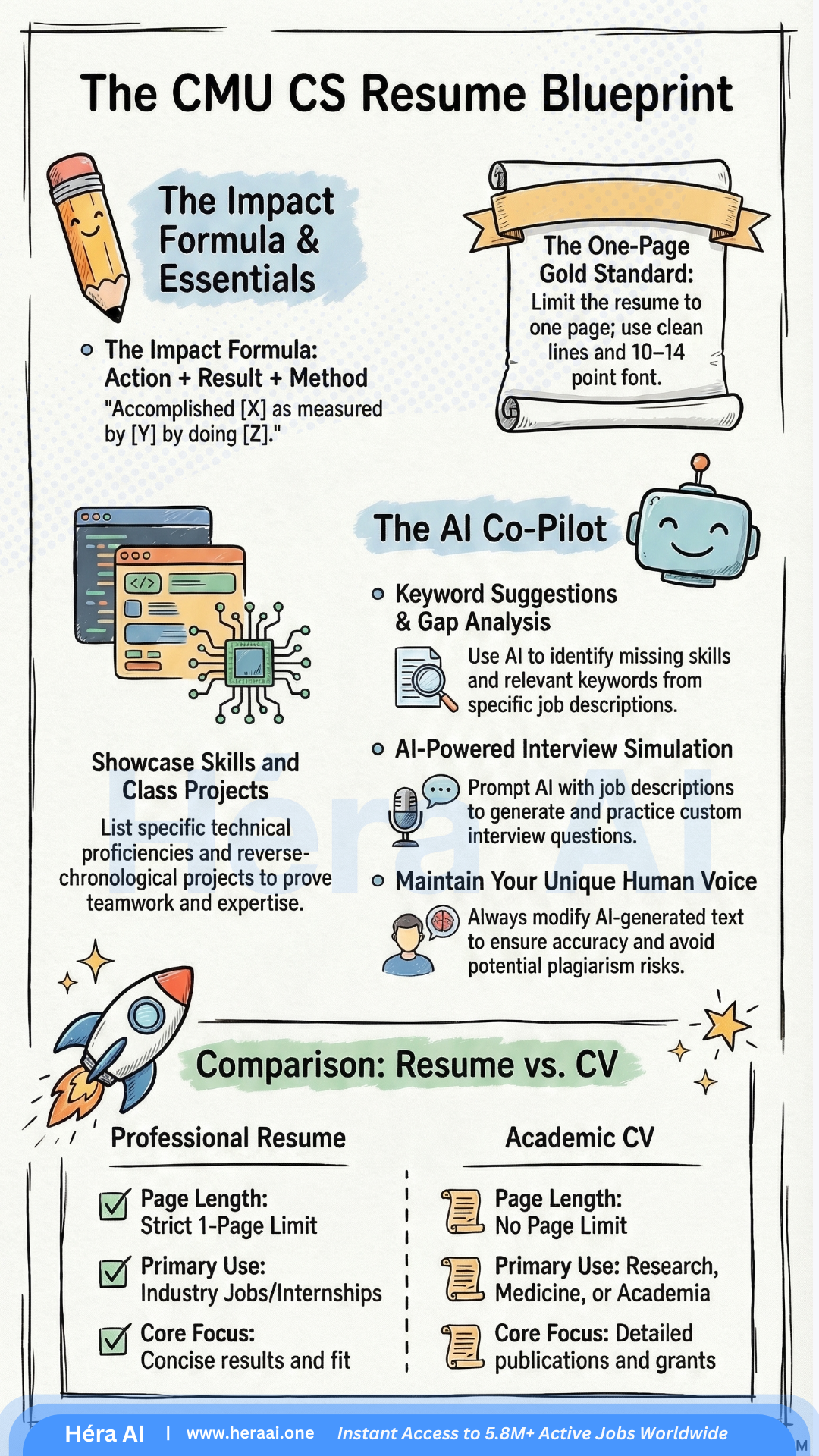
The most operationally specific guidance in the CMU framework is the XYZ formula for bullet points: 'Accomplished [X] as measured by [Y] by doing [Z].' It's a three-part structure that forces precision at every stage — what you did, how you know it worked, and how specifically you did it.
The formula addresses the single most common weakness in CS resumes: responsibility language. Responsibility language describes what a role involves. Impact language proves what a specific person delivered. The XYZ structure makes impact language the default, not the exception.
The three components combine into a single bullet: 'Reduced API response latency for the primary checkout service by 20%, from 340ms to 270ms under peak load, by implementing a Redis caching layer with a 5-minute TTL policy.' Every word is doing work. The recruiter knows the system, the result, and the method — in one sentence.
Finding your Y when you don't have a metric: Not every project produces a clean percentage. Acceptable Y values include: test coverage increased from 60% to 90%, deployment time reduced from 45 minutes to 8 minutes, API errors reduced from 12 per hour to 0 after fix, or feature adopted by 3 internal teams within one sprint. The number doesn't have to be dramatic — it has to be real and specific.
3. Technical Depth: Making Your Skills Section Work Harder
For CS students and recent graduates, the Skills section is often treated as a quick list to fill space. In practice, it's one of the most important ATS-facing elements in the document — and one of the most consistently misformatted.
The CMU standard organizes technical skills into named categories rather than a flat list. This structure serves two purposes: it makes extraction by ATS systems more reliable, and it signals to a human reviewer that you understand the distinctions between different classes of technical capability.
4. Class Projects as Professional Evidence
The most common mistake CS students make with project experience is understating it. A well-documented class project — with a named problem, a specific technical approach, measurable outcomes, and a team scope — is direct evidence of the same capabilities that internship experience demonstrates.
The key is presentation. A project listed as 'Group assignment using React and Node.js' communicates almost nothing. The same project presented as 'Built a full-stack task management application for a 4-person team using React, Node.js, and PostgreSQL, reducing manual project tracking time by 60% through automated status updates and Slack integration' is a professional evidence statement.
The project presentation standard: For every project you list, answer four questions: What problem did it solve? What did you specifically build? What technologies did it use? What was the measurable outcome? If you can't answer all four, the project isn't ready to be on your resume yet — go back and document it properly.
5. AI as Career Co-Pilot: Four High-Value Applications
CMU's guidance on AI in the job search reflects a clear position: AI tools are a starting point and a revision tool, not a replacement for original thinking. The distinction matters because the resume gets you through the door, but authenticity wins the interview. A resume written entirely by AI — with no genuine grounding in your actual experience — will fall apart at the first follow-up question.
Used correctly, AI accelerates four specific parts of the job search process. Each has a clear use case, a concrete expected output, and a caveat that determines whether the output is useful or dangerous.
The ethical boundary that protects you: AI tools can suggest skills, rephrase bullets, and generate questions. They cannot invent experience you don't have. Every claim on your resume must be something you can discuss in depth, defend under pressure, and verify if asked. The resume gets you the interview. Your actual knowledge and experience determine everything that happens after.
6. Where CMU Fits in the Resume Architecture Lab Series
CMU's framework is the sixth model in HéraAI's Resume Architecture Lab series. Each framework adds a distinct layer to a complete resume strategy. Together, they cover every dimension of the document — from micro-level bullet construction to macro-level document architecture, from market-specific calibration to AI-enhanced optimization.
CMU's specific contribution to the series is the intersection of technical precision and AI strategy. Where Princeton provides the sentence-level formula and MIT provides the document-level architecture, CMU provides the CS-specific application of both — and adds the AI co-pilot layer that no other framework addresses directly.
The Resume That Gets You Through the Door
The CMU framework closes with a principle that applies across every resume model in this series: the resume is a marketing document with a single objective — to generate an interview invitation. It doesn't need to tell your full story. It needs to make a targeted, evidence-based case that you are worth an hour of a hiring manager's time.
The XYZ formula, the three pillars, and the AI co-pilot strategy are all in service of that single objective. Used together, they produce a document that is precise, credible, and tailored — which is the standard the 2026 technical hiring market actually requires.
At HéraAI, the complete Resume Architecture Lab series — Princeton through CMU — is built to develop exactly that standard. Each framework is a tool. The strategy is knowing when and how to use each one.