10 min read
The Generic Resume Is a Career Trap: The Major-Specific Blueprint That Actually Gets Canadian Interviews
You spent four years building highly specialized knowledge. Then you submitted a resume that could have been written by anyone. In a market where Scotia Capital, Deloitte, and KPMG process hundreds of applications per opening, that's a disqualifying signal — and it's entirely fixable.
The candidates who break through in the Canadian job market aren't the ones with the most experience. They're the ones who've learned to speak their industry's specific dialect from the very first line of their application. Specificity isn't a stylistic preference — it's the entire competitive strategy. Here's how to execute it across every layer of your application.
1. Every Major Has a Set of 'Industry Ingredients' — Employers Scan for Them in Seconds
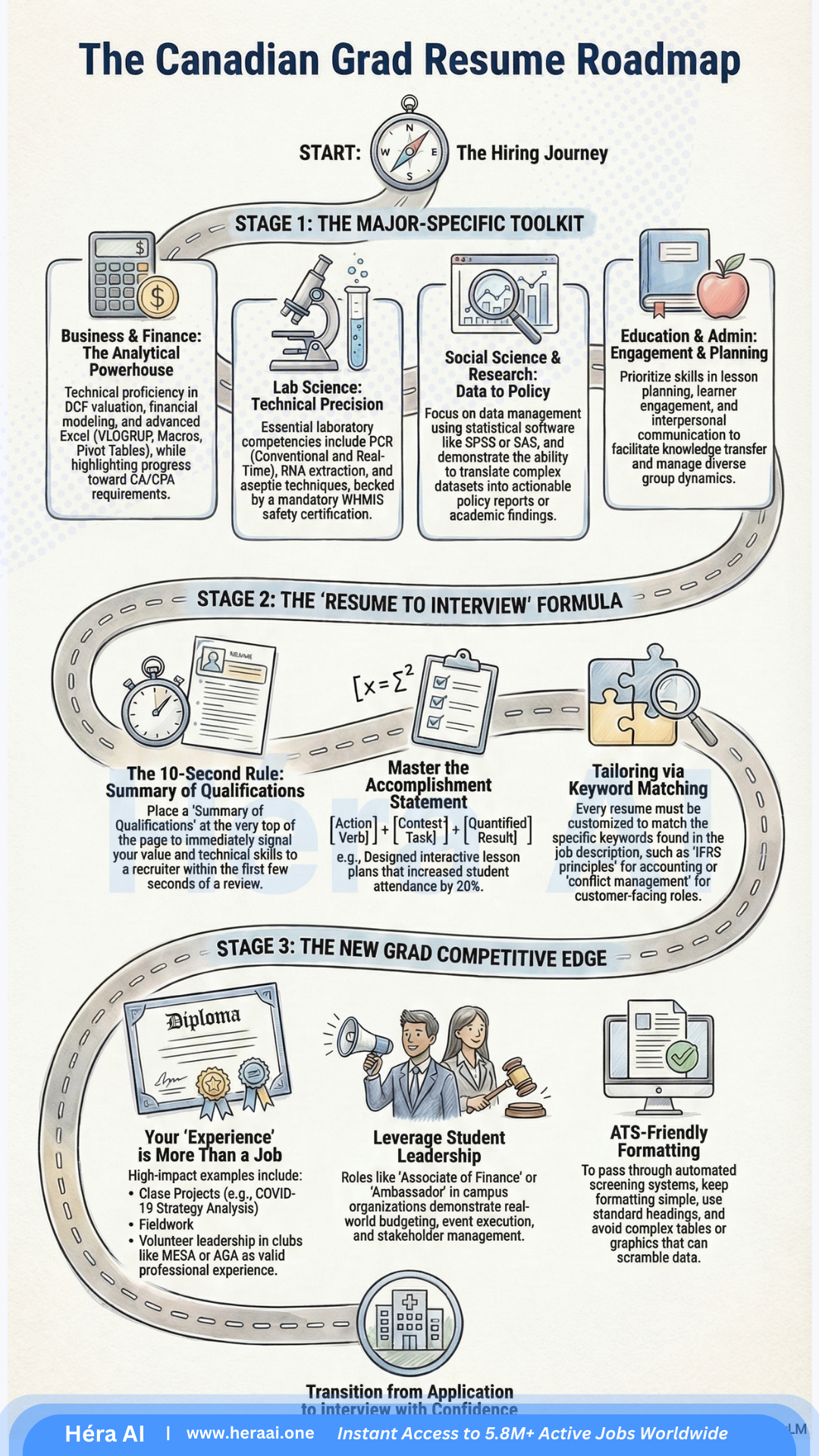
The most underutilized piece of career intelligence available to any graduate is this: hiring managers in different fields are scanning for completely different signals. Not 'skills' in the abstract — specific technical markers that immediately communicate professional readiness. A resume without them reads as entry-level regardless of academic achievement.
2. The Accomplishment Formula — Why 'Did Research' Is Costing You Interviews You Deserve
There is a phrase pattern that appears across the majority of student resumes, across every major, every university, every year. It sounds professional. It is quietly devastating to your application.
The formula that changes the equation: Action Verb + Context and Scope + Quantifiable Result. The transformation isn't cosmetic — it's a signal that reframes you from presence to contributor.
3. Your Coursework Is More Powerful Than You've Been Told — If You Frame It Correctly
For candidates without extensive full-time work history, the project experience section of a resume can be the single most powerful differentiator — if it's treated with the same rigor as a professional role. Not as supplementary. Not as 'Academic Projects' in a smaller font at the bottom of the page.
As primary evidence of professional capability, presented with the same structure as employment experience: scope, methodology, output, and outcome. The section title is Relevant Experience — not 'Academic Projects,' not 'Coursework.'
4. The Cover Letter Is Not a Resume Summary — It's the Bridge to Culture Fit
Most graduates treat the cover letter as an obligation — a slightly more personal version of the resume's top section, restating credentials and expressing enthusiasm. This approach leaves the most valuable real estate in the entire application completely unused.
A resume proves capability. A cover letter proves fit. Its actual function is to do something a resume structurally cannot: demonstrate values alignment. And in 2026, across firms like KPMG and Deloitte that publish explicit organizational values, generic enthusiasm is immediately distinguishable from genuine research.
Specificity Is the Entire Competitive Advantage
Every insight in this breakdown points to the same root principle. The candidates who succeed in the Canadian job market — at every experience level, across every major — are the ones who've replaced generic with specific at every layer of their application. Specific technical vocabulary. Specific quantified outcomes. Specific project framing. Specific cultural alignment.
At HéraAI, we work with candidates who are ready to stop broadcasting their history and start marketing their specific value to the specific employers who need it.
Next issue: The informational interview playbook — how one 20-minute conversation can put you in front of a hiring manager before a role is ever posted.
Subscribe. Always free. Always actionable.
— HéraAI Team