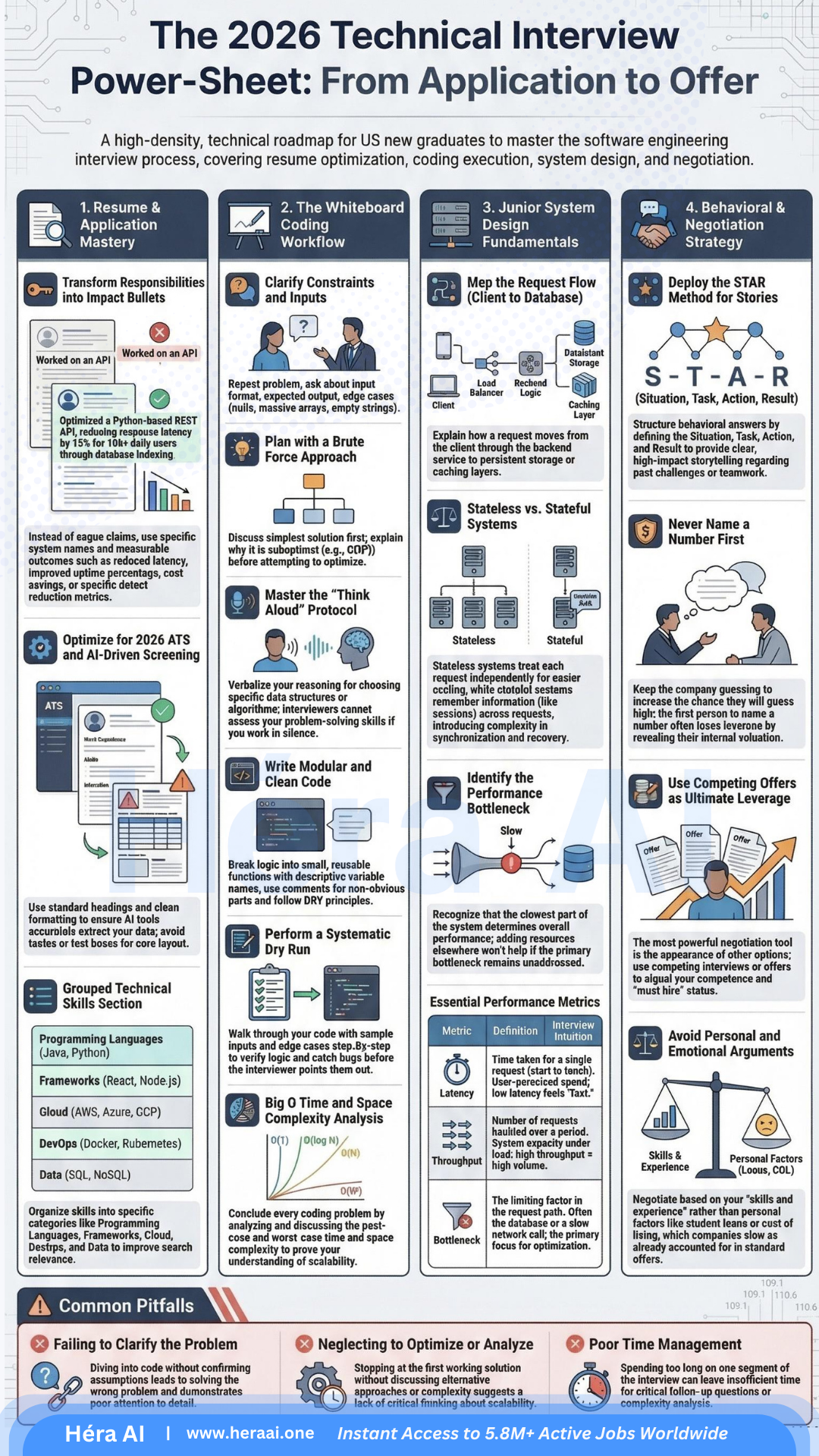
The 2026 Technical Interview Power-Sheet: From Application to Offer
Resume optimization, coding execution, system design, and negotiation — the complete playbook for US software engineering interviews.
The software engineering interview process in 2026 is a four-stage evaluation. Each stage tests something different — and failure at any one of them ends the process, regardless of how well you perform in the others. A candidate with a weak resume doesn't get to the coding screen. A candidate who codes correctly but can't explain their reasoning doesn't advance to system design. A candidate who clears all three technical rounds but negotiates poorly leaves money on the table.
This article consolidates the complete framework: resume and ATS optimization, the whiteboard coding protocol, junior system design fundamentals, behavioral storytelling, and offer negotiation strategy. It's designed as a reference you return to at each stage of the process — not a one-time read.
1. Resume and ATS Mastery: Getting Into the Process
The resume is not a record of what you've done. In a 2026 hiring context, it's a document optimized to pass two filters sequentially: an AI-driven Applicant Tracking System (ATS) that extracts structured information from your text, and a human recruiter who typically spends 15–30 seconds on an initial scan. Both filters must be cleared before any technical evaluation begins.
The most common failure mode is prioritising aesthetics over information density. Fancy templates, graphics, and non-standard layouts actively harm ATS extraction. The system is looking for structured data — job titles, company names, dates, and skills — and non-standard formatting breaks the parsing logic.
The impact bullet formula: [Strong action verb] + [specific system or tool] + [measurable outcome] + [scale or context]. Every bullet that doesn't follow this structure is leaving evidence of your capability on the table.
2. The Whiteboard Coding Workflow: Six Steps, No Skipping
Technical coding interviews evaluate two things simultaneously: your ability to solve algorithmic problems, and your ability to communicate your reasoning under pressure. Most candidates focus exclusively on the first and neglect the second. The whiteboard coding workflow below addresses both.
The six steps are not optional enhancements to a coding session — they are the session. Interviewers at top-tier companies are explicitly trained to score candidates on each of these dimensions, not just on whether the final code runs correctly.
The time allocation principle: A 30-minute coding problem should be approximately: clarify (2 min) → plan and brute force (4 min) → code (15 min) → dry run (5 min) → complexity analysis (3 min) → optimize (remainder). Deviating significantly from this distribution is one of the most common reasons technically capable candidates receive mixed feedback.
3. Junior System Design Fundamentals
System design interviews are often perceived as the exclusive domain of senior engineers. In 2026, they appear at the junior level with increasing frequency — particularly at larger companies and high-growth startups. The expectation isn't architectural mastery. It's structured thinking about how a request moves through a system and where problems can emerge.
The three core concepts below form the foundation of every junior system design conversation. Understanding them at the level of articulate explanation — not just recognition — is what the interview is testing.
Essential Performance Metrics — What Interviewers Expect You to Know
The system design principle for junior candidates: You won't be expected to architect a distributed database from scratch. You will be expected to explain what happens when a user clicks 'submit' on a form — from the client, through the load balancer, through the backend, into the cache, and finally to persistent storage. Know that flow cold.
4. Behavioral Interviews: The STAR Method, Applied Correctly
Behavioral interviews are scored with the same rigor as technical rounds at most top-tier companies. The STAR method — Situation, Task, Action, Result — is the expected structure, and interviewers are trained to detect whether candidates are following it deliberately or answering unstructured.
The most important nuance in applying STAR is the distinction between what the team did and what you specifically did. 'We redesigned the architecture' is not an answer. 'I designed the caching layer, which reduced database load by 40%' is an answer. The Task and Action sections must be singular and personal.
5. Offer Negotiation Strategy: From Offer to Final Number
Negotiation is the stage most candidates are least prepared for — and the one that has the largest single-conversation financial impact. A 10-minute negotiation conversation can be worth $10,000–$30,000 in base salary, plus compounding effects on equity grants, bonuses, and future raises that are anchored to your base.
The rules below are not theoretical. They reflect the actual dynamics of how compensation offers are structured and how recruiters are trained to respond.
The preparation you need before any negotiation conversation: Know the market rate for your target role in your target geography — from Levels.fyi, Glassdoor, and LinkedIn Salary. Know your number, your walk-away point, and at least one genuine competing signal (even an informal interview invitation). Enter the conversation knowing what outcome you're trying to achieve.
6. The Three Common Pitfalls That Eliminate Capable Candidates
Technical interviews don't only select for the best engineers. They also filter out candidates who make specific, avoidable process errors — regardless of their actual ability. The three pitfalls below eliminate otherwise qualified candidates at every company, at every level, in every interview cycle.
The meta-skill that prevents all three: Time management across the interview. A candidate who is conscious of where they are in the conversation — and actively manages their pacing — is significantly less likely to commit any of these errors. Before each section of the interview begins, set a mental clock.
From Application to Offer: The Complete Process
The software engineering interview loop rewards candidates who prepare systematically across all four stages — not candidates who have a strong coding session but neglect behavioral prep, or who clear every technical round and then mismanage the negotiation.
The framework in this article is not exhaustive — every company runs a slightly different process, and every interviewer brings their own emphasis. But the fundamentals it covers appear, in some form, at every company at every level: resume clarity, structured coding communication, system design awareness, behavioral storytelling, and negotiation discipline.
At HéraAI, the Interview Cheatsheet Vault is built to operationalize exactly this kind of systematic preparation — with SQL and Python references, behavioral question banks, and company-specific interview intelligence for every stage of the process.