10 min read
You've Been Learning R Wrong: 4 Insights That Reveal How Experts Actually Think
Most candidates treat R interview prep like a vocabulary test. The engineers who actually get hired think about R completely differently — as a coherent paradigm, not a list of functions to memorize.
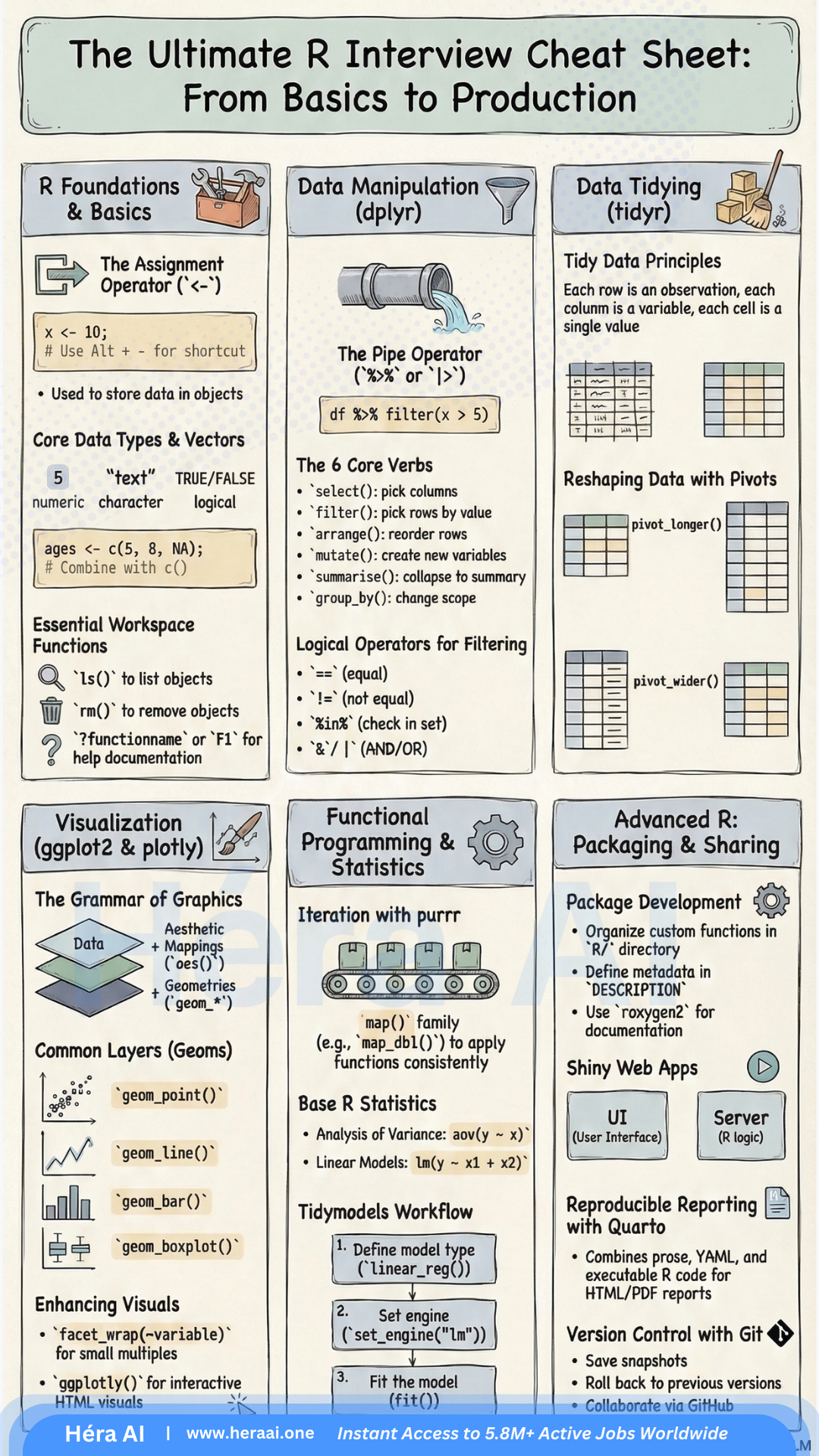
Thousands of data candidates list R on their resume. A fraction of them can answer follow-up questions about why R works the way it does — its object philosophy, its data model, its production architecture. The cheat sheet is a map. This article is the territory behind it.
1. The Assignment Operator Is a Philosophy — Not a Syntax Quirk
The cheat sheet opens with the most basic thing in R: x <- 10. It looks trivial. It isn't.
In Python, you write x = 10. In R, the arrow <- signals something structurally different: you are deliberately placing a value into a named object in your environment. This is intentional storage, not implicit assignment. And understanding that distinction changes how you answer interview questions about workflow, reproducibility, and debugging.
The candidates who learned R as 'Python but with weird syntax' never make this connection. The ones who learned R as its own paradigm do — and it's visible within the first two minutes of an interview.
2. The Pipe Operator Is the Most Underrated Interview Signal of All
Most candidates know the pipe exists. Far fewer use it the way interviewers are watching for.
The %>% operator from magrittr — and the native |> introduced in R 4.1 — isn't a shortcut. It's a readability philosophy. Interviewers aren't checking whether you know it. They're watching how naturally you chain operations — and whether your code looks like something a human can maintain.
3. The dplyr / tidyr Gap Is Where Most Analysts Get Stuck — and Where Interviewers Probe Hardest
The cheat sheet separates Data Manipulation (dplyr) from Data Tidying (tidyr) into two distinct sections. This isn't cosmetic. It reflects two completely different mental operations — and most candidates have only practiced one of them.
4. The Jump from Analyst to Engineer Happens at purrr, Shiny, and Quarto
Most candidates stop at ggplot2. They can make a scatter plot and a bar chart. That's table stakes for an analyst role — necessary, but not differentiating. The tools that move you into senior or engineering-adjacent roles are in the bottom half of the cheat sheet.
Memorizing Syntax Won't Get You Hired. Having a Mental Model Will.
The R Interview Cheat Sheet is a map. But the territory is your ability to reason about data, communicate about decisions, and write code that other humans can maintain and trust. Those capabilities don't come from memorizing function signatures.
At HéraAI, we help professionals build that deeper layer — not just what to know, but how to think in the tools that actually matter in production.
Next issue: Python vs. R in 2026 — which one should you actually prioritize for your data career?
Subscribe. We cut through the noise so you don't have to.
— HéraAI Team