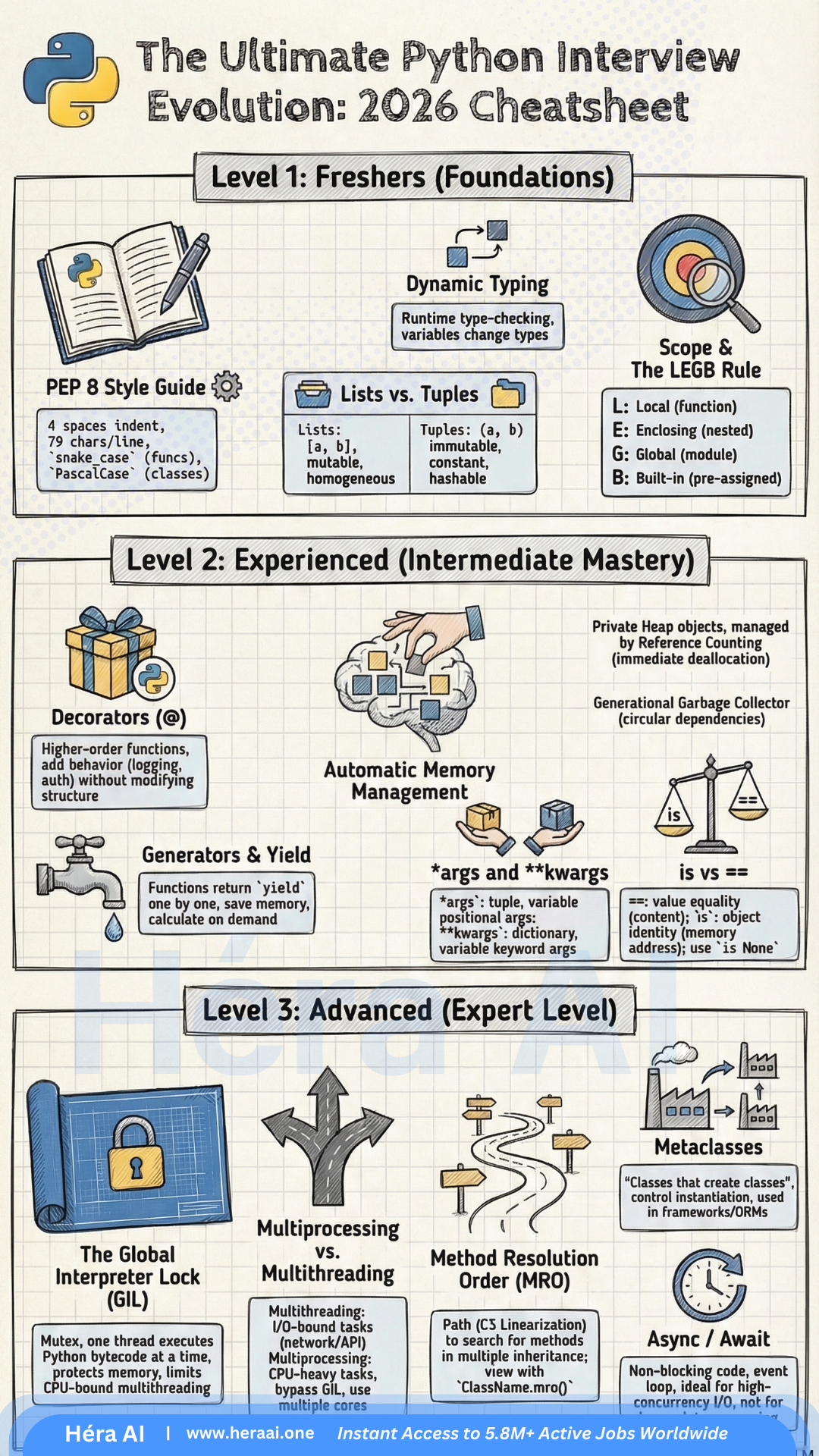
The 2026 Python Interview Playbook: From Junior to Architect
Three seniority tiers. Five architectural realities. One concurrency decision framework. Everything you need to pass — and lead — the Python technical interview.
Python's position in the 2026 job market spans three distinct domains — AI and machine learning, data engineering, and web development — and the interview bar in each has risen significantly. 'Knowing Python' is no longer a differentiator at any level. The differentiator is understanding why Python works the way it does: its memory model, its concurrency constraints, its execution pipeline, and the architectural implications of each.
This article covers the full spectrum. Part one maps the topic landscape by seniority level — what interviewers actually probe at each tier, and what signal they're looking for. Part two goes under the hood: five architectural realities that separate candidates who have used Python from candidates who genuinely understand it. Both sections are written as preparation tools, not concept overviews.
1. The Interview Landscape: What Gets Tested at Each Level
Python technical interviews have a clear seniority gradient. Entry-level screens test language mechanics. Mid-level interviews shift to efficiency and API design. Senior and lead interviews probe runtime internals, concurrency architecture, and the reasoning behind design trade-offs. Preparing for the wrong tier — in either direction — is one of the most common ways otherwise qualified candidates underperform.
The table below maps the specific topics that appear at each level, along with the evaluative signal each tier is designed to generate. Use it both as a preparation checklist and as a self-assessment tool for where you currently sit in the spectrum.
The preparation principle across all three tiers: Don't memorise definitions. Prepare to explain mechanisms. 'A generator uses yield to produce values lazily' is a definition. 'A generator avoids loading an entire dataset into memory by generating one value at a time, which matters when processing a 10GB log file that would exceed your available RAM' is a mechanism. Interviewers at every level are probing for the latter.
2. The Ecosystem Layer: NumPy, Pandas, and the Libraries That Signal Depth
Across all three seniority tiers, knowledge of the Python data ecosystem is what interviewers use to separate candidates with genuine applied experience from those with theoretical preparation. Two libraries appear consistently in senior-level job descriptions and interview feedback:
3. Python Under the Hood: Five Architectural Realities
The questions that determine senior and lead-level interview outcomes are not about Python syntax. They're about the decisions Python's designers made — and the constraints and capabilities those decisions create for engineers who build systems with it. The five realities below are the most frequently probed topics in senior Python technical screens.
The thread that connects all five: Python's design consistently prioritises developer experience and memory safety over raw performance. Every architectural feature — the GIL, the garbage collector, the dict, the PVM — is a deliberate trade-off. Senior candidates who can articulate those trade-offs, and explain when and how to work around them, are demonstrating exactly the judgment that lead-level roles require.
4. The Concurrency Decision Framework: Threading, Multiprocessing, or asyncio?
The GIL question almost always leads to a follow-up: 'So when would you use threading vs. multiprocessing vs. asyncio?' This is the practical application that separates candidates who can recite the GIL's definition from those who understand how to architect around it.
The answer is not 'it depends' followed by vague qualifications. It's a clear decision framework based on the nature of the workload — and the ability to explain the mechanism behind each choice.
In practice, these models are often combined. A high-concurrency FastAPI service (asyncio) might spawn multiprocessing workers for CPU-intensive inference tasks, while using threading for database connection pooling. The architectural sophistication is in knowing which tool applies to which layer — and being able to explain why.
The senior-level answer structure: When asked 'how would you handle concurrency in Python?', the strongest responses name the task type first (I/O-bound vs. CPU-bound), identify the appropriate model (threading/asyncio vs. multiprocessing), explain the GIL interaction, and cite a specific use case from their own experience. Four components, in that order.
5. The Mutable Default Argument — Python's Most Common Senior Trap
Of all the Python gotchas that appear in technical interviews, the mutable default argument is the one most consistently used to distinguish mid-level from senior candidates. It's not obscure — but the depth of explanation required at the senior level goes well beyond the typical fix.
From Coder to Python Architect
The 2026 Python interview market rewards candidates who can move between levels of abstraction fluidly — from the syntax a junior writes, to the memory model that syntax operates within, to the architectural trade-offs that model creates at scale. That fluency is not built by memorising answers. It's built by understanding mechanisms.
The Specializing Adaptive Interpreter and the experimental JIT compiler in Python 3.13 are signals that the language itself is closing the performance gap with compiled alternatives. As that gap narrows, the candidates who thrive will be those who understand both what Python can do today and the direction its architecture is evolving — and who can translate that understanding into systems that perform at production scale.
At HéraAI, the Interview Cheatsheet Vault is built to develop exactly that depth — with Python and SQL references, system design frameworks, and real interview questions from the companies where this level of preparation actually matters.