Cracking the NVIDIA Data Analyst Interview: It Is Not Just About the Code
The difference between a junior DA and a senior DA at NVIDIA is not knowing SQL — it is knowing why the query matters to the business, who needs to act on the result, and how to tell them.
NVIDIA interview questions look like standard SQL and Python problems on the surface. Candidates who answer them by the book — technically correct, analytically complete, presented without context — will likely be rejected. The reason is structural: NVIDIA's DA role sits at the intersection of silicon engineering and corporate strategy, and the interview is explicitly designed to find candidates who can operate in both registers simultaneously.
The technical questions are real filters, not formalities. A GROUP BY where a window function is needed signals a candidate who produces correct output but destroys analytical granularity. A dashboard that leads with Revenue signals a candidate who has not thought about the supply chain economics that define NVIDIA's business model. These are not wrong answers — they are junior answers. The interview is calibrated to find the difference.
This post breaks down NVIDIA's three evaluation pillars, the specific SQL and business metric questions most frequently cited in interview reports, and the cross-functional communication skill that the interview explicitly tests in its behavioural round.
The Three Pillars NVIDIA Evaluates
NVIDIA's DA interview scorecard maps to three explicit evaluation dimensions. Understanding which pillar each question is probing — before answering — is what allows a candidate to deliver the right level of response rather than the technically correct but contextually incomplete one.
The calibration insight that changes how you approach every question: Before answering any NVIDIA interview question, identify which pillar it is primarily testing. A SQL question is testing Technical Precision — but the follow-up 'and what would you present to the CFO?' is testing Cross-Functional Literacy. A dashboard design question that begins technically is actually testing Business Health Literacy. Candidates who recognise the pillar shift and adjust their answer accordingly are the ones who pass all three filters in a single response.
The SQL Window Function Question: Why GROUP BY Is the Junior Answer
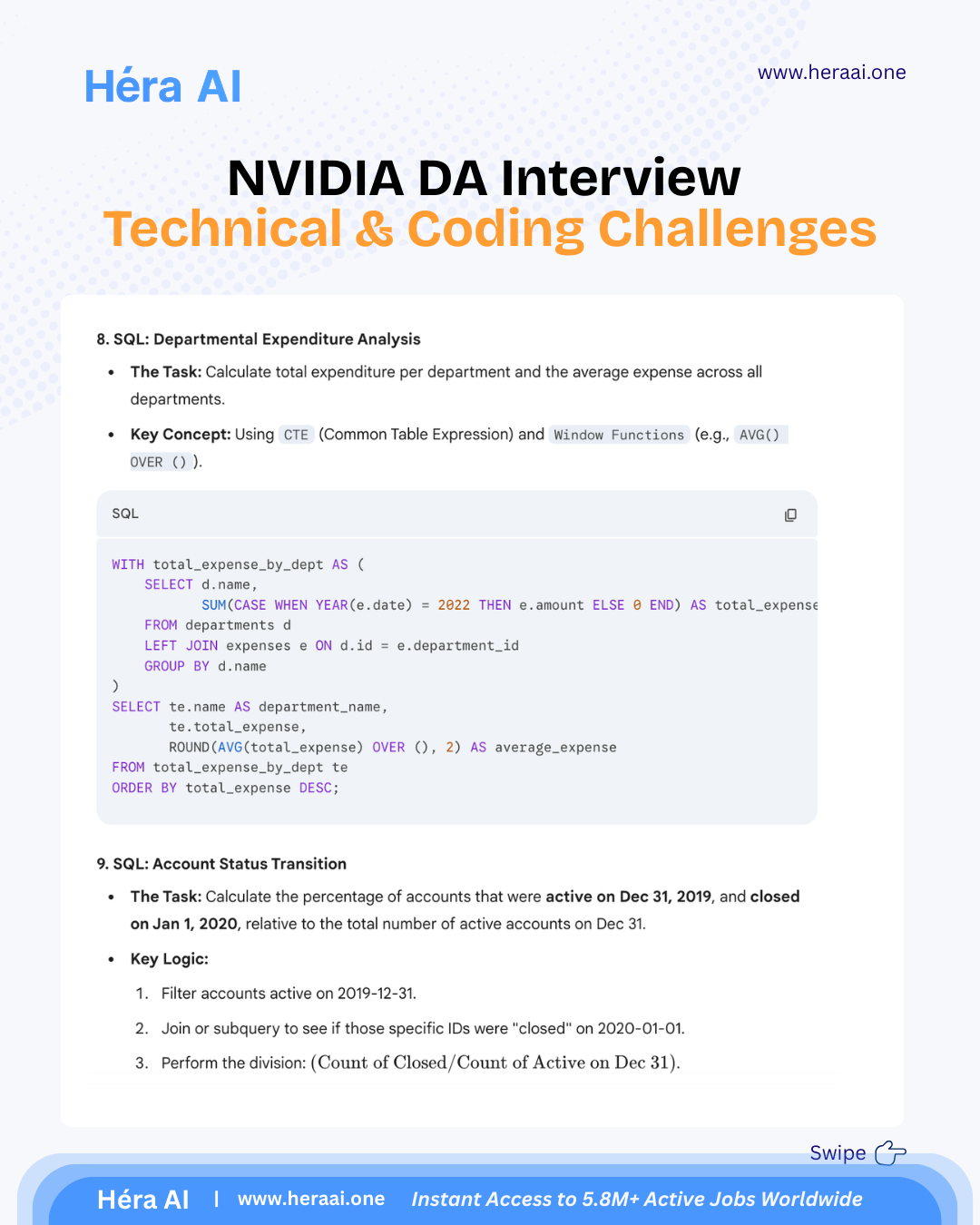
The departmental expenditure question asks candidates to calculate each department's salary total and compare it to the company-wide average. The junior answer is a GROUP BY with a subquery for the average. The senior answer uses window functions to keep every individual row intact while adding the aggregated comparisons as computed columns — allowing a single query to surface the outlier without requiring a second analytical request.
The business framing of the window function answer matters as much as the technical execution. A senior candidate who writes the correct window function query and then adds: 'This gives the CFO a single view where they can immediately identify which employee or department is driving the variance — without needing to come back to the DA for a drill-down' has completed both the technical and the cross-functional components of the answer in a single response.
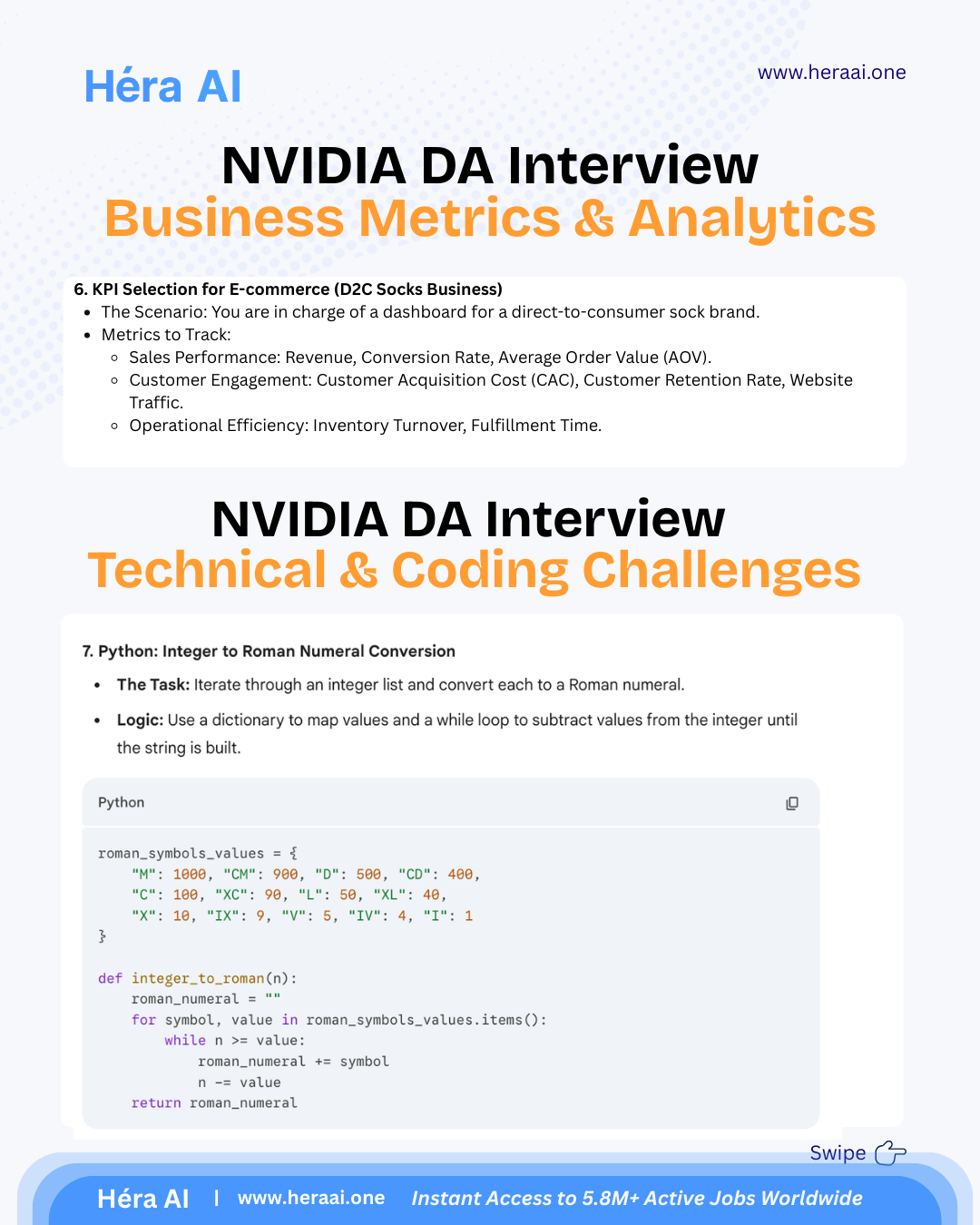
The Python edge case question and what NVIDIA is actually testing: The Integer to Roman Numeral conversion question is not primarily testing Python knowledge — it is testing whether a candidate thinks about edge cases before they become bugs. The subtractive notation cases (IV, IX, XL, XC, CD, CM) require explicit handling that a naive loop will miss. At a company that builds chips where a single logic error in a billion-gate design can cost hundreds of millions of dollars, the habit of asking 'what are the edge cases?' before writing a single line of code is a cultural value, not just a technical skill. Mentioning the subtractive cases proactively — before being asked — is the signal the interviewer is watching for.
The Account Status SQL: A Churn Question Disguised as a JOIN Question
The account status question asks candidates to write SQL that classifies accounts based on their presence or absence on December 31 and January 1. The technical answer involves a FULL OUTER JOIN on account ID with date filtering. The senior answer treats the question as what it actually is: a churn, retention, and reactivation classification problem — with a seasonality consideration built in.
The seasonality flag that distinguishes a senior business interpretation: Q4 enterprise churn at a company like NVIDIA — which sells hardware to large data centre operators and cloud providers — is heavily influenced by fiscal year-end contract renewal cycles. A December 31 churn rate may reflect a contract timing pattern rather than genuine product dissatisfaction. A candidate who presents the raw churn number without flagging this seasonality has answered the SQL question but missed the business question. The senior response: 'Before presenting this churn figure to the product or sales team, I would segment by contract type and renewal date to confirm whether this is structural churn or fiscal year timing.'
The Dashboard Design Question: Why Revenue Is the Junior Answer
The D2C dashboard question is designed to surface whether a candidate defaults to generic top-line metrics or thinks about the specific business model they are measuring. For a hardware-adjacent company, the metrics that drive decisions are not the same as the metrics that drive decisions for a SaaS platform or a social media product. Inventory Turnover and CAC Payback Period are the answers that signal NVIDIA business literacy.
The CAC Payback Period answer is the one that most reliably distinguishes candidates with capital allocation thinking from those with general marketing analytics backgrounds. Calculating CAC in isolation — how much it costs to acquire a customer — is table stakes. The Payback Period frames that cost as a duration of commitment: 'we will not recover this acquisition cost until Month 18.' For a hardware business where customer relationships are long-cycle and product generations advance every two years, that duration frames the entire retention strategy.
The Bridge Skill: Speaking Engineer and Executive Simultaneously
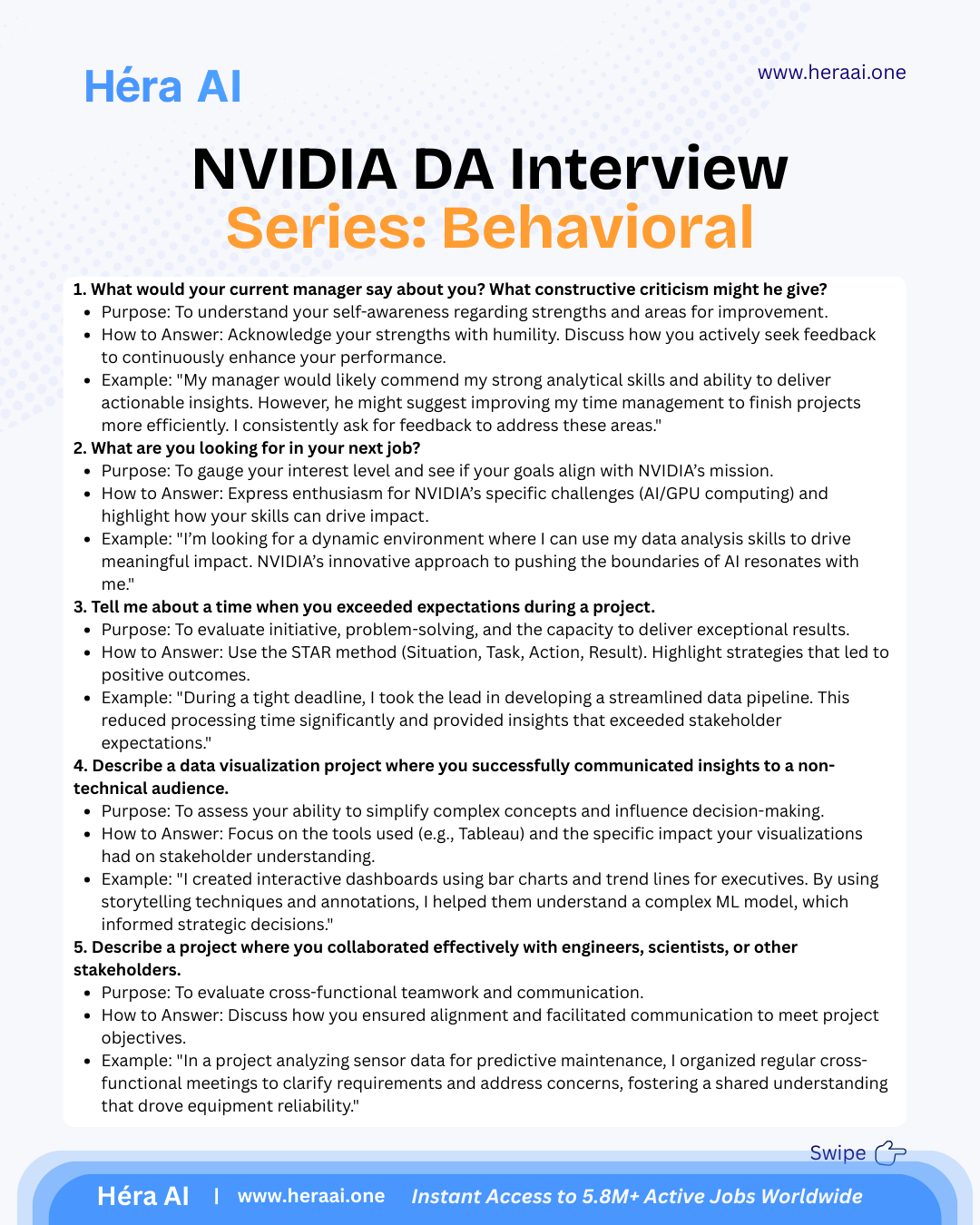
Question 5 in the NVIDIA interview explicitly tests collaboration with engineers and stakeholders. This is not a behavioural question dressed up as a technical one — it is a direct test of whether a candidate can modulate their communication register based on the audience without losing precision in either direction. NVIDIA's DA sits between the silicon teams who produce the product data and the executive teams who make capital allocation decisions based on it. Both audiences require different language and different levels of detail.
The principle that defines the NVIDIA DA hire: NVIDIA does not hire data professionals who support product decisions. It hires analysts who are the bridge between the silicon and the strategy — who can write a technically precise window function query, interpret the result in the context of NVIDIA's supply chain economics, and communicate the finding to a VP in two sentences without losing a single degree of analytical accuracy. That compound capability — precision across technical, business, and communication dimensions simultaneously — is what the three-pillar interview is designed to find, and what this post has been built to help you demonstrate.