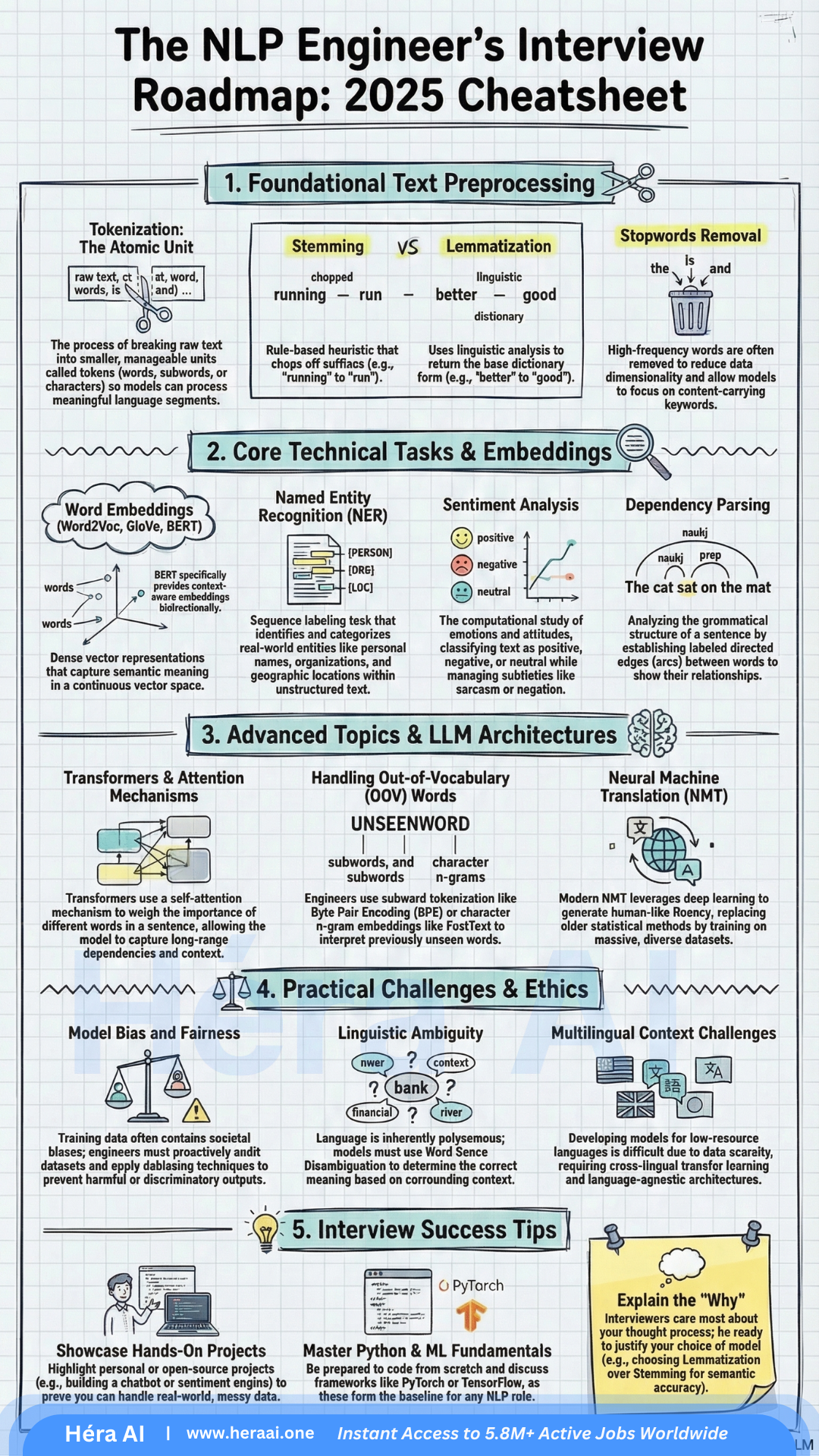
From Career Switcher to NLP Engineer: Your 2026 Interview Masterclass
NLP is no longer a niche for academics. It is the engine behind a $201B market — and the interview is accessible to anyone who understands the mechanics, not just the theory.
Natural Language Processing has moved from research papers into production infrastructure. Every customer-facing AI system, every enterprise search tool, every automated document processor runs on NLP foundations. The $201.49 billion market projected for 2031 is not being built by academics — it is being built by engineers who understand how language models work well enough to deploy them reliably, evaluate them honestly, and explain their limitations clearly.
For career switchers, the path into NLP engineering is real and structurally accessible — but it requires targeted preparation. NLP interviews test a specific combination of theoretical understanding and practical judgment that neither pure coding practice nor pure reading will produce. The engineers who pass these interviews are the ones who can explain not just what each concept does, but why it matters for the specific task at hand and what it breaks on in production.
This post covers the ten technical questions that define the NLP interview at most companies hiring in 2026, a tokenization deep-dive that separates Level 1 from Level 3 answers, and the four-part preparation strategy designed specifically for career switchers entering the field without a conventional ML background.
The Big 10: Technical Questions and the Senior-Level Answers
The ten questions below are not a random sample — they represent the technical pillars that appear most consistently across NLP engineering interviews at companies ranging from AI-native startups to enterprise tech employers. For each, the table below provides the pillar category and the content that constitutes a senior-level answer, not just a correct one.
The distinction that separates a passing answer from a strong one across all ten questions: Every technical question in an NLP interview has a surface answer and a depth answer. The surface answer demonstrates familiarity with the concept. The depth answer demonstrates understanding of why the concept exists — what problem it solves, what it fails on, and what trade-off it makes. Interviewers at companies building production NLP systems are not testing whether you have read the Wikipedia article. They are testing whether you have thought about the production implications.
Tokenization Deep-Dive: The Question Behind the Question
Tokenization is Question 1 on the Big 10 list for a reason: it is the foundational architectural decision that determines everything downstream. An engineer who understands why subword tokenization exists — and can connect it to the specific models that use each approach — has demonstrated the conceptual depth that NLP interviewers are screening for in the first five minutes.
The most common tokenization interview follow-up: 'What happens when you tokenize a domain-specific term your model has never seen — say, a proprietary drug name or a company's internal product code?' The answer reveals whether a candidate understands OOV handling in practice. With BPE, the term will be split into known subword units — potentially losing the specific meaning of the whole token. The production solution: include domain-specific terms in fine-tuning data so the tokenizer learns them as single units, or use a character-level fallback. This level of answer is what closes the interview loop.
AI Ethics: The Technical Requirement That Most Candidates Treat as a Soft Skill
Question 9 — bias identification and mitigation — is the one that most career switchers either over-prepare for with philosophical language or under-prepare for with no technical depth. Neither approach works. Interviewers at companies deploying NLP in hiring, healthcare, legal, or financial contexts are asking this question because bias in their system is a regulatory and reputational liability. They need an engineer who has a technical plan, not an ethical position.
The technical answer for a 2026 NLP interview covers three stages: data auditing before training (examining corpus composition for demographic representation and historical encoding of discrimination), balanced sampling or reweighting during training (ensuring model does not optimise against minority-class language patterns), and disaggregated evaluation after training (measuring performance separately across demographic and linguistic subgroups rather than reporting a single aggregate accuracy that can mask group-level failures).
The AI ethics answer that signals production experience rather than academic awareness: 'I would start by auditing the training corpus for demographic representation — specifically checking whether the data over-represents certain geographic, linguistic, or socioeconomic groups in ways that would encode their language patterns more strongly than others. Then I would evaluate the trained model separately across subgroups before deployment, and set minimum performance thresholds for each group as a release criterion — not just overall accuracy.' This answer describes a process with concrete decision points, not a values statement.
The Career Switcher's Preparation Strategy
The four strategies below are ordered by dependency: Foundation must come first, because the portfolio and communication skills build on it. The Linguistic Intuition advantage is listed third not because it is less important, but because it is only visible to an interviewer after the technical foundation is established.
The principle that defines the career switcher's path into NLP engineering: You are not competing with CS graduates on their home ground — you are bringing a combination they do not have: engineering fundamentals plus domain knowledge plus the communication skills that come from working in a field where language precision mattered before you ever wrote a line of Python. The NLP interview rewards people who understand how language actually works in context, not just how models process tokens. That understanding is your entry point — and this post is the map to make it visible in the interview room.