ByteDance ML Interview: How Recommendation Engines Actually Think
At ByteDance, machine learning is not a nice-to-have skill — it is the core product. The interview tests whether you understand why the algorithms work, not just that they exist.
Day 5 is where the ByteDance DA interview series reaches its technical ceiling. Days 1 through 4 established that a candidate can extract data, validate findings, deliver them efficiently, and translate them into product decisions. Day 5 asks whether the candidate understands the machine learning infrastructure that generates the data they are analysing — and whether they can build and evaluate models that feed directly into TikTok's core product surfaces.
The key reframe for Day 5: ByteDance interviewers are not testing algorithm memorisation. They are testing the reasoning behind algorithm selection. A junior candidate says 'I would try a different algorithm to improve the model.' A senior candidate says 'I would improve the data preprocessing — specifically the feature engineering and outlier handling — because the algorithm is rarely the bottleneck in a production ML system at this scale.' That distinction in orientation is the primary filter.
This post covers four technical areas tested most frequently in ByteDance ML interviews: storage architecture, clustering algorithms, the recommendation engine distance metric question, and the standard preprocessing pipeline. Each is presented with the trade-off context that the senior-level answer requires.
Storage Architecture: Why Columnar Storage Is the ML Foundation
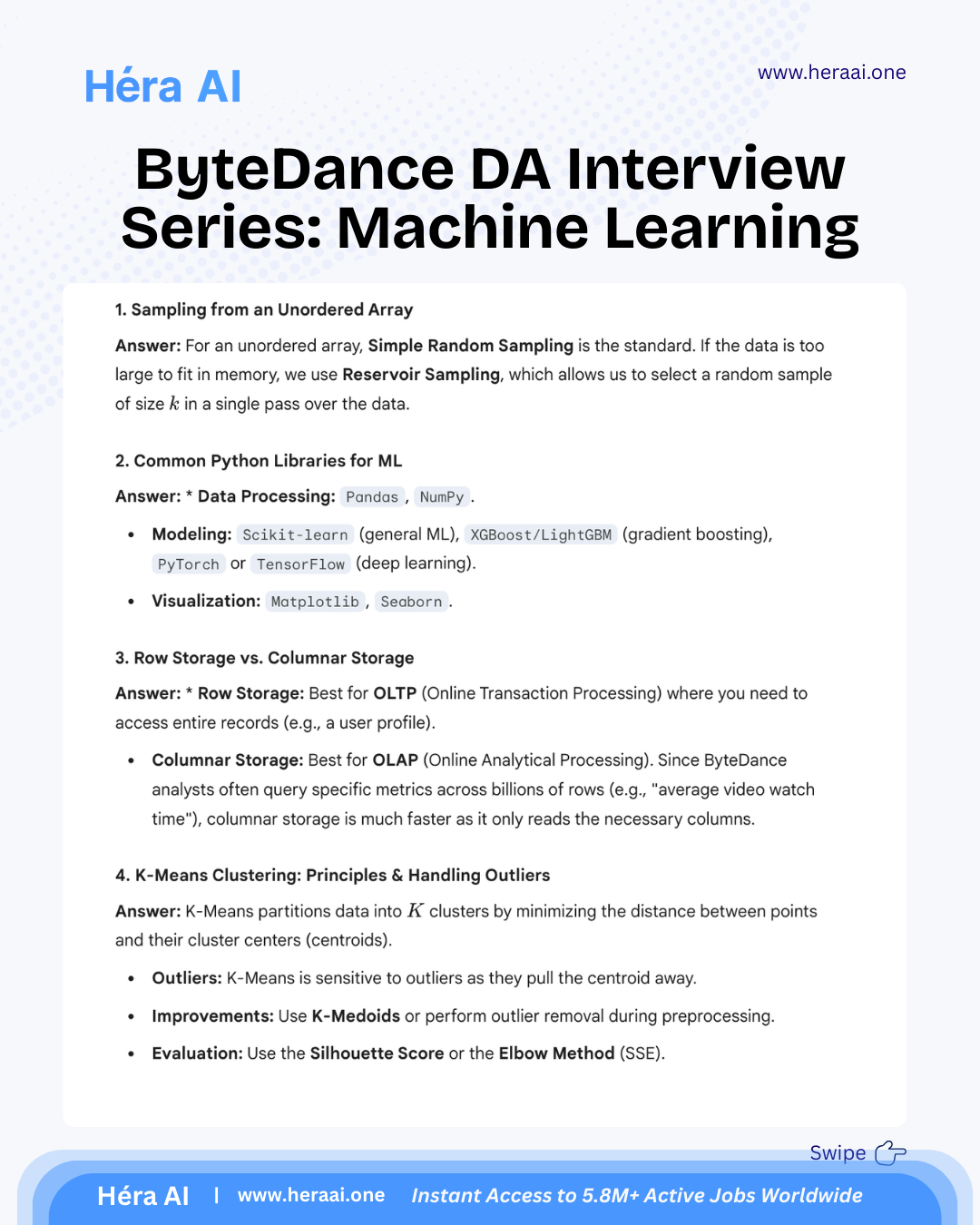
The question 'why do we use columnar storage for ML features?' appears frequently in ByteDance DA interviews as a technical filter question — it seems like an infrastructure question, but it is actually probing whether the candidate understands the data access patterns that ML training workloads require. The answer reveals whether a candidate has thought about how features are stored and retrieved at platform scale, or only about how models are trained in a Jupyter notebook.
The infrastructure reasoning the interviewer is waiting for: ML training on a dataset with 500 features does not read all 500 features for every training run. A model predicting Day-7 retention might use 12 features. Columnar storage allows the system to read only those 12 columns across all rows — ignoring the other 488. With billions of user records, that I/O reduction is not a convenience; it is the difference between a training job that completes in 2 hours and one that runs for 3 days.
Clustering and Classification: The Algorithm Trade-off Questions
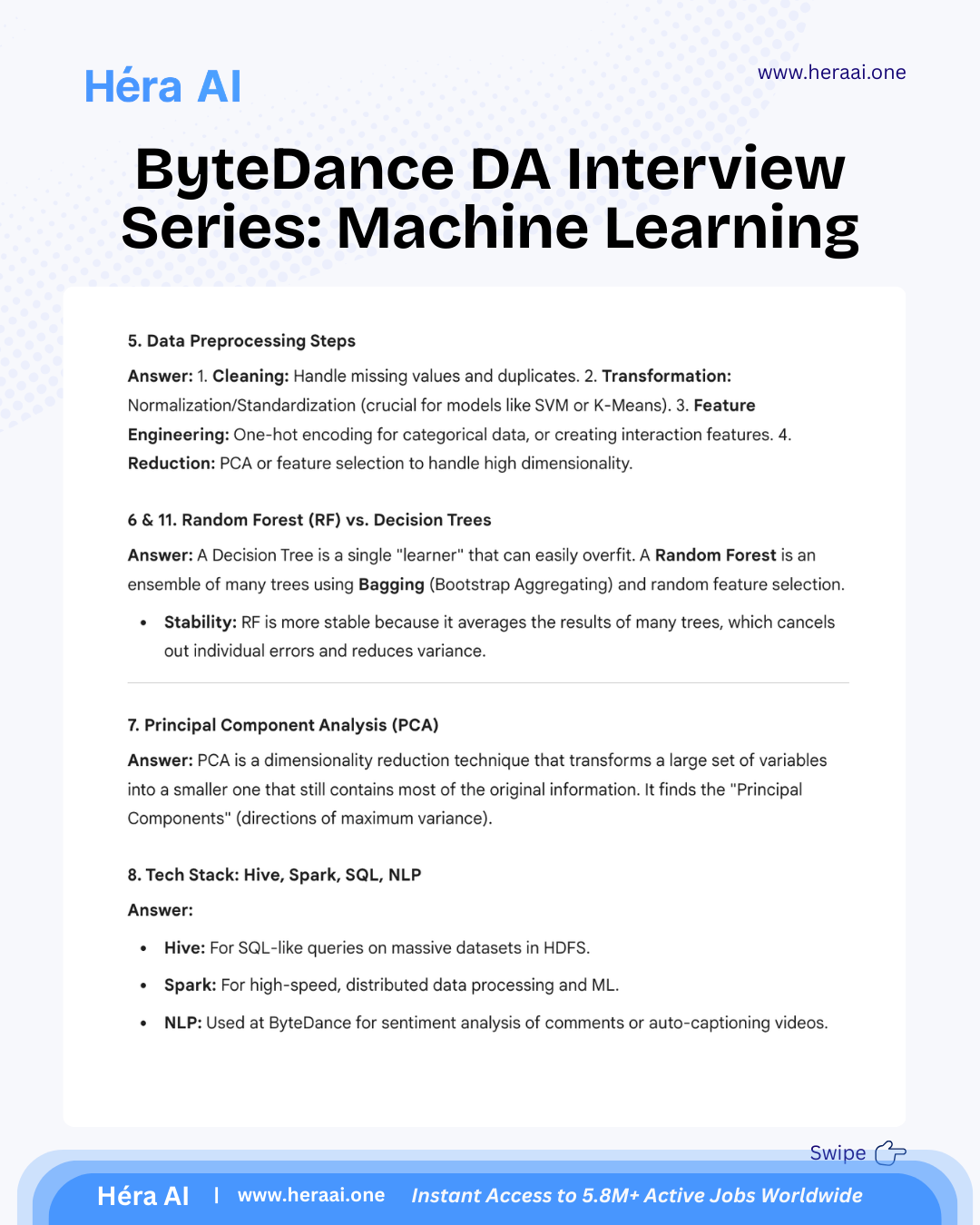
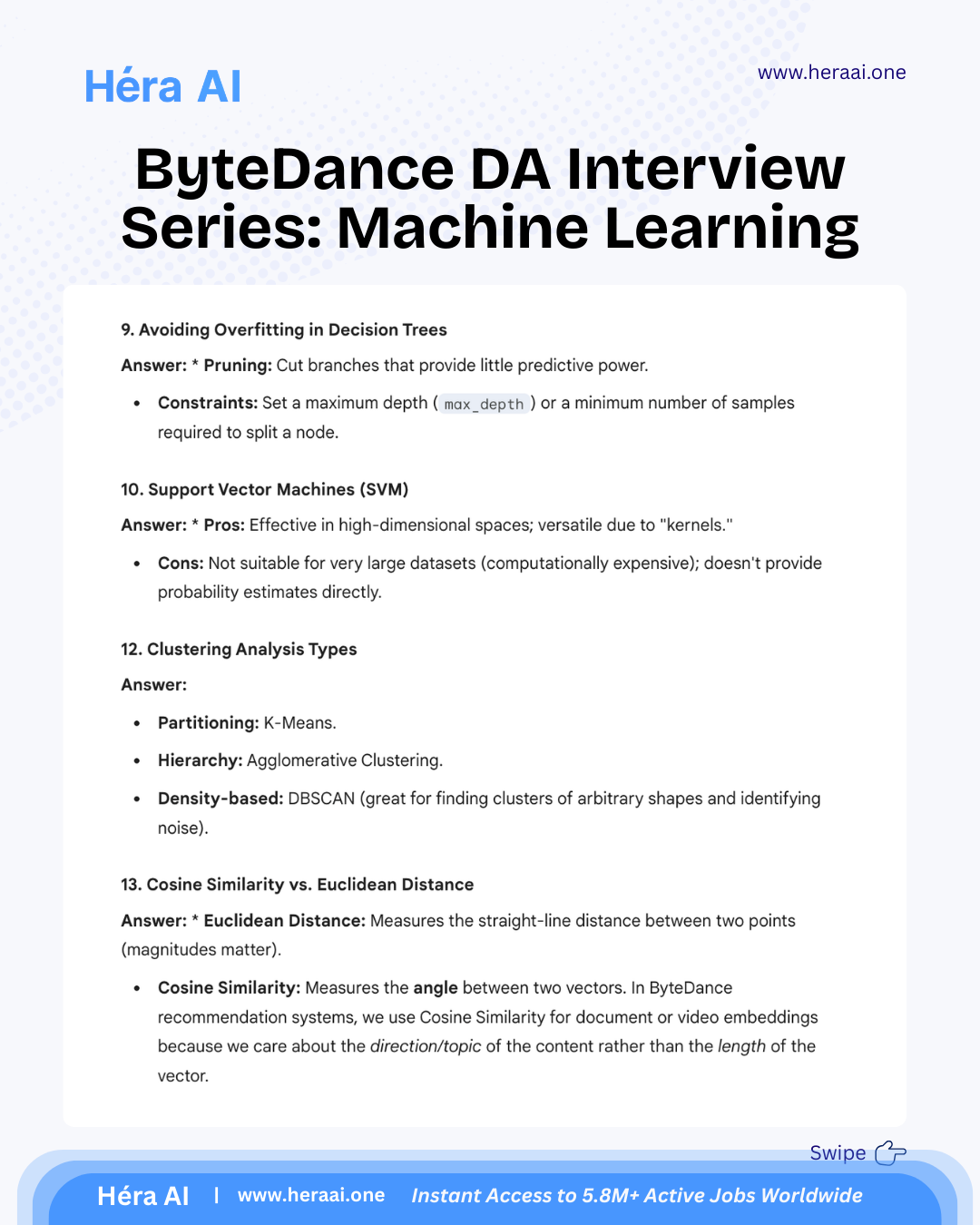
ByteDance ML interviews test algorithm selection judgment, not algorithm recall. The question is never 'what is K-Means?' — it is 'when would you choose DBSCAN over K-Means, and what would you need to observe in the data to make that decision?' The table below presents the four algorithms most frequently appearing in ByteDance Day 5 interviews alongside the trade-off context that constitutes the senior-level answer.
The overfitting answer that signals production experience: A candidate who recommends Random Forest without mentioning hyperparameter constraints is describing the algorithm in the abstract. In a ByteDance production context, the interviewer will follow up: 'How do you prevent the forest from overfitting on the training cohort?' The correct answer includes max_depth to limit tree depth, min_samples_split to require a minimum number of samples before a node splits, and cross-validation on a held-out cohort from a different time period — not just a random train/test split, which can leak temporal patterns. The time-based validation split detail is the practitioner signal that separates someone who has trained models from someone who has debugged them in production.
The Recommendation Engine: Why Cosine Similarity Runs the For You Page
The distance metric question is the most product-connected ML question in the ByteDance Day 5 interview. The For You Page recommendation system matches user taste profiles — encoded as vectors of content preferences, watch history, and engagement signals — to video embeddings. The choice of distance metric determines what 'similar' means in that matching process. Getting this wrong produces a recommendation system that surfaces popular content rather than relevant content.
The NLP context adds a further dimension to this question. ByteDance uses NLP for comment sentiment analysis, auto-captioning, and content categorisation — all of which produce text embeddings that are compared using cosine similarity. A candidate who connects the cosine similarity answer to NLP applications ('this is the same distance metric used in ByteDance's NLP pipelines for content tag matching and comment sentiment clustering') demonstrates product-stack depth that the interviewer will note as a strong signal.
The Standard Preprocessing Pipeline
When asked how they would improve a model, junior candidates change the algorithm. Senior candidates improve the data. The preprocessing pipeline is where the majority of ML quality improvements at ByteDance are made — not in algorithm selection, but in the sequence and precision of data preparation before the first model is trained. The four-step pipeline below is the production-standard sequence. The order is not arbitrary.
The reservoir sampling detail in the feature engineering step is the specific signal that differentiates candidates with academic ML experience from candidates with production ML experience. In an academic setting, datasets fit in memory. At ByteDance, a single day of TikTok event logs does not. Reservoir sampling — which selects a random sample of size K from a stream of N records in a single pass, with each record having equal probability of inclusion — is the correct tool for exploratory work on datasets that exceed memory capacity. Most statistics courses do not cover it. Knowing it signals that you have worked with data at the scale ByteDance operates at.
The Complete Series: D1 Through D5
The principle that connects all five days — and defines what ByteDance is actually hiring: ByteDance does not hire candidates who are strong in one of these five domains. It hires candidates who can move fluidly across all five: extract the right data with SQL, validate the finding with statistics, deliver it efficiently with Excel, translate it into a product decision with business sense, and build the predictive model that automates that decision at scale with machine learning. Each day of this series is a layer in the same capability stack. A DA who can do all five layers — and who understands why each one matters for the product, not just how to execute it technically — is the hire that ByteDance's interview process is designed to find.