ByteDance Business Case Study: How to Answer "Why Is Retention Dropping?"
Hard skills get you the interview. Business sense and ownership get you the offer. Day 4 covers the framework that turns raw data findings into product decisions.
Days 1 through 3 of the ByteDance DA series built the technical foundation: SQL for extraction, statistics for validation, Excel for delivery. Day 4 is where those technical skills are tested in the context of the question that actually appears on the interview scorecard: can this person translate a data finding into a product decision?
The most dangerous response to a ByteDance business case question is to start building a model. The most common reason otherwise-qualified DA candidates fail the business sense round is not insufficient technical skill — it is insufficient structure. They hear 'retention is dropping' and immediately think about which features to correlate with churn, which queries to run, which model to build. The interviewer is watching for something different: whether the candidate defines the problem before touching the data.
This is Day 4 of the ByteDance DA Interview Series. The content covers the 6-step analytical workflow, the three-source anomaly diagnosis framework, the three evaluation filters the interviewer is scoring against, and the transferable metrics that allow candidates from any industry background to answer TikTok product questions with precision.
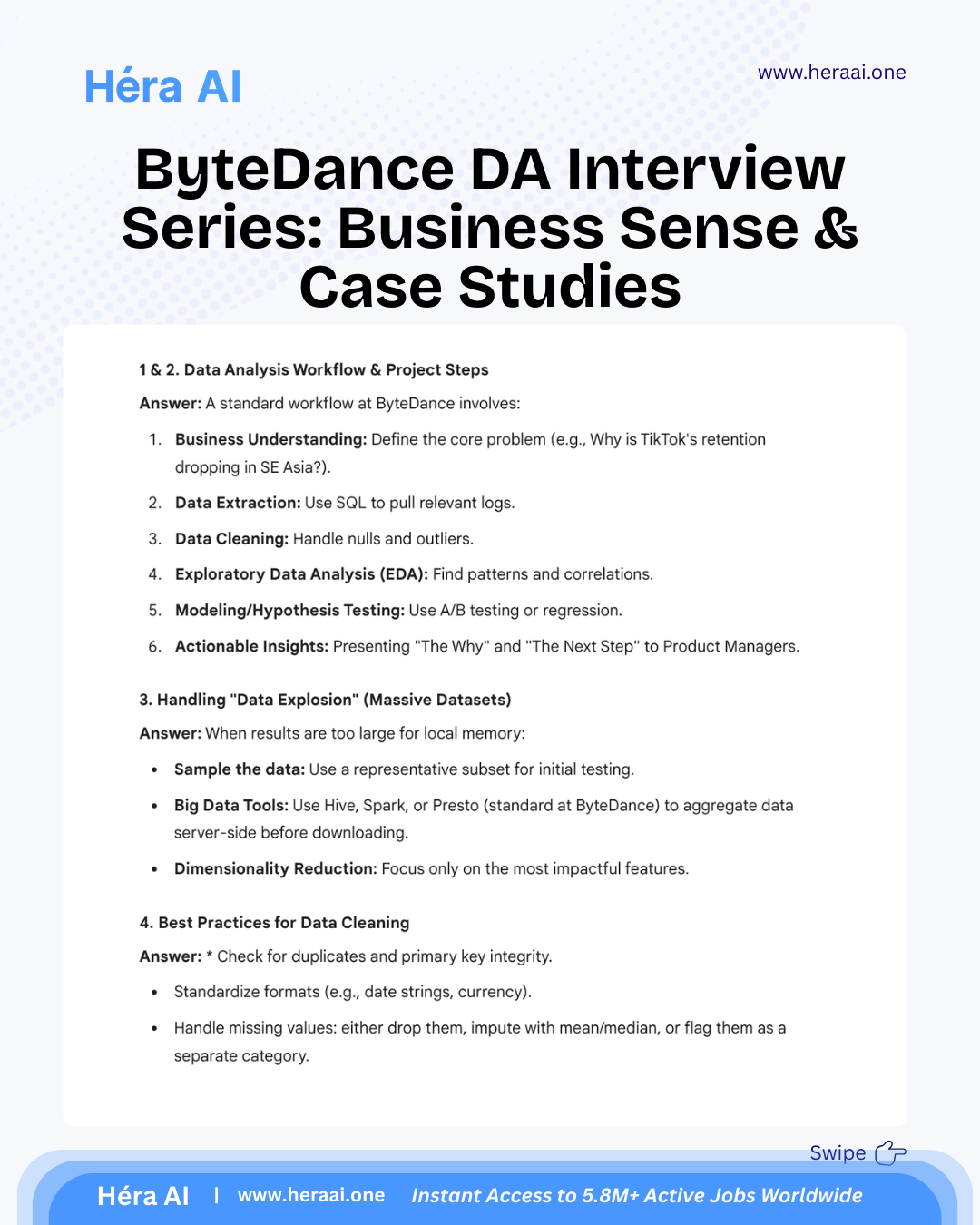
The 6-Step Analytical Workflow
The 6-step framework below is not a template to recite. It is a discipline that prevents the most common business case failure: answering a well-defined analytical question before the problem scope has been established. At ByteDance, where product decisions affect hundreds of millions of users, an analysis that answers the wrong question at high precision is worse than no analysis at all — it produces confident misdirection.
The scoping question that separates a senior response from a junior one: When the interviewer says 'retention is dropping,' the first words out of a senior candidate's mouth are a clarifying question, not a hypothesis. Is this Day-1, Day-7, or Day-30 retention? Is it dropping globally or in a specific region or cohort? Is the drop in the metric itself or in the underlying event log completeness? The candidate who scopes before analysing is demonstrating the product ownership mindset. The candidate who starts hypothesising is demonstrating pattern-matching without problem definition.
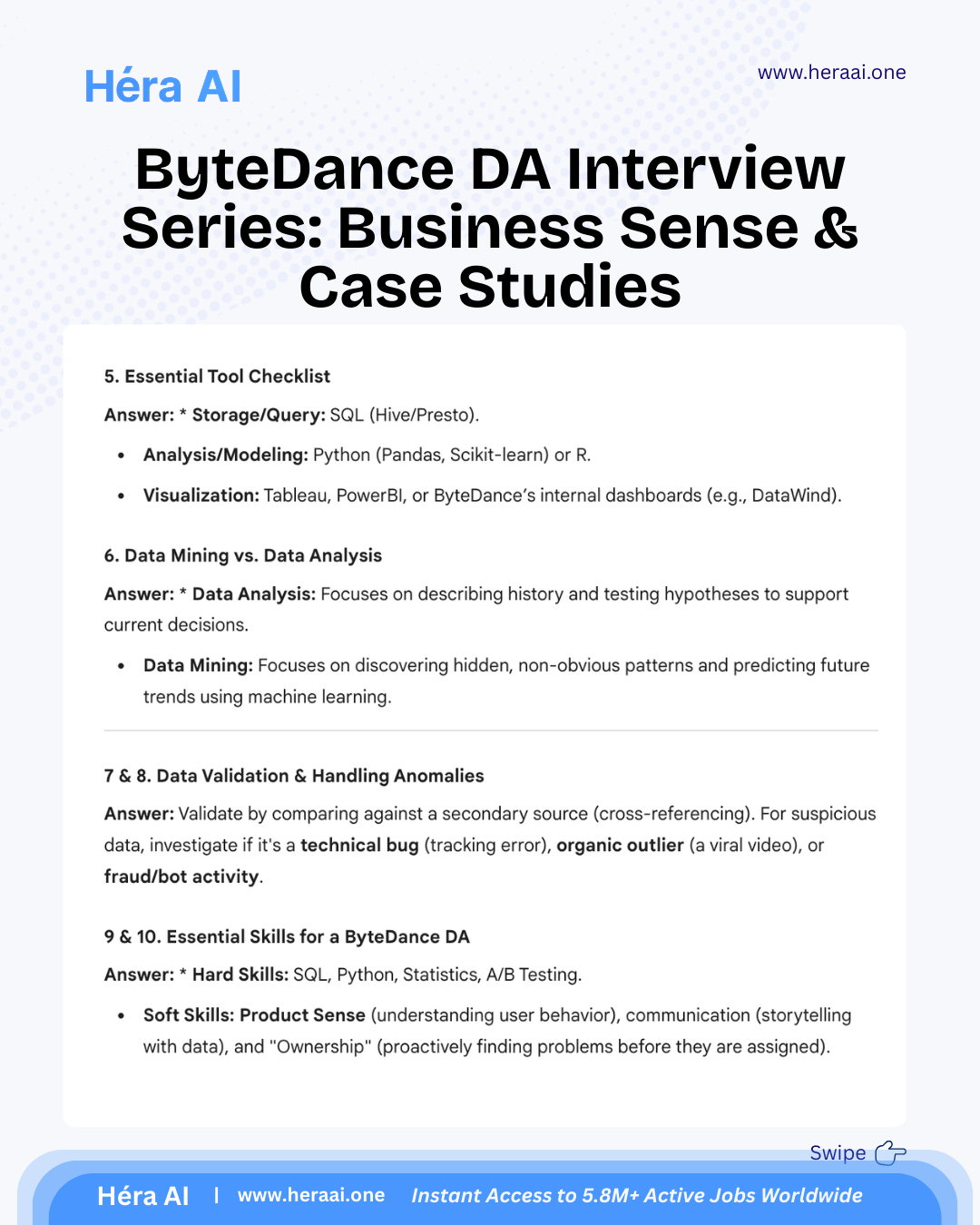
Anomaly Diagnosis: Bug, Outlier, or Fraud
A metric movement that appears in a ByteDance dashboard has three possible sources, and each requires a completely different response. A candidate who jumps to product hypotheses without first ruling out technical and fraud causes is building an analysis on an unvalidated foundation. The anomaly diagnosis step belongs between data extraction and EDA — before any product conclusions are drawn.
The cross-reference discipline that signals senior analytical thinking: When a ByteDance DA sees a retention drop, the first three checks are: (1) null rate in the event log — is the data pipeline intact? (2) deployment log — did an app release or infrastructure change coincide with the timing of the drop? (3) cohort segmentation — does the drop affect all user segments uniformly, or is it concentrated in a specific device type, geographic region, or content category? A uniform drop across all segments on the day of a pipeline deployment is almost certainly a tracking bug. A drop concentrated in one cohort that coincides with a specific content policy change is a product signal. These are different problems requiring different responses — and the candidate who knows to check before hypothesising is the one who avoids presenting a tracking error as a product crisis.
The Three Evaluation Filters
ByteDance interviewers score business case responses against three explicit criteria. Understanding what each filter is actually measuring — rather than what it appears to measure — is what allows a candidate to answer precisely rather than comprehensively.
The ownership filter is the hardest to perform under interview conditions because it requires demonstrating an attitude rather than a skill. The most reliable way to signal ownership in a case interview is to close every analytical step with a proactive next action: 'Having found that the retention drop is concentrated in the Day-7 cohort from Southeast Asia, I would immediately check whether this coincides with a recent localisation change or a content moderation policy update in that region — rather than waiting for the PM to ask.' The word 'immediately' and the absence of any request for guidance are the ownership signals.
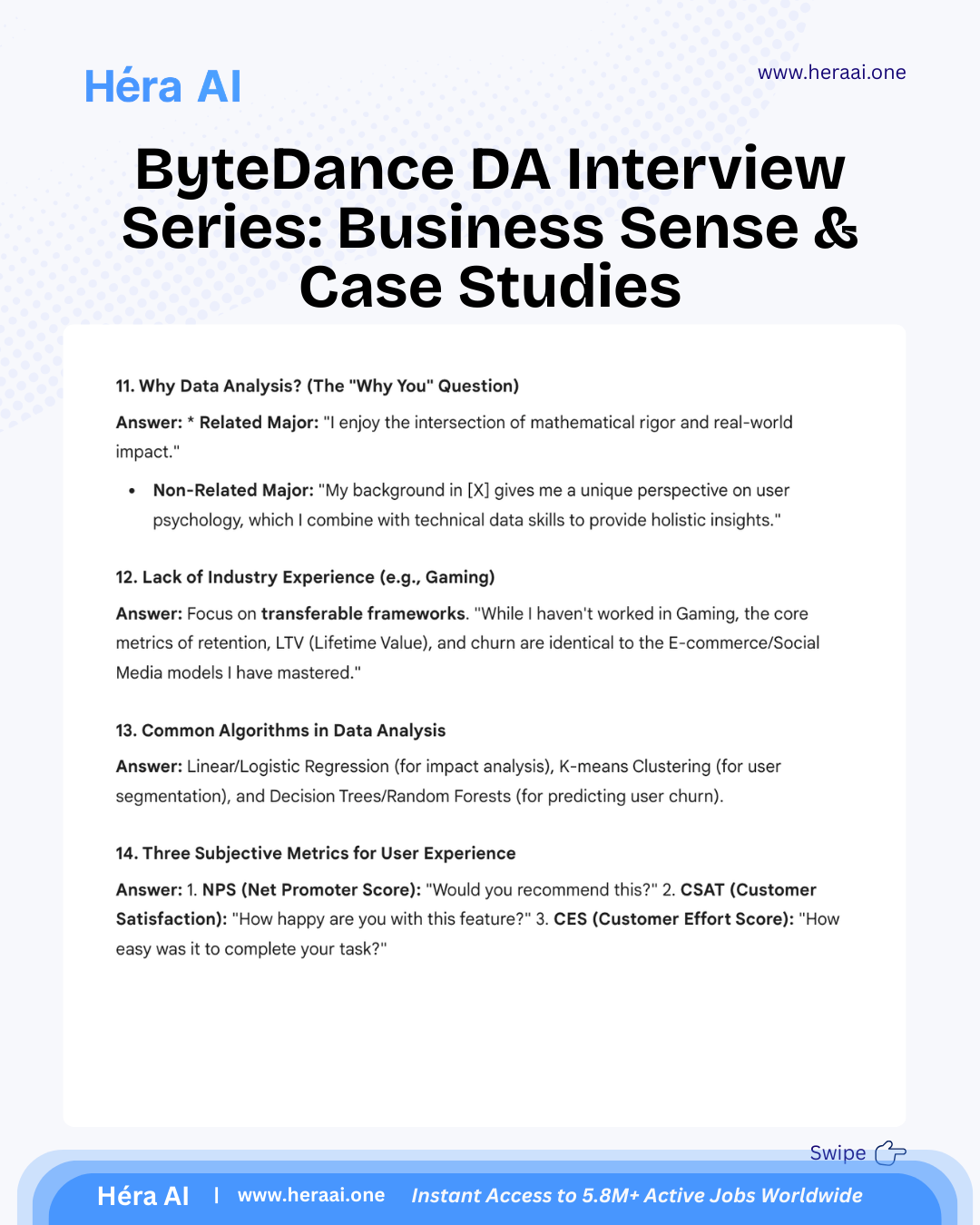
Transferable Metrics: Why Industry Background Is Not a Barrier
ByteDance DA candidates come from e-commerce, fintech, gaming, SaaS, and consulting backgrounds. The interviewer is not expecting short-video platform experience — they are expecting metric literacy and analytical framework transfer. The metrics and tools below appear across every industry that generates user behaviour data. Knowing their precise definitions and the business questions they answer allows a candidate with no TikTok experience to structure a compelling response to a TikTok product question.
The framing that turns non-industry experience into an asset: A candidate from retail analytics should not apologise for the absence of short-video experience. The correct framing: 'In retail, I measured Day-30 repeat purchase retention as the primary cohort health metric — the definition of the activation event was different, but the cohort construction logic and the segmentation approach are identical to what you would use for TikTok Day-30 return-to-app retention. The metric is transferable; the product context is learnable.' This framing demonstrates analytical maturity and eliminates the perceived industry gap in one sentence.
The Full Series: D1 Through D4
Day 4 completes the foundational layer of the ByteDance DA interview series. The four-day arc builds a single composite capability: the ability to move from raw event data to a product recommendation that the team can act on — without introducing errors at any stage in the pipeline.
The principle that defines the ByteDance DA standard across all four days: Data is just the starting point. SQL extracts it. Statistics validates it. Excel delivers it. Business sense decides what to do with it. A ByteDance DA who can do all four — who extracts the right data, validates the finding, delivers it efficiently, and owns the product implication without being prompted — is not a data professional who supports product decisions. They are a product thinker who happens to work in data. That is the hire ByteDance is looking for, and that is what all four days of this series are designed to help you become.