ByteDance Statistics Interview: Why Most Analysts Misinterpret A/B Tests
At TikTok's scale, almost every test is statistically significant. The real question — the one that decides the offer — is whether the result is practically meaningful.
Day 1 of the ByteDance DA series covered the SQL traps that eliminate 90% of candidates before the statistics round begins. Day 2 is where the remaining candidates get separated. The statistical concepts themselves are not advanced — p-values, confidence intervals, and the central limit theorem are standard curriculum. What separates a ByteDance hire from a ByteDance reject is precision in applying these concepts to the specific data environment of a platform with hundreds of millions of daily active users, viral content distributions, and product decisions that cost millions of dollars to reverse.
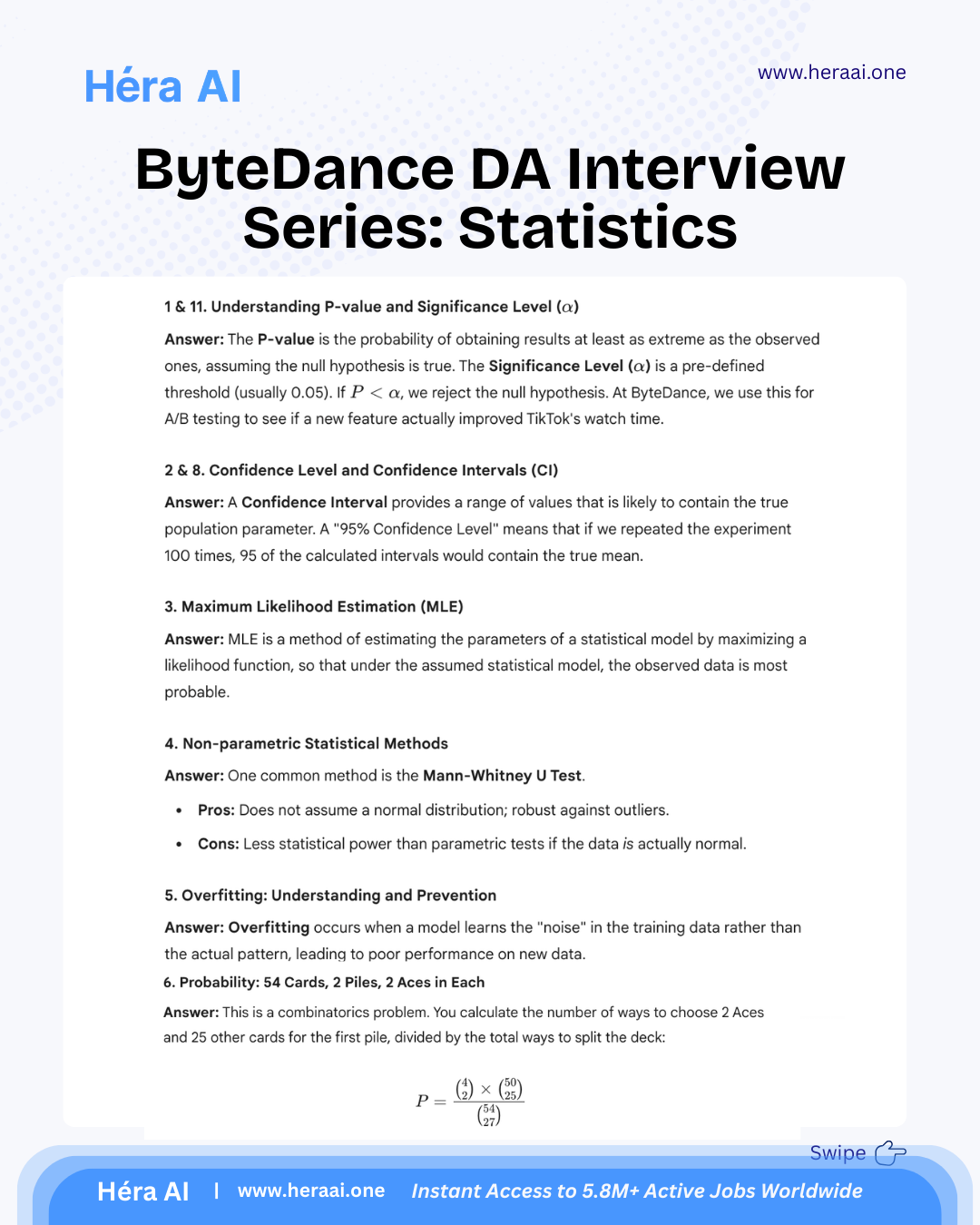
At TikTok's scale, almost every A/B test will reach statistical significance. The sample sizes are enormous. A feature that improves average watch time by 0.0001 seconds will produce a p-value well below 0.05. A candidate who presents that finding as 'the feature is a success' has answered the wrong question. The interview is testing whether you can ask the right question: Is the effect large enough to justify shipping?
This is Day 2 of HéraAI's ByteDance DA Interview Series. Here are the five statistical concepts that appear most frequently, the five A/B testing traps that eliminate otherwise-qualified candidates, and the precision distinctions that signal senior-level analytical thinking.
The Five Concepts — What ByteDance Is Actually Testing
The five statistical areas below are not being tested in isolation. Each one is a proxy for a specific analytical judgment that ByteDance DAs exercise daily. The table maps each concept to the business question it answers and what the interviewer is actually probing for.
The framing shift that defines a senior candidate: ByteDance interviewers are not testing your ability to recall statistical definitions. They are testing your ability to translate statistical logic into product risk. The difference between a junior and senior answer to any statistics question is: the junior answers the math, the senior answers the business cost of getting the math wrong.
The A/B Testing Trap Table: Five Mistakes That Signal Junior Thinking
The five traps below are not obscure edge cases. They appear in the majority of ByteDance DA statistics interviews and account for a disproportionate share of candidate rejections at the statistics stage. Each one has a surface-level correct response that is actually wrong in the ByteDance context.
The statistical power trap deserves special attention because it is the one most candidates never raise proactively. Statistical power is the probability of correctly detecting a real effect. An experiment designed with insufficient power — too small a sample, too short a duration — risks a Type II error: concluding no effect exists when it actually does. At ByteDance, where product decisions are made on the basis of experimentation results, a false null conclusion can lead to discarding a genuinely valuable feature. Raising this before the interviewer asks shows you think about experiment design, not just experiment interpretation.
The Mann-Whitney signal — why it works as a senior filter: Most candidates default to t-tests because that is what statistics courses teach. ByteDance interviewers know that TikTok engagement data is not normally distributed — it is severely right-skewed by viral content. A candidate who says 'given the outlier structure of TikTok engagement data, I would use the Mann-Whitney U Test rather than a t-test because it compares distributions by rank rather than mean, making it robust to the viral outlier problem' has demonstrated three things simultaneously: statistical knowledge, platform understanding, and practical judgment. That combination is rare enough to be a strong hire signal.
Precision Distinctions: The Concept Pairs That Interviewers Probe
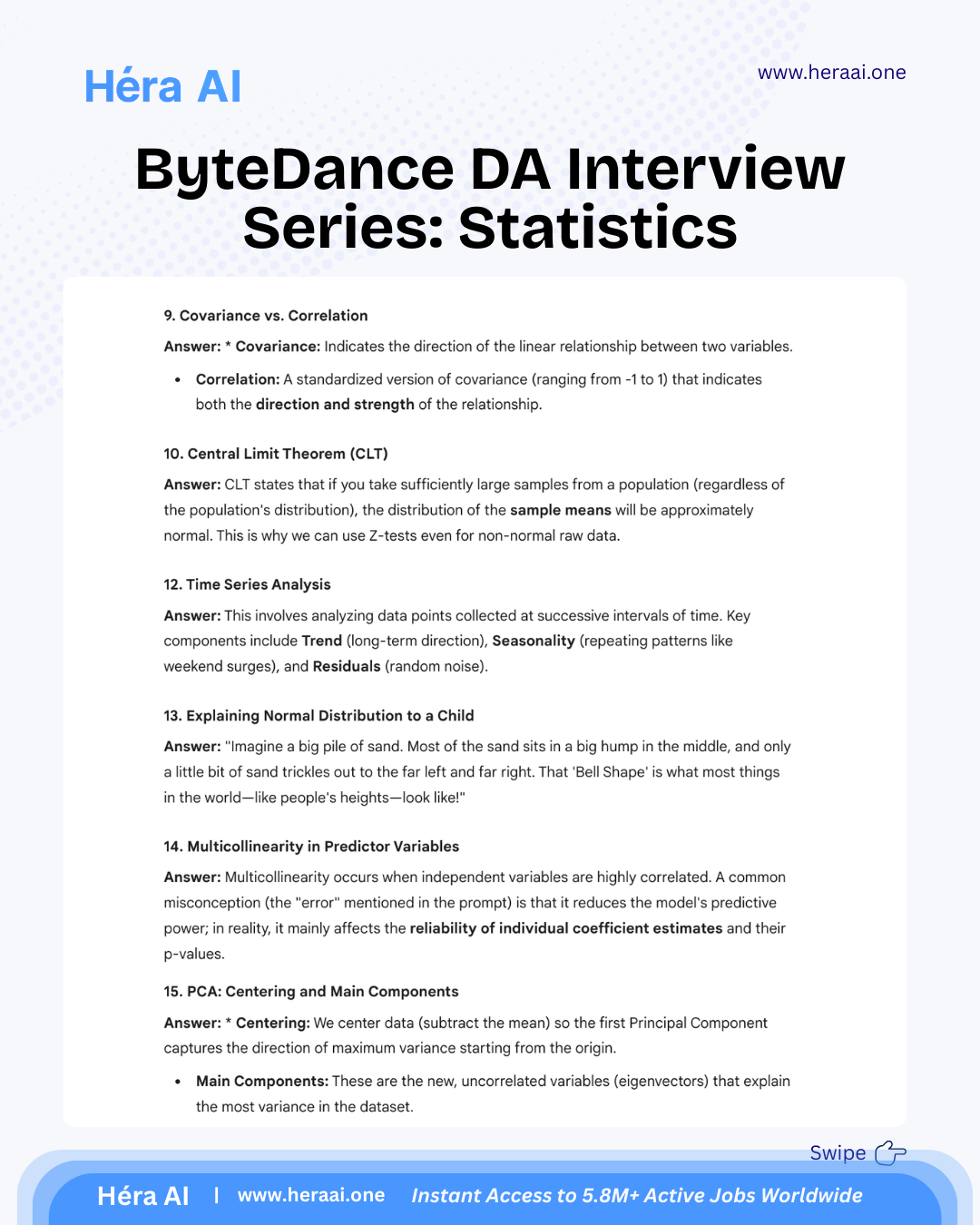
The questions below are frequently used to separate candidates who understand statistical concepts from candidates who have memorised definitions. The correct answer to each requires not just the distinction but the business context in which the distinction matters.
The time series decomposition row is frequently underweighted by candidates who focus entirely on A/B testing. ByteDance DA roles are not only about experiment analysis — they involve ongoing metric monitoring, anomaly detection, and attribution of metric movements to specific causes. A DA who cannot separate a weekend seasonality spike from a product-driven trend change will produce incorrect feature attribution and flawed roadmap recommendations. The decomposition framework — trend, seasonality, residual — is the analytical tool that prevents this error.
Explain Normal Distribution to a Five-Year-Old — Interview Question 13
This question appears deceptively simple. It is not. ByteDance asks it because the ability to explain statistical concepts to non-technical audiences is a core job requirement for a DA embedded in a product or growth team. A DA who can only speak to other statisticians cannot influence product decisions, cannot defend their analysis in design reviews, and cannot communicate experiment results to the PMs and engineering leads who will act on them.
The correct approach is to prepare three versions of the explanation — one for each type of audience — and to know which version to deploy based on who is in the room.
Why communication range is the hidden filter in the statistics interview: ByteDance hires DAs who will sit in product reviews and growth meetings with mixed audiences. The ability to adjust statistical communication to the listener — not just the ability to compute correct answers — is what enables a DA to actually influence decisions. A technically perfect analysis that the PM cannot understand does not change the product roadmap. Question 13 is testing influence capability disguised as a statistics question.
Series Comparison: Day 1 SQL vs. Day 2 Statistics
The ByteDance DA interview series builds a cumulative profile of what the hiring team is actually evaluating across the two technical rounds. Day 1 establishes whether you can extract and structure data correctly. Day 2 establishes whether you can reason about what the data means and whether it is telling the truth.
The principle that connects D1 and D2 — and defines the ByteDance DA standard: SQL is how you extract data. Statistics is how you prevent that data from lying to you. A DA who writes perfect SQL but misinterprets the resulting A/B test has done the easy part right and the important part wrong. ByteDance's interview sequence is designed to test both layers because the job requires both: technical precision in data extraction and analytical judgment in data interpretation. The candidates who pass both rounds are the ones who treat every query as a hypothesis and every result as a claim that needs to be validated before it reaches a product decision.
Explore the HéraAI Content Hub
ByteDance DA interview series, SQL cheatsheets, Python references, statistics frameworks — the complete Interview Cheatsheet Vault.