ByteDance DA Interview, Day 1: Why 90% of Candidates Fail with Correct SQL Queries
The real ByteDance SQL screen doesn't test syntax — it tests whether you think like a product owner. Here are the five traps that eliminate technically correct candidates.
If you're preparing for a Data Analyst role at ByteDance or TikTok, the foundational SQL questions are your baseline. But at petabyte scale with real-time business logic, a technically correct query that ignores product context is a failing grade — and the interviewers are specifically designed to surface that gap.
At ByteDance, data is not a reporting function. It's a decision engine. The analysts who advance to offer stage are not the ones with the cleanest syntax — they're the ones who ask the right clarifying questions before writing a line of code, who understand why a specific JOIN choice corrupts a retention metric, and who can explain the computational cost of a self-join on a table with 10 billion rows.
This article breaks down five SQL concepts that appear in ByteDance DA screens and maps the gap between the surface-level answer and the senior-level one. Each section covers what most candidates say, what the interviewer is actually probing, and what the top 1% of candidates demonstrate instead.
The Five Traps at a Glance
The table below maps each SQL concept to the hidden trap it contains and the response pattern that signals senior-level thinking. Use it as a preparation checklist — for each concept, the question to answer is not 'do I know this' but 'can I explain the business implication under follow-up pressure?'
The meta-signal ByteDance interviewers are looking for: The difference between a junior and a senior data analyst is not the code they write — it's the mistakes they anticipate before writing it. Every senior response begins with a clarifying question or a denominator definition. That instinct, more than any technical skill, is what the interview is designed to detect.
Trap 01 — The JOIN Bias: Accuracy vs. Truth
The most commonly cited SQL concept in retention analysis is JOIN type. Most candidates know the difference between INNER and LEFT JOIN in mechanical terms. Fewer understand what happens to a metric's validity when the wrong JOIN type is selected — and at ByteDance, metric validity is the entire job.
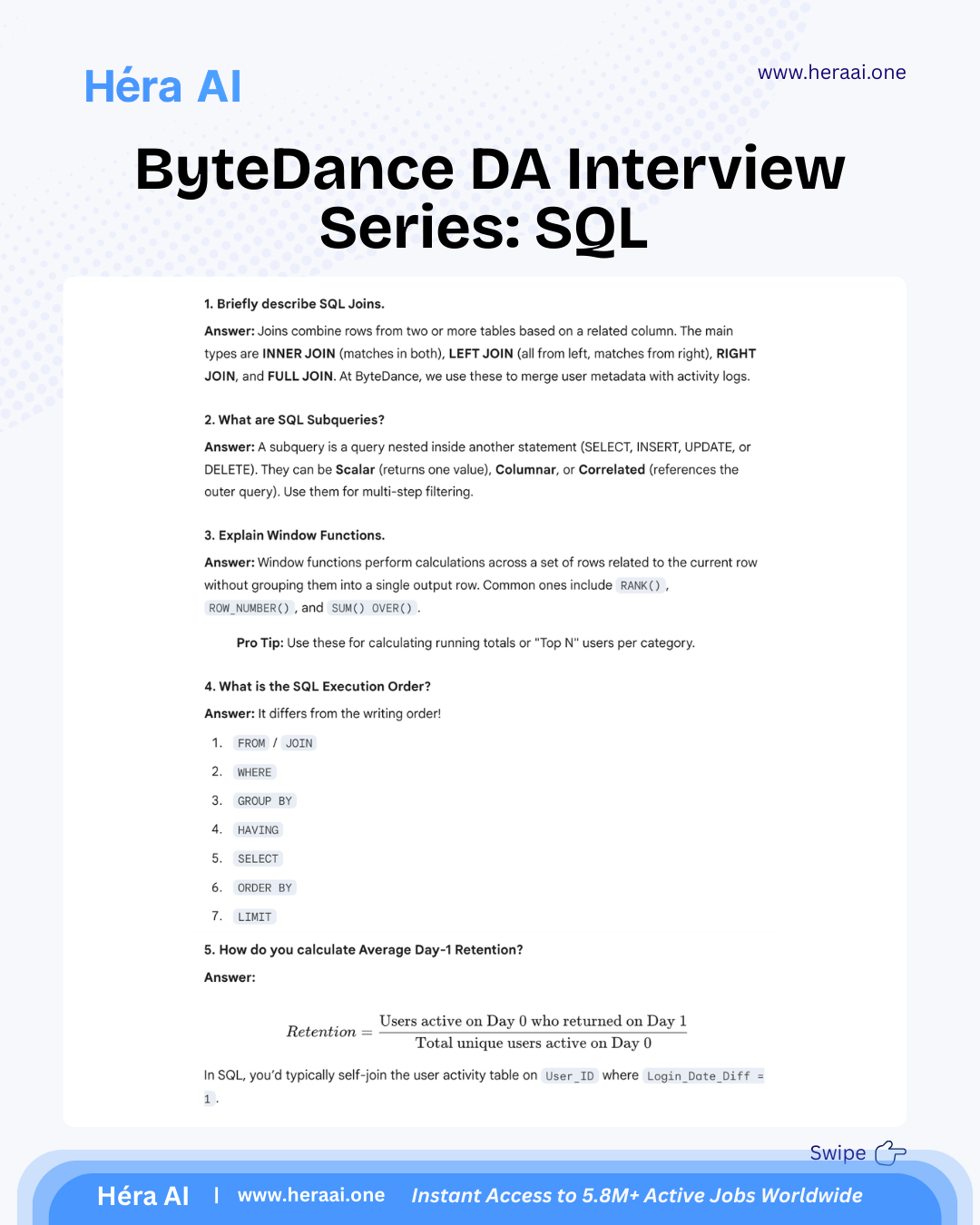
The specific trap: calculating Day-1 Retention using INNER JOIN between a user registration table and an activity table. An INNER JOIN returns only rows that match in both tables — which means every user who registered but never performed the defined activity is automatically excluded. The denominator shrinks. Retention appears higher than it is.
The retention figure in the LEFT JOIN query is not lower because ByteDance has a worse product — it's lower because it's accurate. The INNER JOIN figure is not wrong because of a syntax error; it's wrong because of a metric design error. That distinction is exactly what the follow-up question is designed to expose.
HéraAI interview technique: In a ByteDance interview, before writing any retention query, state your denominator explicitly: 'I'll use LEFT JOIN to preserve the full registered cohort in the denominator. I'm assuming we want to measure what percentage of all registered users returned — not just the subset who were already active. Can you confirm?' This single question signals product ownership.
Trap 02 — Window Functions: The Senior Signal
Window functions are standard SQL knowledge. The ByteDance DA screen uses them to test something more specific: whether you understand the computational cost difference between a window function and a self-joined subquery — and whether you can articulate the edge cases that determine which ranking function to use in a business context.
The setup: 'Find the top 3 creators by view count in each content category.' The junior answer produces a correlated subquery with a self-join that scans the table multiple times. The senior answer uses a window function in a single pass — and names the specific function based on the tie-handling requirement.
The DENSE_RANK() vs. RANK() distinction is not academic in this context. ByteDance's Creator Fund distributes incentive payments based on creator rank tiers. If two creators tie for rank 2 and RANK() is used, rank 3 is skipped — meaning a creator who would qualify for Tier 3 incentives under a continuous ranking system loses out due to a SQL function choice. Demonstrating awareness of this edge case is the fastest way to signal production experience.
The performance signal that closes the conversation: After presenting the window function solution, add: 'At ByteDance's data volume, a self-join on the creator activity table would require scanning billions of rows twice. A window function processes the data in a single pass. The performance difference at this scale could mean the difference between a query that runs in 30 seconds and one that times out.' This frames a technical choice as an infrastructure cost decision.
Trap 03 — SQL Execution Order: The Debugging Superpower
SQL execution order is taught in every introductory course. At ByteDance, it's used as a senior filter because knowing the order conceptually is different from being able to debug a production error by tracing the order mentally — without running the query.
The most common trap: filtering on an aggregated metric in a WHERE clause. WHERE runs before GROUP BY and SELECT, which means aggregate functions don't exist yet when WHERE is evaluated. Using AVG(engagement_score) > 80 in a WHERE clause produces a syntax error in standard SQL. The correct clause is HAVING — which runs after GROUP BY, when aggregate results are available.
The engine-specific nuance that separates candidates: whether SELECT aliases are available in ORDER BY depends on the SQL engine. In BigQuery and Presto (common at ByteDance), aliases defined in SELECT are available in ORDER BY. In standard SQL and some strict engines, they are not. Mentioning the specific engine — and demonstrating awareness that behavior varies — signals that you've actually spent time in a production query environment.
The debugging framing that impresses interviewers: When asked to optimize or debug a query, say: 'Let me trace the execution order. FROM loads the data, WHERE filters individual rows — so I can't use an aggregate here, that needs to go in HAVING — GROUP BY creates the aggregation buckets, HAVING filters on the aggregated result, then SELECT evaluates...' Walking through the order out loud demonstrates the production debugging instinct that senior DA roles require.
Trap 04 — The Retention Formula: It's Strategy, Not Arithmetic
The retention formula is conceptually simple: returning users divided by total users from the cohort. The ByteDance interview uses it to test something entirely different — whether you understand the business decisions embedded in every component of that formula, and whether you know what happens to the metric when those decisions change.
Three dimensions define the formula's validity. Each one is a clarifying question you must raise before writing the query — and each one has a specific implication at global product scale.
The timezone dimension is the one that most directly distinguishes candidates with global product experience. ByteDance operates across every major timezone. A user in Seoul who registers at 11:30pm local time registers at 14:30 UTC the same day. If your Day-1 window is defined as the next calendar UTC day, this user's 'Day 1' begins in 30 minutes — making any activity in the next 24 hours fall outside the Day-1 window in your query, even though it's genuinely Day-1 behaviour.
The fastest path to a 'Strong Hire' rating: Mention timezone normalization unprompted. Most candidates never raise it. The moment you say 'I'd want to confirm whether we're normalizing UTC to the user's local timezone for the day boundary calculation — this can shift retention figures by 10-15% for global cohorts' you have demonstrated a level of metric engineering awareness that the majority of candidates at every level do not.
Trap 05 — 3NF and Data Types: Where Theory Meets Infrastructure Cost
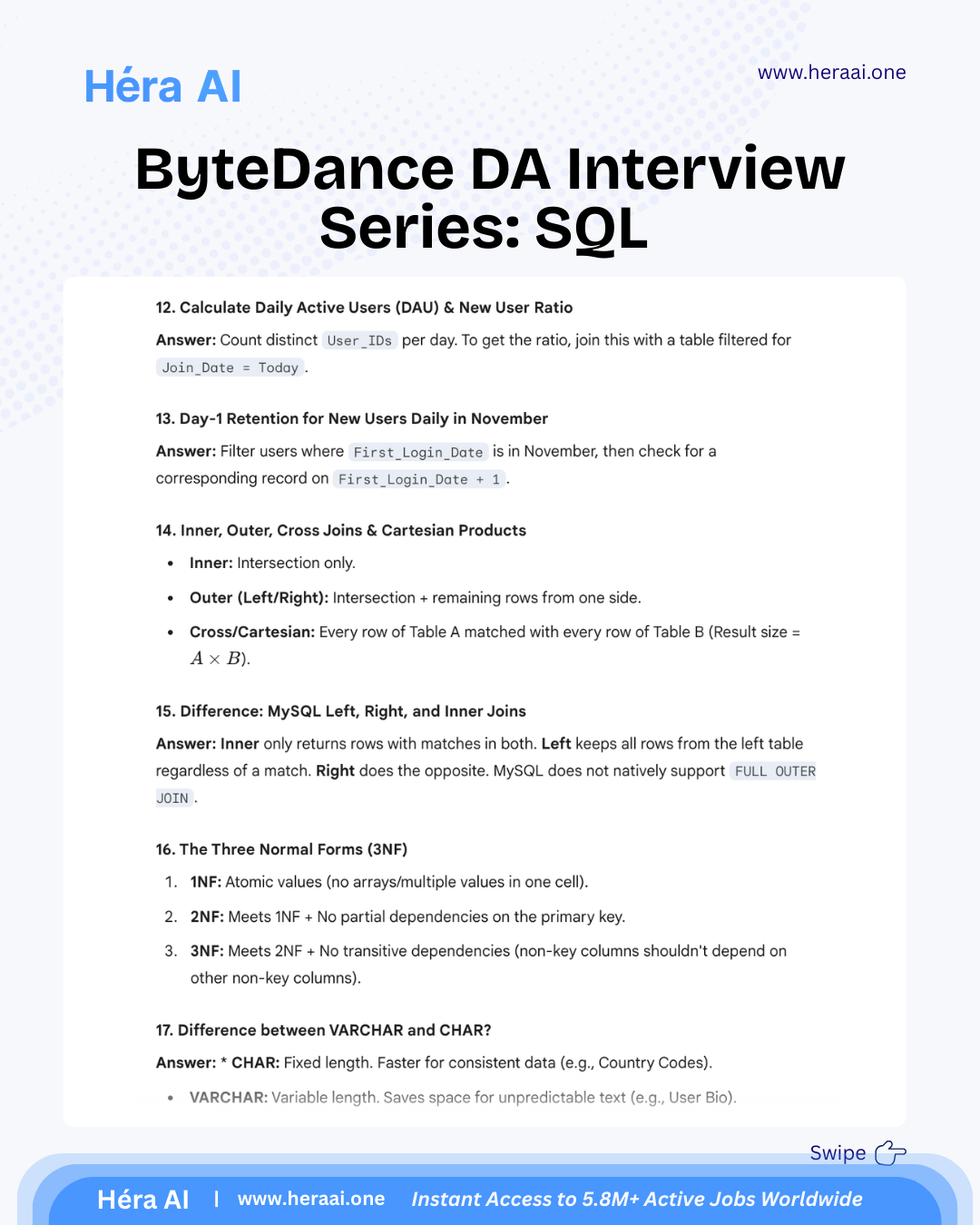
Third Normal Form and data type selection are the SQL concepts most candidates treat as textbook theory. At ByteDance, they're asked to assess whether you understand data engineering collaboration and infrastructure economics — two dimensions that matter significantly for a senior DA who works at the intersection of product and data platform.
SQL Is the Language. Business Judgment Is the Message.
The five traps in this article share a common structure: each one has a technically correct answer that fails the interview, and a strategically correct answer that passes it. The difference is not SQL knowledge — it is the instinct to ask what a query is actually measuring before deciding how to write it.
At ByteDance, data analysts are not query writers. They are product decision partners who happen to use SQL as their primary tool. The interview is designed to determine whether you approach a metric as a coder — asking 'how do I calculate this?' — or as a product owner — asking 'what exactly are we measuring, why does it matter, and what could make this number misleading?'
This article is Part 1 of HéraAI's ByteDance DA Interview Series. Part 2 covers Statistics and A/B Testing — including why p < 0.05 is not always a win, how ByteDance applies Bayesian thinking in experiment design, and why the 'average user' is a distribution trap that eliminates senior candidates who don't see it coming.