The Modern ML Engineer: 2026 Market Analysis, Skill Blueprint, and Career Pivot Guide (part 1)
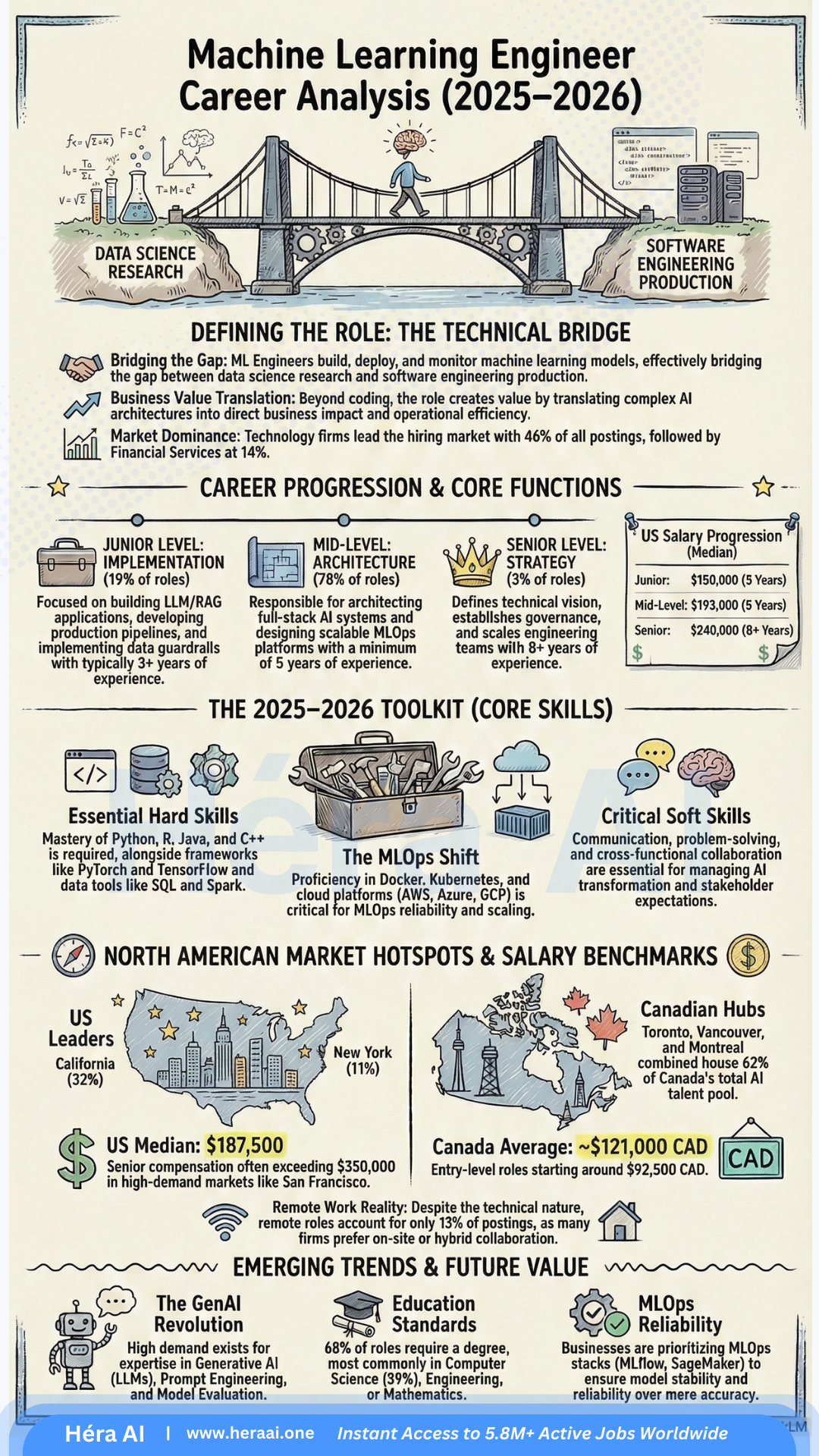
Based on analysis of 10,000+ job postings. Median US salary: $187,500. Senior ceiling: $350,000+. Here's what the market actually requires.
Machine Learning Engineering has become the most critical — and most compensated — bridge role in enterprise technology. As AI moves from research labs into production infrastructure, organisations no longer just need people who can train models. They need engineers who can deploy them, monitor them, scale them, and keep them running at 24/7 reliability.
This article covers two interconnected topics: the full state of the ML Engineer market in 2026, and the specific roadmap for Data Analysts looking to make the transition. Both are grounded in analysis of over 10,000 current job postings and the latest North American compensation data.
1. What ML Engineers Actually Do — And Why It's Different from Data Science
The most important distinction in the current market is between Data Scientists and ML Engineers. Both work with machine learning — but they operate at opposite ends of the production spectrum.
Data Scientists focus on exploration: they analyse data, test hypotheses, and build models in controlled environments. ML Engineers are responsible for what happens next — taking those models into production, ensuring they perform reliably at scale, and building the infrastructure that keeps them running. The shift from 'model accuracy' to 'model reliability' is the defining characteristic of the ML Engineer role.
That production focus is exactly what's driving the demand surge. Organisations that invested in AI research capability over the past five years are now trying to convert that capability into working systems. The bottleneck isn't ideas — it's engineers who can build and maintain the infrastructure that makes ideas deployable.
The market signal: 21% of current ML Engineer job postings specifically cite 'cross-functional communication' and 'business translation' as required skills — not preferred. Companies aren't just buying technical capability. They're buying the ability to connect that capability to organisational outcomes.
2. The Seniority Spectrum: Responsibilities, Market Share, and Compensation
The current ML Engineer market has a distinct structural shape. Mid-level roles account for 78% of all postings — reflecting an industry that has moved past initial experimentation and is now scaling production systems. Junior roles focus on implementation; senior roles focus on vision and team-building; the bulk of the market is in the middle, where the real architectural work happens.
The mid-level opportunity: The 78% concentration of postings at the mid-level is not just a market stat — it's a strategic signal. Candidates who can demonstrate end-to-end ownership of an ML system (from design through production monitoring) are entering the most active and best-compensated hiring segment in the current market.
3. The Complete Skill Stack for 2026
The skill requirements for ML Engineers in 2026 reflect a fundamental shift in what 'production AI' means. The baseline (Python, ML frameworks) is now assumed. The differentiators are MLOps fluency, GenAI stack experience, and the communication capability to translate system performance into business language.
The GenAI column deserves specific attention. LLMs, RAG architectures, and prompt engineering were considered specialist skills 18 months ago. In current job postings, they appear as core requirements — not enhancements — at both mid and senior levels. Candidates without this stack are increasingly screened out at the first filter.
The MLOps imperative: Docker, Kubernetes, and SageMaker are no longer 'nice to have.' They are the production infrastructure that every deployed ML system runs on. An engineer who can build a model but can't containerise, deploy, and monitor it in a live environment is not a production ML engineer — they're a research engineer. The market is paying for the former.
4. North American Compensation: US vs. Canada, Level by Level
The compensation data confirms ML Engineering's position at the top of the technology labour market. US ML Engineers are in the top 4% of earners nationally. The Canada market is structurally similar but compensates at approximately 60–65% of US levels in nominal terms — though purchasing power parity and quality of life calculations shift that comparison significantly in certain markets.
Geographic concentration is significant. In the US, California (32%) and New York (11%) account for 43% of all postings — and the highest compensation bands. In Canada, Toronto, Vancouver, and Montreal represent 62% of the country's AI talent market. Remote-eligible roles remain available, particularly at mid and senior levels in Software, Finance, and Insurance sectors.