
Decoding Microsoft's 'Working with AI' report: a strategic guide to AI delegation and occupational shifts in 2026.
For years, the conversation around AI and employment has been dominated by speculative doom-and-gloom. A new report from Microsoft changes that. By analyzing over 200,000 anonymized conversations with Microsoft Copilot, researchers have mapped — with real-world data — exactly where AI is already doing the heavy lifting. If you're currently in the workforce or entering the 2026 job market, this data is your new North Star. Here's what it actually says.
1. The Information Life Cycle Is Ground Zero
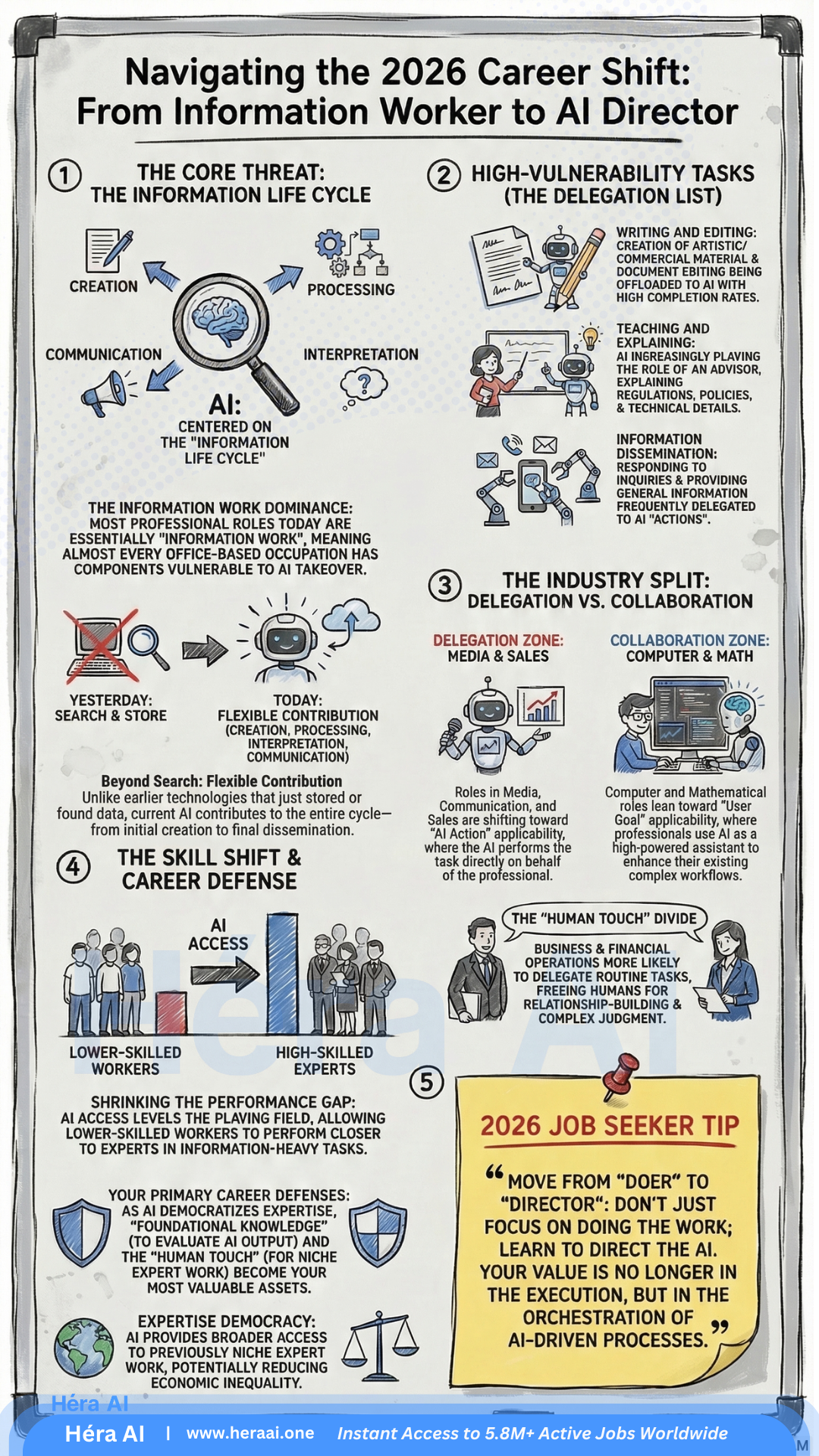
The report's most significant finding is that AI applicability isn't uniform — it concentrates almost entirely on information work: the creation, processing, and communication of data. The occupations sitting at the top of the AI applicability scale are those most deeply embedded in that cycle.
Most Impacted Roles
- Media & Communications
- Sales Representatives
- Information & Records Clerks
- Business & Financial Operations
Least Impacted Roles
- Physical labor & manual trades
- Hands-on care & healthcare support
- Heavy machinery operation
- Roles requiring constant physical presence
The pattern is clear: the further a role is from a screen, the lower its AI applicability score. The closer it is to producing, managing, or communicating information, the higher the exposure.
Key takeaway: AI applicability is not random. It follows the information supply chain. Understanding where your role sits on that chain is the first step in building a future-proof career strategy.
2. The Great Task Split: Delegation vs. Collaboration
One of the most practically useful insights in the report is the distinction between two modes of AI integration — and they have very different implications for how you should think about your career.
The Delegation Zone
The Collaboration Zone
The insight that matters: knowing which zone your role occupies changes everything about your career strategy. Delegation Zone workers need to move up the value chain — fast. Collaboration Zone workers need to master AI acceleration before someone else does.
3. Specific Tasks Being Handed to AI Right Now
The report doesn't just identify industries — it maps the specific task types that are seeing the highest AI delegation rates. These are called Information Work Activities (IWAs), and they are already shifting. These aren't future predictions. Microsoft's dataset confirms they are happening now, at scale, across major enterprises.
High-Delegation Task Categories (IWAs)
4. Three Things That Will Actually Matter in the 2026 Job Market
The data from this report translates into three concrete strategic priorities for anyone building or pivoting their career right now.
The 'Connecting Glue' Skill
As AI democratizes information work, the most durable asset becomes cross-task judgment: the ability to connect dots across domains, read a room, and build relationships. AI can produce the output. It cannot own the relationship or make the call in a non-routine situation. That gap is where your premium lives.
Foundational Domain Expertise
The report flags a crucial catch: AI can shrink the performance gap between low- and high-skilled workers — but only if the human evaluating the output has the expertise to know when AI is right and when it's wrong. In 2026, 'AI literacy' isn't about prompting. It's about having enough domain knowledge to be a credible judge of AI output. Without that, you're not working with AI — you're just forwarding its mistakes.
The Task Refactoring Mindset
Entirely new occupations are emerging, and existing ones are being restructured around what humans and machines each do best. Even physical roles — food service, healthcare support — are seeing AI enter through their administrative and informational components. No role is AI-proof. Almost every role is AI-enhanceable. The competitive skill is learning to split your work deliberately: what to delegate, what to automate, and what to own.
The HéraAI bottom line: Don't just learn to do the work. Learn to direct the AI that does the work.
The Frontier Has Moved. Have You?
Microsoft's report confirms what the most forward-thinking career strategists have been saying: AI is becoming a general-purpose technology, comparable in scale to the internet or the steam engine. Its effects won't be uniform, and they won't all arrive at once.
For current employees, the priority is identifying which parts of your information lifecycle can be safely delegated — so you can redirect that time toward the creative, interpersonal, and judgment-intensive work that AI cannot replicate.
For the class of 2026, the message is direct: the workers who will thrive aren't the ones who know how to use AI. They're the ones who know how to think alongside it. At HéraAI, that's exactly the transition we help people navigate.
Note: Insights are based on Microsoft Copilot usage data from late 2024 through 2025, as reported in 'Working with AI: Measuring the Applicability of Generative AI to Occupations.'