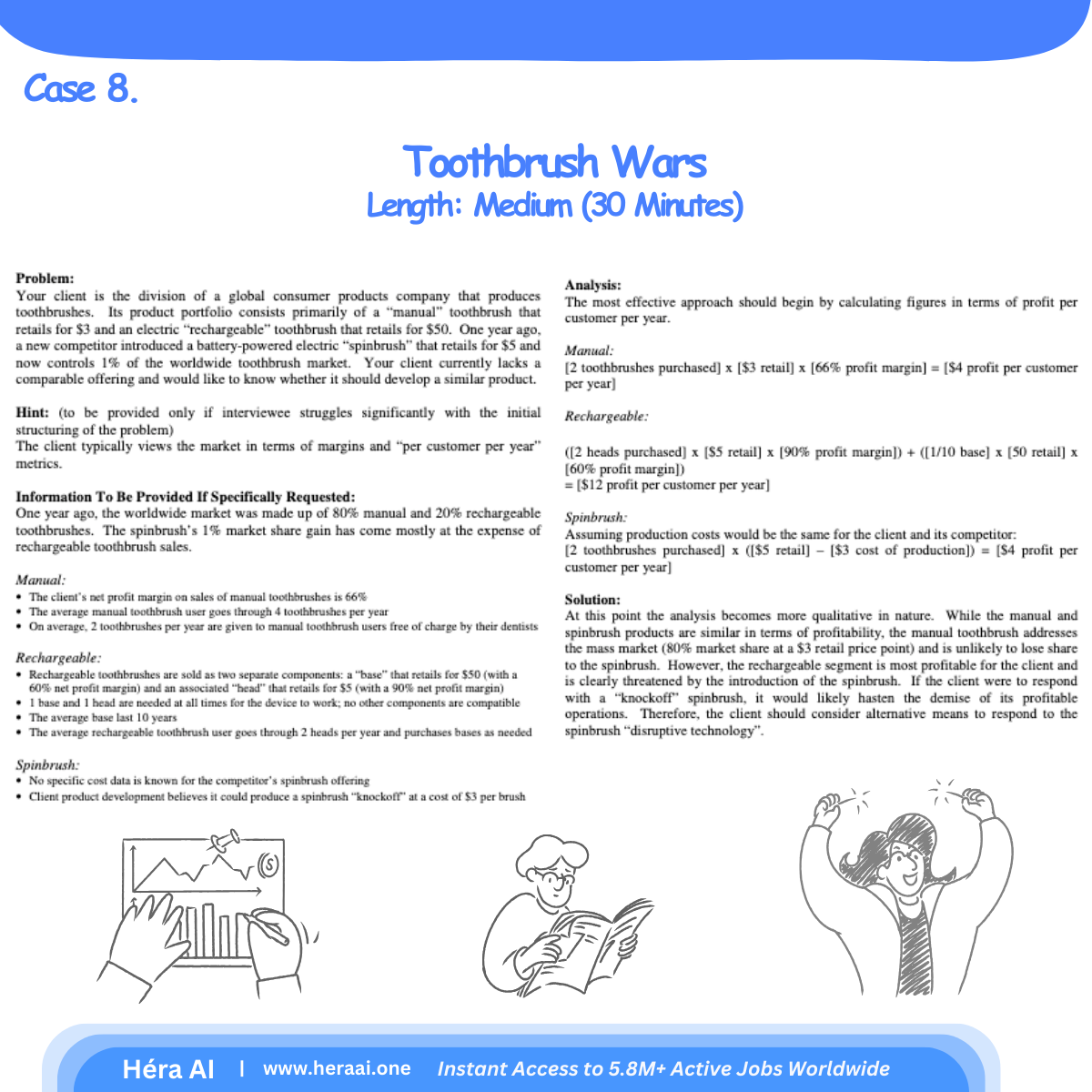
Case 8: Toothbrush Wars — When Disruption Targets Your Most Profitable Segment
A $5 spinbrush captures 1% of the global market. That sounds small. But it does not draw from the $3 manual segment — it draws from the $12-per-year rechargeable segment. The case is not about market share. It is about profit pool erosion — and why a knockoff response accelerates the problem it was meant to solve.
Case 8 is a consumer products disruption case with a specific analytical trap: the instinctive response to a new competitor is to match it. Launch a spinbrush. Defend the market. Protect the share. In this case, that response destroys more value than the competitor does on its own. The spinbrush does not attack the high-volume, low-margin manual segment — it attacks the low-volume, high-margin rechargeable segment. A direct competitive response by the client accelerates the cannibalization of its own most profitable customer base.
The analytical reframe that unlocks this case is the shift from market share to profit per customer per year. Management stated this is how they view the business — and that hint is the key. At 1% market share, the spinbrush looks like a minor competitive irritant. Measured in annual profit per customer lost ($8 per converted rechargeable user), the threat is structurally serious before it becomes visible in the volume numbers.
The case tests whether candidates can identify the correct competitive metric, map the profit pool before drawing strategic conclusions, trace where the spinbrush draws its share from (rechargeable, not manual), and name why the knockoff response is the worst available option. These four moves, in sequence, produce a recommendation that is both analytically rigorous and strategically sound.
The Profit Pool: Three Products, Three Different Economic Realities
The first analytical step is to map the annual profit per customer across all three product tiers. This mapping reveals the economic structure of the competitive threat — and immediately reframes the case from a market share question to a profit pool question.
The reframe that changes everything: 'The spinbrush has 1% of global market share. That sounds manageable. But 1% of what? If the spinbrush draws disproportionately from the rechargeable segment — which generates three times the annual profit per customer — then 1% of volume can represent a much larger share of profit impact. Before assessing whether the threat is serious, we need to know which customers the spinbrush is taking. That question determines everything that follows.'
Why This Is a Profit Threat — Not Just a Market Share Threat
Strategic Response Options: What Helps and What Accelerates the Problem
The strategic response options for the client span a range from self-defeating to structurally sound. The table below evaluates each option against the profit pool logic established in the analysis — distinguishing responses that protect value from those that erode it.
The cannibalization logic that separates strong answers from average ones: 'If the client launches a $5 spinbrush, it defends volume share in the entry-level electric segment. But where does that spinbrush volume come from? Not from manual users — they were not going to upgrade to a $50 rechargeable anyway. It comes from customers who were deciding between spinbrush and rechargeable, and who now choose the client's spinbrush instead of the client's rechargeable. The client has successfully competed — against itself. The market share number improves. The profit per customer number falls. This is not a response to disruption; it is a subsidy of it.'
The 5-Step Framework
The meta-lesson that Case 8 is designed to teach — applicable to every disruption case: Not all market share is worth defending. Disruption often enters at the point where the incumbent's margins are highest and its value proposition is most vulnerable to a price anchor that redefines what the category is worth. The correct response is not to match the disruptor on its terms — it is to widen the gap between the premium product and the disruptor, making the premium's price feel justified rather than vulnerable. Strategy is not about reacting faster. It is about reacting smarter, with a clear understanding of where value is actually created and where it is at risk.