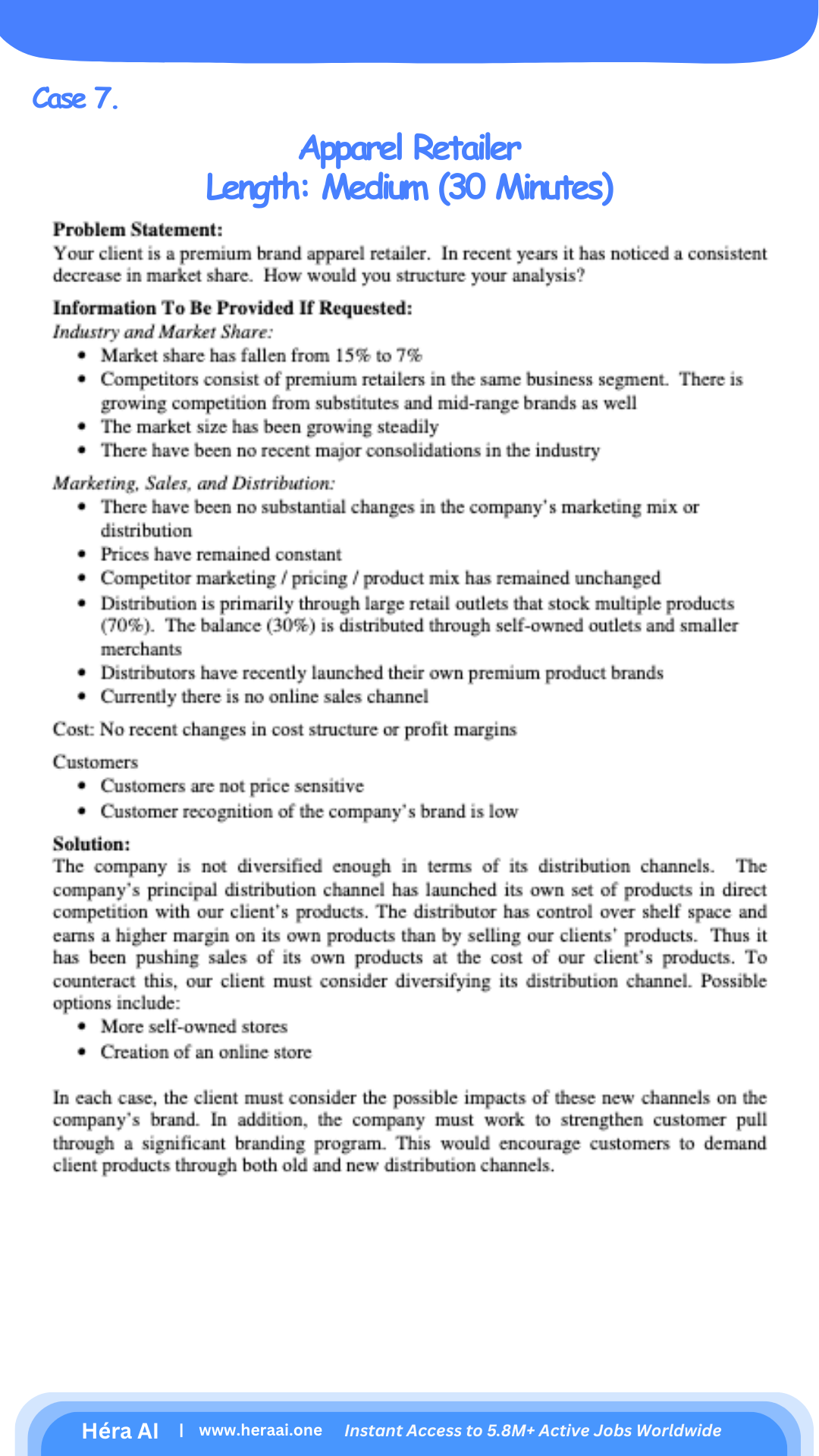
Case 7: Premium Apparel — When Your Distributor Becomes Your Competitor
Market share fell from 15% to 7% in a growing market. Prices unchanged. Costs unchanged. No obvious competitor moves. The problem was not what the client was doing wrong — it was what its channel partners started doing differently.
Case 7 is a market share decline case with a diagnostic trap. The headline numbers are puzzling: share halved in a growing market, with no price changes, no cost disruption, and no visible competitive product entry. The standard hypotheses — pricing, demand, product quality, cost structure — are all eliminated by the facts given. The problem only becomes visible when the analysis shifts from the client's internal operations to the structure of the value chain through which its products reach customers.
The diagnosis is channel power and incentive misalignment. Seventy percent of the client's sales flowed through large multi-brand retailers. Those retailers launched their own premium private-label brands — and in doing so, reversed their incentive structure. The distributor, previously a partner whose profits depended on selling the client's product well, became a competitor whose profits depended on replacing it. With control of shelf space, product placement, and staff recommendation, the distributor could execute that substitution quietly, in every store, without any single visible competitive event.
The second condition that made the decline so severe was low brand recognition. Brand pull — customers actively seeking the brand by name — is the only reliable demand-side protection against distributor substitution. Without it, the client had no ability to prevent the channel shift from translating directly into lost sales. Both conditions were necessary: channel concentration made the client structurally exposed, and the absence of brand pull removed the protection that would have limited the damage.
Diagnostic Elimination: Ruling Out the Standard Hypotheses
A market share decline case should begin with a systematic elimination of the standard hypotheses before looking for an unconventional root cause. In Case 7, the data given eliminates every standard explanation — which is the signal that the problem lives somewhere less obvious.
The diagnostic discipline that interviewers are testing: 'I want to work through the standard hypotheses before looking elsewhere — because if any of them apply, the solution is straightforward. Pricing unchanged, so no affordability issue. Market growing, so no demand collapse. No product disruption identified, so no quality gap. Costs unchanged, so no supply-side deterioration. All four eliminated. That means the problem is not inside the client's operations — it is in the relationship between the client and the pathway through which its products reach customers. I would like to explore the distribution channel next.'
The Root Cause: Channel Power Shift and Brand Pull Absence
Once the standard hypotheses are eliminated, the analysis moves to the value chain. The question becomes: who controls the customer interface, and what are their incentives? In Case 7, the answer to both parts of that question changed when the distributor launched its own private-label products.
Strategic Response: Rebuilding Channel Control and Brand Pull
The strategic response must address both conditions simultaneously: reduce structural dependency on the channel that now has conflicting incentives, and build the brand pull that provides demand-side protection against substitution in any channel. The table below evaluates each option.
The brand dilution caveat that demonstrates premium market understanding: 'For a premium brand, channel expansion is not neutral — it is a positioning decision. Owned retail done well, in high-footfall premium locations with carefully designed brand environments, reinforces the premium positioning and justifies the price premium. Owned retail done cheaply, in secondary locations with inconsistent service quality, undermines it. The recommendation is channel diversification, but the execution standard matters as much as the channel choice. A premium brand's distribution strategy is its brand strategy.'
The 5-Step Framework
The meta-lesson that Case 7 is designed to teach — applicable to every market share decline and channel strategy case: Many performance problems are not caused by what a company does wrong — but by what its partners start doing differently. Market growth does not guarantee firm-level success. Even in expanding markets, power shifts within the value chain can quietly destroy incumbents by removing the intermediaries' incentive to sell on the incumbent's behalf. Spotting those shifts early requires looking beyond the client's internal operations to the incentive structures of every actor in the value chain. Distribution strategy is not a logistics decision. It is a strategic decision — because losing control of the customer interface means losing control of demand.