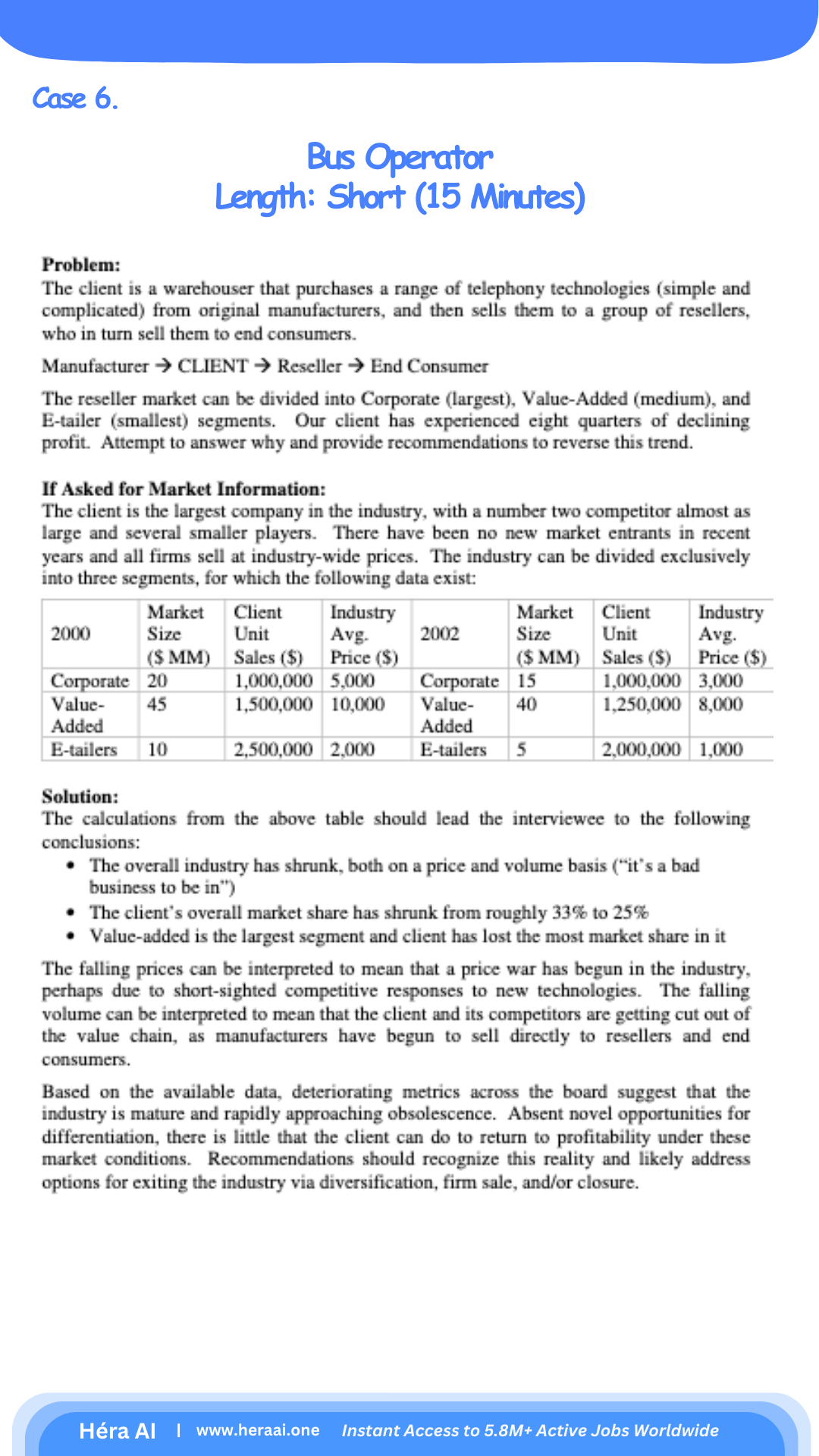
Case 6: Telecom Wholesale — Using Data to Tell the Hard Truth
Eight consecutive quarters of profit decline. Prices down. Volumes down. Market share eroding in every segment. Manufacturers bypassing wholesalers entirely. The data pattern has a story — and the consultant's job is to read it accurately, not optimistically.
Case 6 is a short but dense case — designed to be completed in 15 minutes — that tests one of the most important consulting skills: the ability to distinguish a firm-specific execution problem from a structural industry decline. The surface question is why profit has been falling for eight quarters. The real question is whether the decline is reversible — and whether the right response is an improvement plan or an exit strategy.
The data pattern is unambiguous once it is read correctly. Price and volume declining simultaneously across all three segments (Corporate, Value-Added Resellers, E-tailers) rules out any hypothesis centred on the client's individual execution failures. Market share falling from 33% to 25% in the largest segment confirms that the client is not merely underperforming a stable market — it is losing ground in a contracting one. The E-tailer segment halving in two years signals that an entire customer type has already exited the wholesale channel. And manufacturers bypassing wholesalers entirely is not a competitive threat — it is a structural elimination of the wholesaler's role in the value chain.
This case is not about finding a growth lever or identifying an operational improvement. It is about using data to reach a clear-eyed conclusion about structural decline — and recommending the strategic options that match the reality: diversification, sale, or orderly closure. Candidates who arrive at an improvement plan have misread the data. Candidates who name the structural reality and propose realistic responses have demonstrated what consulting judgment actually looks like.
Segment-by-Segment Deterioration: Reading the Pattern
The first step is to map the decline across all three segments and identify what the pattern reveals about whether the problem is structural or operational. When all three segments deteriorate simultaneously in both price and volume, the data is pointing to an industry-level shift — not a firm-level execution gap.
The diagnostic read that separates structural from cyclical: 'Price and volume declining together in every segment simultaneously is a structural signal, not an execution signal. If the client were underperforming operationally, we would expect to see peer companies holding share while the client loses it. If the market itself is structurally declining, we would expect the pattern we see: broad-based, multi-segment deterioration that cannot be explained by any internal factor. I would want to confirm that competitors are experiencing similar trends — if they are, this is industry structure, not execution. If they are not, we have a firm-specific problem worth diagnosing further.'
Structural vs Firm-Specific: How to Read Five Key Data Signals
Each data signal in Case 6 carries a specific diagnostic implication. The table below pairs each observation with the distinction it enables — firm-specific (addressable by execution improvement) versus structural (requiring a strategic response that may include exit).
Strategic Options: When the Viable Space Narrows to Three
When structural decline is confirmed — disintermediation eliminating the wholesale role, all segments deteriorating, no differentiation or cost levers remaining — the strategic option space narrows. The honest recommendation covers three paths and names which is most appropriate given the client's specific circumstances.
The recommendation framing that demonstrates consulting maturity: 'My recommendation is structured around three realistic options, in order of value preservation. First, explore diversification into adjacent categories where the logistics and supplier relationship capabilities generate defensible margin — this requires a 60-day capability and market assessment. Second, if diversification is not capital-viable, initiate a sale process within the next two quarters while the business still operates and a credible sale price is achievable. Third, if sale is not feasible, plan an orderly wind-down that preserves residual value for stakeholders. I am not recommending an improvement plan because the data does not support the premise that this is an execution problem. It is a structural problem, and the response must match the diagnosis.'
The 5-Step Framework
The meta-lesson that Case 6 is designed to teach — applicable to every structural decline and industry lifecycle case: Consulting is not just about solving problems. It is about using data to tell the hard truth and guide leadership toward realistic strategic decisions. The most valuable thing a consultant can deliver in a structural decline situation is clarity — about what the data shows, what it means for the options available, and what the cost of delay is. A recommendation that softens the structural reality to make it more palatable is not consulting. It is delay. Each quarter of inaction in a structurally declining business narrows the options and reduces the recoverable value. Data-driven clarity, delivered with confidence and evidence, is the highest-value contribution available.