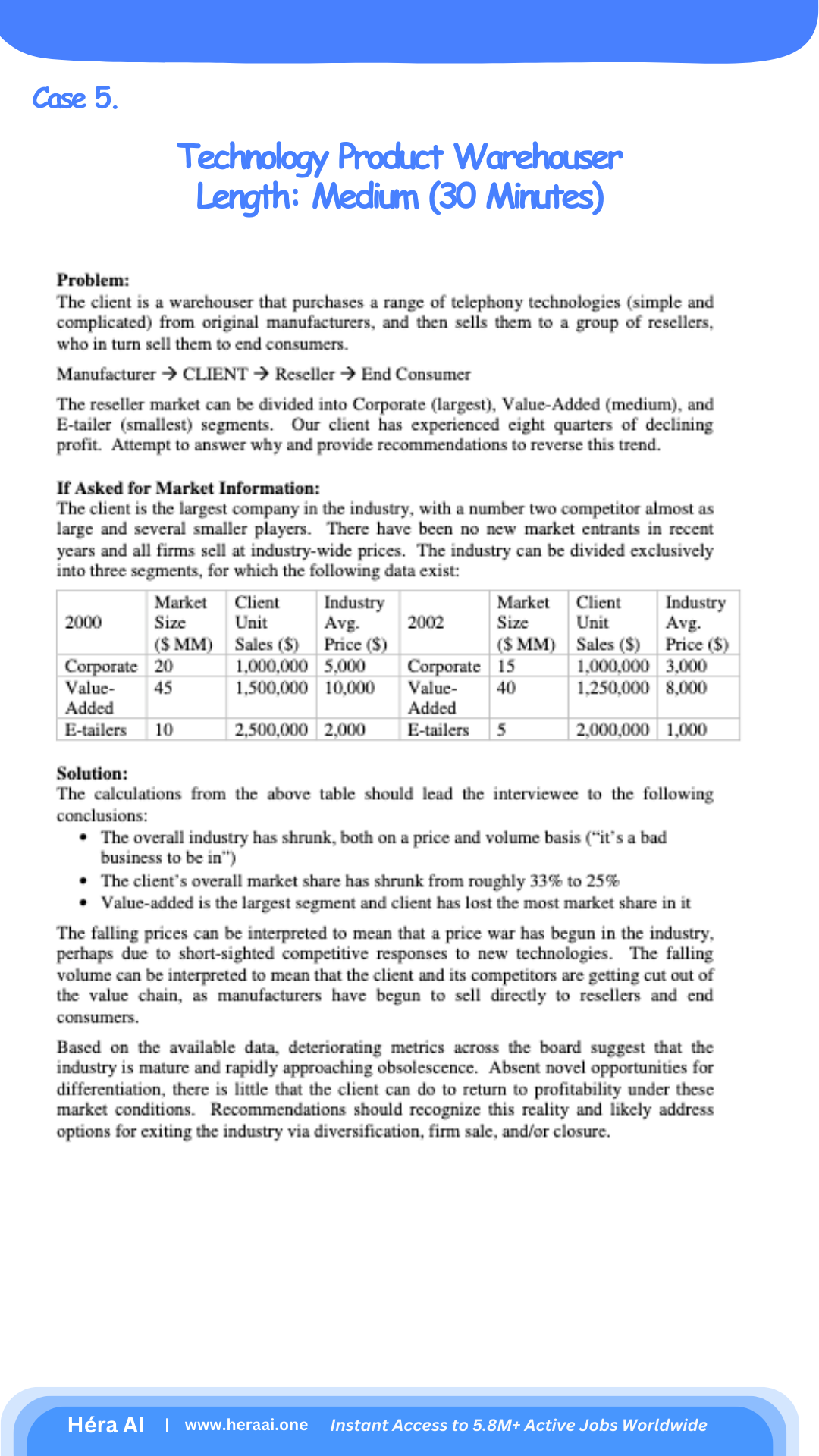
Case 5: Technology Product Warehouser — When the Best Advice Is to Stop Playing
Eight consecutive quarters of profit decline. Simultaneous price, volume, and market size contraction. Manufacturers restructuring the value chain to bypass intermediaries entirely. Sometimes the hardest consulting lesson is knowing when not to recommend a turnaround.
Case 5 is one of the most instructive cases in the series — not because it involves complex calculations, but because it demands something harder: the ability to separate evidence from hope, and to deliver a strategic recommendation that management does not want to hear. A technology product warehouser in the telephony sector has experienced eight consecutive quarters of declining profits. From 2000 to 2002, the industry shrank simultaneously across price, volume, and total market size. Manufacturers began bypassing intermediaries to sell direct. Market share fell from 33% to 25%, with the steepest losses in the Value-Added segment — the one where differentiation was supposed to matter most.
The analytical challenge is not identifying that the business is declining. The data makes that obvious. The challenge is classifying the decline correctly — structural, not cyclical — and resisting the temptation to propose operational improvements that look like consulting value but cannot address the root cause. A business whose structural role in the value chain is being eliminated cannot be saved by cost reduction, service improvement, or targeted marketing. It can be redirected — through diversification into adjacent categories — or it can be exited responsibly through sale or orderly closure.
Case 5 tests three skills that are critical in real consulting engagements: recognising structural decline from a data pattern, separating what hope says from what evidence shows, and communicating clear, honest recommendations even when the conclusion is uncomfortable. These are the skills that distinguish a consultant who advises with clarity from one who defers the hard conversation until it costs the client more than it had to.
Five Structural Signals — and Why Each Rules Out a Cyclical Explanation
The case diagnosis begins with data. Before any strategic option is considered, five signals must be read correctly — each one ruling out a different cyclical or firm-specific explanation, and collectively pointing to a structural industry decline that no internally-focused response can reverse.
The analytical discipline the case is testing: 'Before I recommend any strategic response, I want to confirm whether this is a structural or cyclical decline — because the correct response to each is completely different. Cyclical decline warrants patience, cost management, and a turnaround plan. Structural decline warrants exit optionality. The data shows simultaneous price and volume contraction across all segments, total market shrinkage, disintermediation by manufacturers, and eight consecutive quarters without a positive inflection. That pattern is structural. My recommendation must match that diagnosis.'
Separating Hope from Evidence
Every structurally declining business has a management team with a set of beliefs about why recovery is coming. Part of the consultant's job is to surface these beliefs, pair each one with the specific data that contradicts it, and do so without dismissing management's perspective. The table below maps the five most common hopeful hypotheses against what the evidence in Case 5 actually shows.
Why separating hope from evidence is a consulting skill, not a personality trait: 'Management is not irrational for holding these beliefs — they are emotionally invested in a business they built and a team they are responsible for. The consultant's role is not to dismiss that investment but to make the gap between the belief and the evidence visible and specific. A general statement that 'the market is structurally challenging' is not enough. Pairing each hopeful hypothesis with the specific data point that contradicts it gives management a clear basis for the recommendation — and makes it harder to dismiss the conclusion as consulting pessimism rather than data-driven analysis.'
Strategic Options: The Viable Space Narrows to Three
When structural decline is confirmed and no differentiation or cost lever remains, the strategic option space narrows. The correct recommendation names all three viable options explicitly, evaluates each against the client's specific capital position and timeline, and identifies which is most appropriate — without softening the conclusion.
The 5-Step Framework
The meta-lesson that Case 5 is designed to teach — applicable to every structural decline and exit strategy case: Case interviews test more than calculations and frameworks. They test the ability to recognise structural decline in a data pattern, separate hope from evidence in a way that is specific and credible, and communicate a clear strategic recommendation even when the conclusion is uncomfortable. The best advice in a structurally declining business is not always how to win. Sometimes it is when not to keep playing — and delivering that conclusion with evidence, clarity, and confidence is the highest-value contribution a consultant can make.