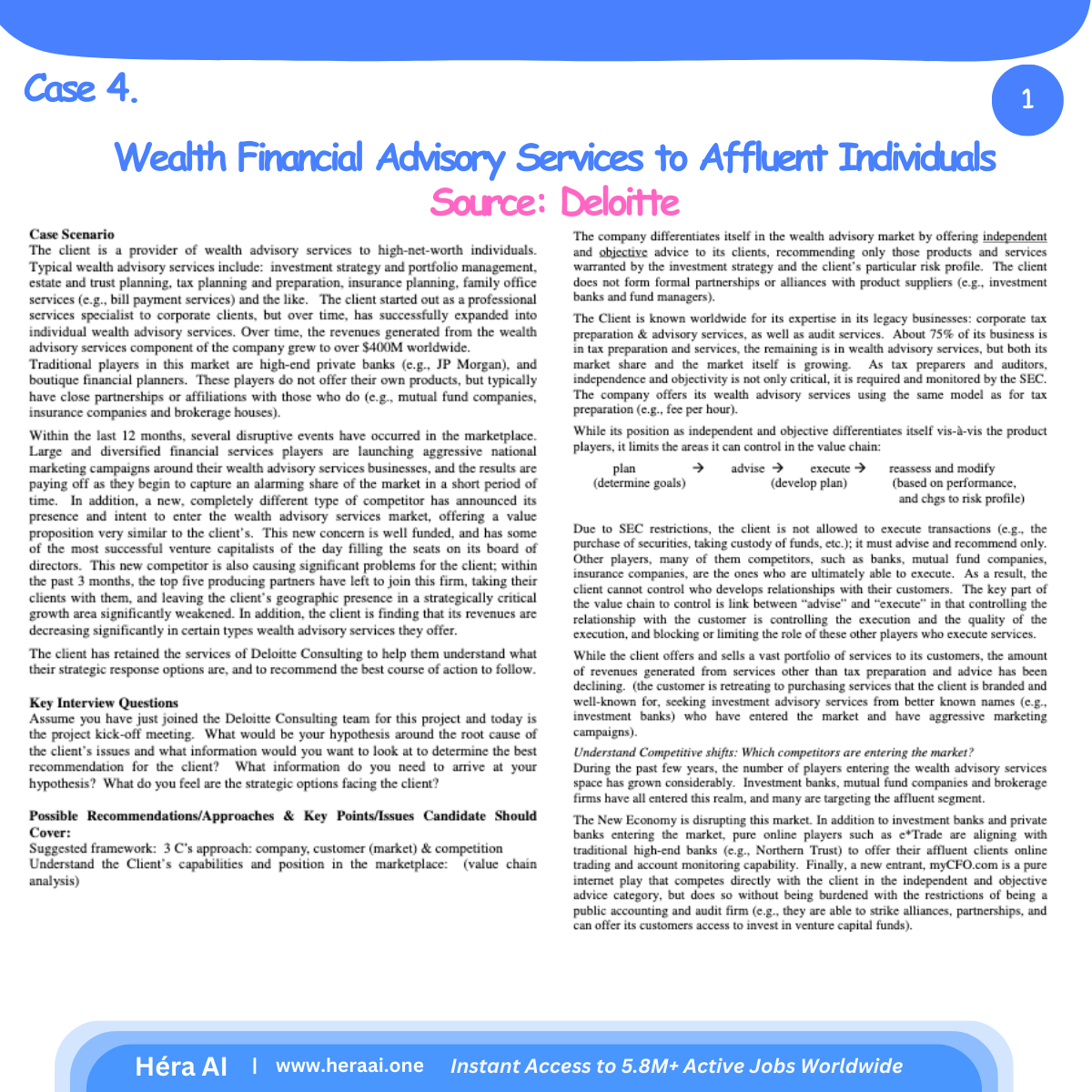
Case 4: Wealth Advisory — When Independence Is Not Enough
A premium wealth advisory firm losing revenue in the affluent individual segment. The problem is not execution — it is a structural value chain gap that independent advisors cannot close without a deliberate strategic choice. Four different competitors are exploiting it simultaneously.
Case 4 is a Deloitte-style market disruption case set in luxury financial services. A premium wealth advisory firm is experiencing revenue decline in the affluent individual segment — a market it once dominated through independent, advice-first positioning. The surface diagnosis — competitor pressure, pricing erosion — understates the structural nature of the problem.
The core issue is a value chain gap. The client's strength is upstream: independent advice, trusted client relationships, deep expertise. Its structural weakness is downstream: SEC restrictions limit control over product selection and transaction execution. This gap was manageable when independent advice was the primary client demand. It has become critical as new entrants offer end-to-end solutions that eliminate the need to choose between advice quality and execution convenience.
The disruption is not coming from a single source. Investment banks are moving down-market with bundled offerings. Fintechs are undercutting on cost structure with technology-driven advice. Big 4 firms are bundling advisory into integrated platforms. Robo-advisors are capturing the next generation of affluent clients before they reach the premium advisory threshold. Each competitor exploits a different dimension of the client's structural gap — which means a single defensive response is insufficient.
Value Chain Analysis: Where the Model Holds and Where It Breaks
The first analytical move is to map the full advisory value chain and identify where the client's capabilities are genuinely strong and where the structural gap creates vulnerability. The left-right comparison below makes the asymmetry visible.
The value chain framing that unlocks the case: 'A strong upstream capability cannot compensate for a downstream constraint when clients are increasingly purchasing the full value chain as an integrated product. Independence is valuable — but independence without execution means the client depends on a third party to complete the service it has sold. When that third party is also a competitor, or when integrated alternatives eliminate the need for the dependency, independence becomes a positioning claim rather than a delivered advantage.'
Four Disruption Mechanisms — Four Different Threats
The competitive disruption in Case 4 does not come from a single source. Mapping each competitor type to its specific attack mechanism reveals that a single strategic response will be insufficient — and that the recommendation must address the structural gap rather than any individual competitor.
Strategic Paths: Three Options, One Analytical Tool
The three strategic paths available to the client require different trade-offs and different capital commitments. Conjoint analysis is the analytical tool that makes the choice between them data-driven rather than directional.
The conjoint analysis framing that elevates the answer: 'Before recommending a strategic path, I would use conjoint analysis to quantify how this client's affluent segment trades off independence against cost, convenience, and integrated delivery. The output tells us: what percentage of the current client base will pay the current fee for independence-only advisory; at what price point does the integrated model become the preferred choice; and which client sub-segments — ultra-HNW, business owners, cross-border families — have planning complexity that the independent model uniquely addresses. Strategy built on this analysis is specific to the client's market rather than a generic response to fintech disruption.'
The 5-Step Framework
The meta-lesson that Case 4 is designed to teach — applicable to every market disruption case in professional services: Frameworks are only the starting point. Real value comes from linking market dynamics directly to the client's specific value proposition and its blind spots. In Case 4, the blind spot is the value chain gap that independence creates — an upstream strength that is not matched by downstream control. Every disruption case in professional services should begin with this value chain mapping before any competitor analysis begins. The gap in the chain is always where disruption enters.'