

Most candidates walk into a growth strategy case and immediately start listing tactics. The ones who get offers start by diagnosing why growth has stalled — and building a framework that separates genuine opportunity from wishful thinking.
The Deloitte Growth Strategy Case is one of the most instructive cases in consulting interview preparation — not because it's technically complex, but because it puts the candidate in a situation that mirrors real strategic advisory work. The client isn't in crisis. The business is functional, growing at market rate, and led by a manager who genuinely believes there is no untapped potential. Your job isn't to validate that belief. It's to challenge it rigorously — and construct a credible path to 10–15% annual growth. Here are the four analytical moves that separate strong candidates from hired ones.
1. The Case Opens With a Skeptical Client — That's the First Test
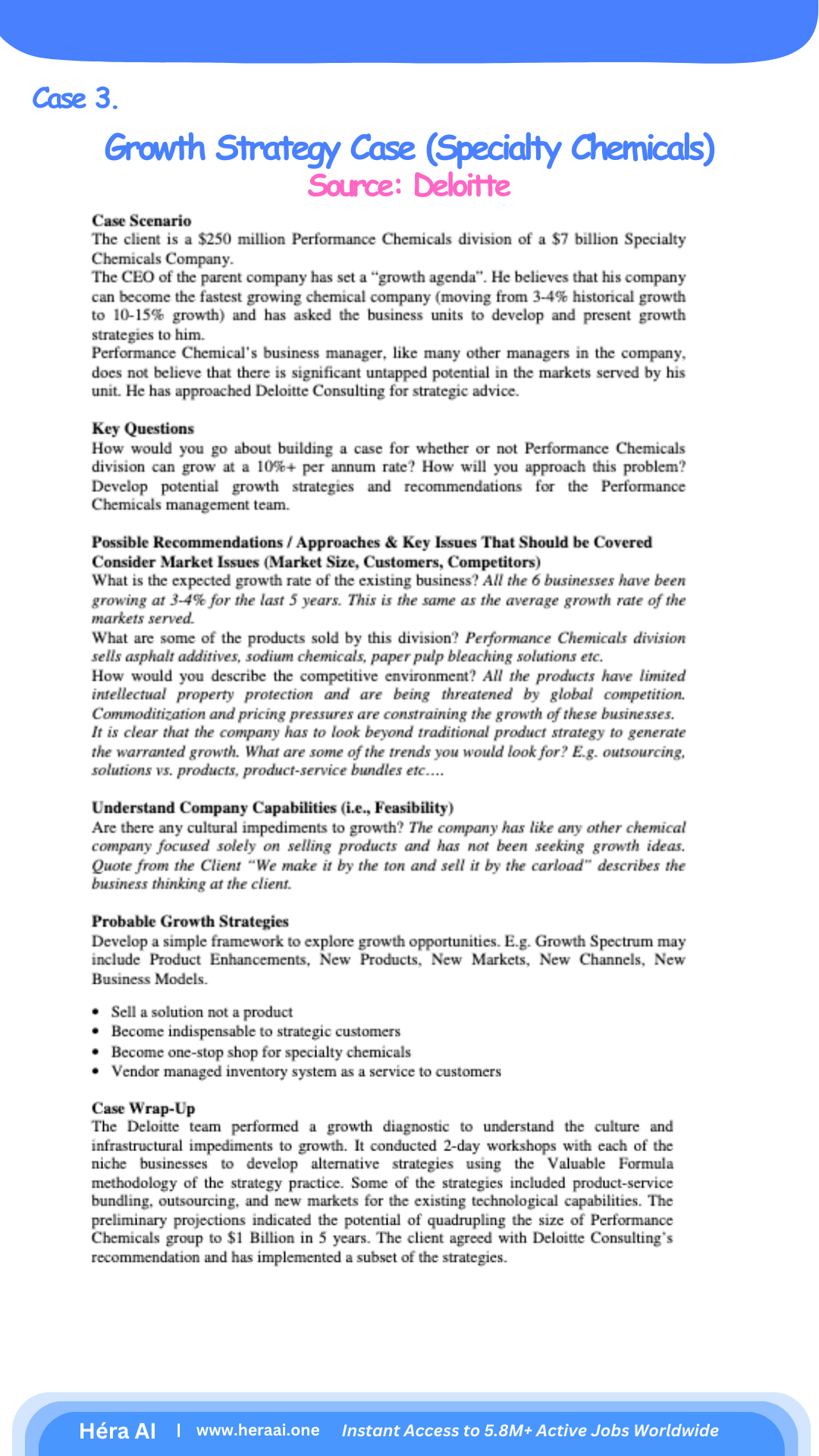
The setup is deliberate. Performance Chemicals' business manager does not believe significant untapped potential exists in his markets. He has approached Deloitte not to validate a growth plan — but to get external cover for a conservative position.
This is a classic consulting dynamic: the client is smart, experienced, and wrong in a specific, diagnosable way. Your first job is not to present a growth strategy. It's to establish why the client's mental model of the market is too narrow.
| The Client's Mental Model vs. The Consulting Reframe | |
|---|---|
| Client's view | Growth is limited by market size. We're already serving the available market at the available rate. 3–4% is what's possible. |
| The flaw | This assumes the only growth lever is penetrating existing markets with existing products. It excludes channel strategy, business model innovation, and cross-industry applications of existing technology. |
| The consulting reframe | The right question isn't 'can we grow faster in our current markets?' It's 'are we in the right markets, with the right model, capturing the right type of value?' Those are three separate questions with three separate answers. |
Interview Signal
When you encounter a skeptical client setup in a case, don't rush to agree or disagree. Name the mental model the client is operating from — and then explain specifically which assumption you're going to test first. That's the move that signals structured, senior-level thinking.
2. Market Diagnosis Comes Before Strategy — Always
Before any growth recommendation is credible, you need to understand the market environment producing 3–4% growth. In this case, the diagnosis reveals structural constraints that make traditional product strategy insufficient on its own.
| Market Diagnostic: What the Numbers and Context Reveal | |
|---|---|
| Growth rate match | The division's 3–4% growth exactly mirrors the average growth rate of its served markets. This is not underperformance — it's market-rate performance. That's an important distinction: the problem isn't execution, it's strategic positioning. |
| Product portfolio | Asphalt additives, sodium chemicals, paper pulp bleaching solutions. These are commodity-adjacent specialty chemicals — high technical barrier to entry historically, but increasingly exposed to global competition. |
| Competitive environment | Limited intellectual property protection. Products are being commoditized. Pricing pressure is structural, not cyclical. Global competitors can replicate at lower cost. |
| Cultural constraint | The business operates on a 'make it by the ton, sell it by the carload' philosophy. This is product-volume thinking — the exact mindset that prevents a services and solutions transition. |
💡 Expert Tip — The Diagnostic Question Hierarchy
3. The Growth Spectrum Framework — and How to Apply It Under Interview Pressure
Once the market diagnosis is complete, the case calls for a structured framework to explore growth opportunities systematically. A Growth Spectrum — ranging from lower-risk product enhancements to higher-risk new business model innovation — prevents the common mistake of jumping straight to the most dramatic option.
The critical discipline: each lever on the spectrum requires a different capability assessment. Product enhancements leverage existing R&D. New markets require channel and customer acquisition capabilities the company may not have. New business models require organizational and cultural transformation — which this company, by its own admission, is not currently built for.
| Applying the Growth Spectrum to Performance Chemicals | |
|---|---|
| Product Enhancements | Lowest risk. Extend existing asphalt additive and bleaching solution lines into adjacent performance specifications. Buys time but doesn't solve the commoditization trajectory. |
| New Markets | Apply existing chemical technology to industries currently underserved — construction materials science, industrial water treatment, agricultural chemical applications. Requires market entry investment but leverages existing IP. |
| New Business Models | The highest-impact lever. Shift from selling chemicals by volume to selling performance outcomes. Vendor-managed inventory, solution bundling, long-term service contracts. This is the move that separates a $250M product business from a $1B solutions business. |
Interview Signal
When applying a growth framework in a case, always connect each option to the client's specific capabilities and constraints — not just to abstract strategic logic. A new business model recommendation that ignores the 'make it by the ton' culture will get challenged immediately. The answer that wins the room acknowledges the constraint and proposes how to address it.
4. The Recommended Strategies — and the Reasoning Behind Them
Deloitte's approach was not to pick one growth lever — it was to run a structured diagnostic across all of them and identify the combination with the highest feasibility-to-impact ratio. The resulting strategy set reflects a deliberate progression from low-disruption to high-transformation.
🎯 Interview Tactic — The Feasibility Challenge
Real Interview Questions From This Case — and How to Answer Them
"How would you build a case for whether Performance Chemicals can grow at 10%+ per annum?"
"The business manager doesn't believe there's untapped potential. How do you handle that?"
What Deloitte Actually Did — and What It Teaches You
The Deloitte team ran a growth diagnostic to understand both the cultural and infrastructural impediments to growth. They conducted two-day workshops with each niche business unit — using the Valuable Formula methodology to develop alternative strategies unit by unit, rather than imposing a single top-down recommendation.
The output included product-service bundling, outsourcing partnerships, and new market applications for existing technological capabilities. Preliminary projections indicated the potential to quadruple Performance Chemicals from $250M to $1 billion within five years. The client agreed and implemented a subset of the strategies.
💡 The Meta-Lesson for Consulting Candidates
Growth Strategy Cases Reward Structured Diagnosis — Not the Fastest Route to Recommendations
The Performance Chemicals case is a master class in one of consulting's most important skills: the ability to tell a skeptical, experienced client something they don't already believe — and back it up with a framework rigorous enough that they can't dismiss it. That requires market diagnosis first, capability assessment second, and recommendation third. Never the other way around.
At HéraAI, we help candidates develop the diagnostic instincts and structural frameworks that make growth strategy cases — and the real client work they simulate — genuinely tractable.
This article is part of the Case Strategy Chamber series from HéraAI — Instant Access to 6.6M+ Active Jobs Worldwide.