The Sugar Beet Revolution: Why a 200% Yield Increase Isn't Always a Win
Vindaloo Biotech has doubled the sugar yield per beet. Most candidates see doubled revenue. The correct answer is a $5B cost-savings story — and the trap that eliminates 80% of applicants.
In biotech and agtech case interviews, 'breakthrough' almost always triggers the same instinct: more output means more revenue. It's the most natural framing — and in commodity markets, it is precisely wrong. Case 29 is designed to expose that instinct and replace it with the analytical framework that actually applies when demand is fixed.
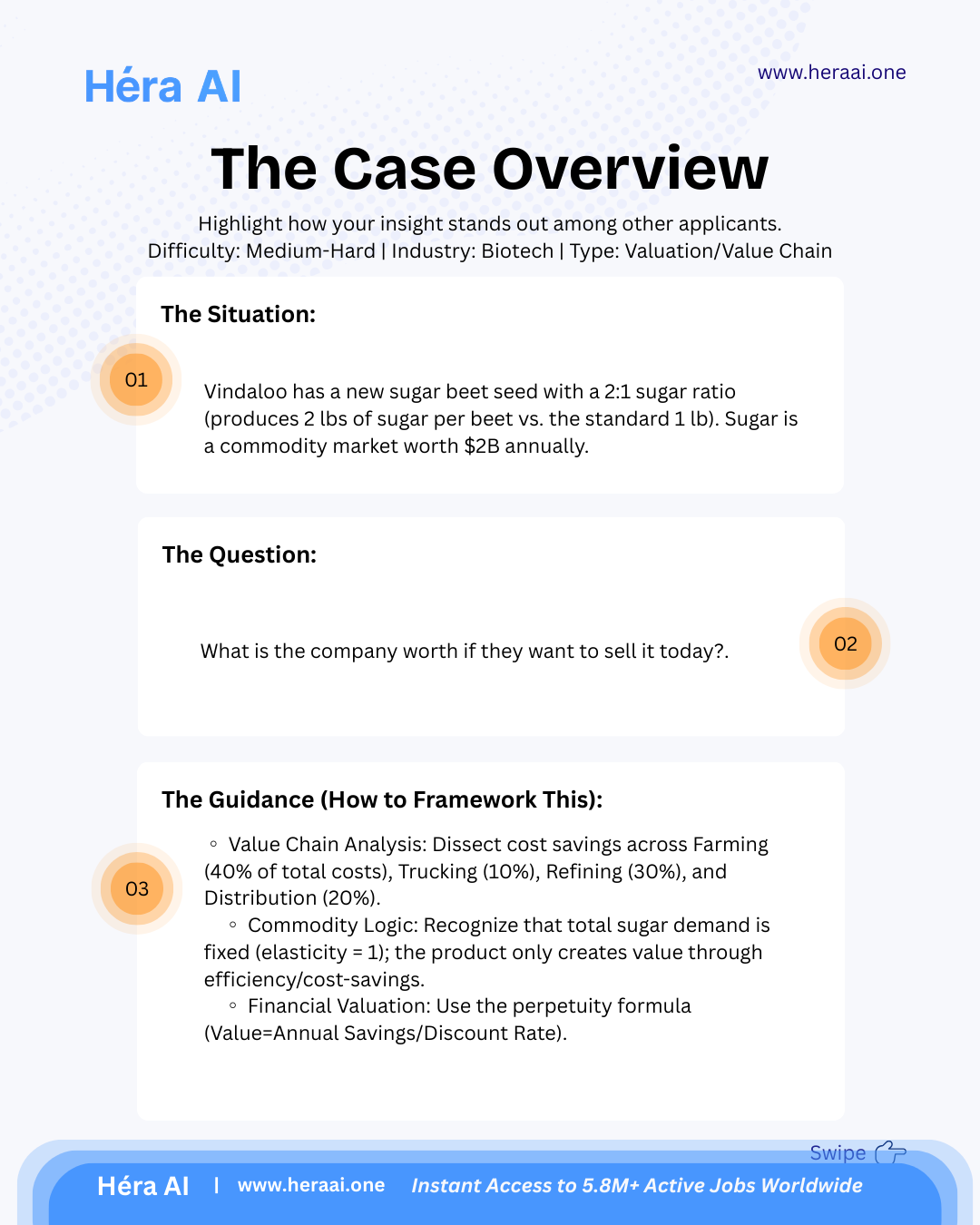
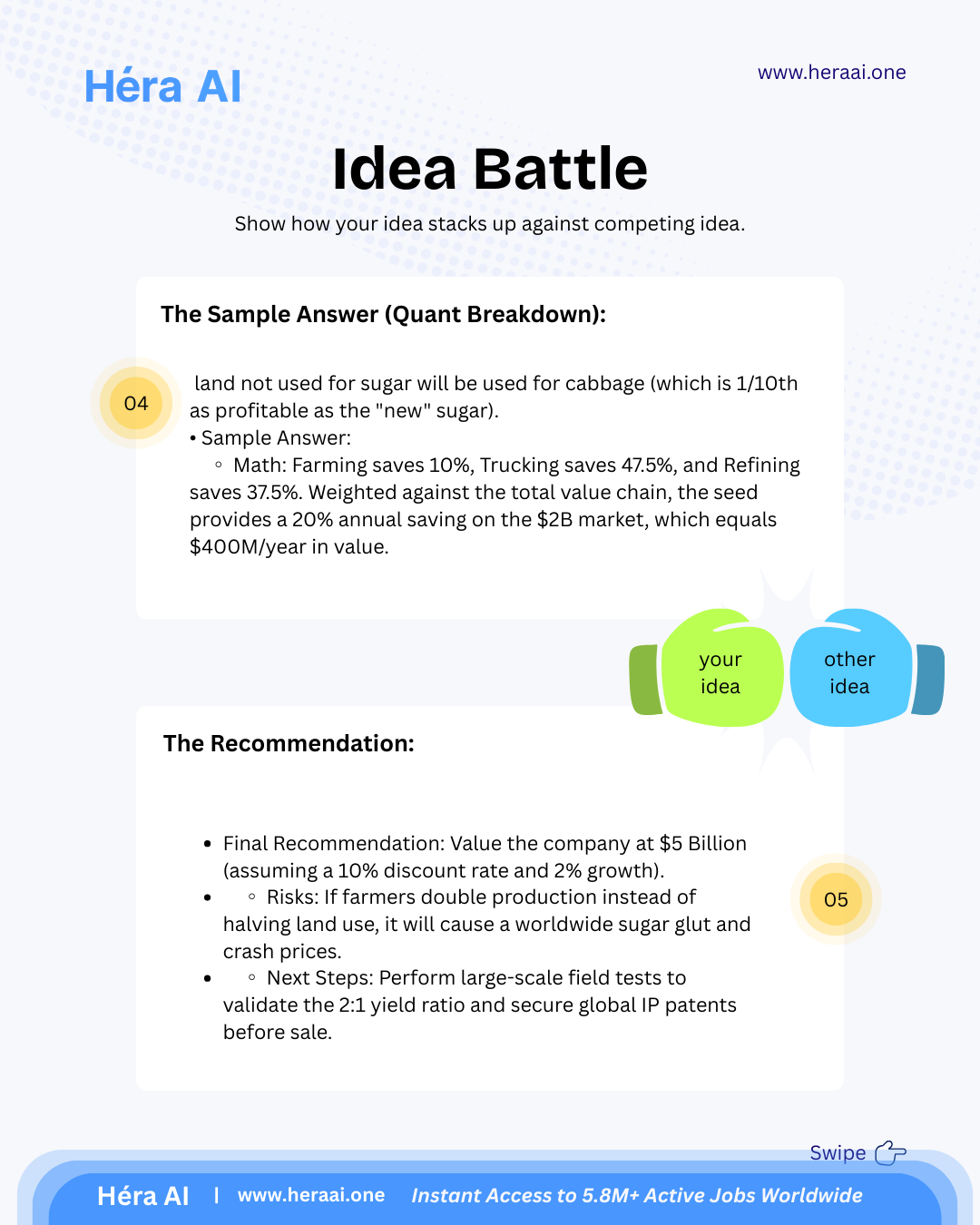
Vindaloo has engineered a sugar beet that produces 2 lbs of refined sugar instead of the standard 1 lb. The global sugar market is worth $2B per year. On the surface, this looks like a technology that doubles the market. The correct analysis shows it does something more valuable and more defensible: it compresses the cost structure of a $2B industry by approximately 20% — generating $400M per year in durable, IP-protected savings. That is the $5B asset.
This is Case 29 in HéraAI's Case Strategy Chamber series. Here is how a top-tier consulting candidate structures the analysis — and the five traps the case is designed to surface.
The Reframe That Decides the Case: Fixed Demand, Variable Cost
The first analytical question in any market entry or technology valuation case is: what type of market is this? In a growth market, innovation creates value through revenue expansion — new customers, new use cases, higher penetration. In a commodity market with fixed or inelastic demand, that mechanism does not apply.
Sugar has a demand elasticity of approximately 1. Consumers do not put more sugar in their coffee because sugar becomes cheaper. Food manufacturers do not reformulate their products on a short timeline in response to price changes. The total market stays at roughly $2B regardless of how efficiently Vindaloo's beet produces the supply. All of the value created by the innovation lives on the cost side of the ledger — not the revenue side.
The reframe that wins the case: The moment a candidate says 'in a commodity market with fixed demand, the value of this technology is entirely in cost savings — not revenue growth' they have demonstrated the analytical lens the case is designed to test. Everything that follows is quantification. The reframe is the insight.
Mapping the Value Chain: Where the Savings Live
Once the cost-savings lens is established, the analysis requires mapping the full value chain and identifying where Vindaloo's technology changes input requirements at each stage. The key principle: savings only exist where the seed's properties — specifically, doubled sugar concentration per beet — reduce the physical inputs required to produce the same output volume of refined sugar.
The value chain has four stages with different cost shares and different sensitivity to the seed's yield improvement. The table below models the savings decomposition across each stage.
The distribution stage is the analytical precision point most candidates miss. Distribution costs are based on the weight of refined sugar delivered — 1 lb of sugar is 1 lb of sugar regardless of how many beets it took to produce it. Downstream logistics are entirely unaffected by the upstream yield improvement. Candidates who apply a blanket 50% savings across all four stages are overcounting by approximately $80M — and will be challenged on it.
The trucking 'dead weight' argument — the senior insight: The largest proportional gain in the value chain is not in farming — it's in trucking, relative to its cost base. Today, a truck carries 1 tonne of beets to extract approximately 200 lbs of sugar. With Vindaloo's seed, the same tonne of beets yields 400 lbs. Half the truck trips are required for the same sugar output. The 'dead weight' being eliminated — the non-sugar mass of the beet transported to the refinery — is the clearest illustration of why this innovation creates value even though it cannot create more sugar demand.
The Perpetuity Valuation: From Annual Savings to Enterprise Value
With $400M in annual cost savings established, the valuation uses the Gordon Growth Model — a growing perpetuity formula appropriate for a stable, IP-protected cash flow stream in a mature market. The formula: Value = Annual Cash Flow ÷ (Discount Rate − Terminal Growth Rate).
The base case uses a 10% WACC — reflecting the biotech risk premium — and a 2% terminal growth rate, consistent with long-term sugar market growth. The table below presents the base case and three sensitivity scenarios that bound the valuation range.
The sensitivity analysis is not a formality — it is the argument. A $5B point estimate presented without bounds is not a valuation; it is a number. The scenarios that matter most are the downside cases: partial savings realization due to incomplete acreage reduction ($4B), and the glut scenario in which commodity price erosion eliminates most of the modeled saving ($2.5B). Presenting these scenarios proactively demonstrates the discipline to stress-test your own analysis.
When to use perpetuity vs. DCF in a case: In case interviews, use the perpetuity formula when the cash flow is recurring, relatively stable, and expected to continue indefinitely — as with a licensing fee on a widely-adopted agricultural technology. Use a full DCF model when cash flows have a defined finite life, significant near-term volatility, or a terminal event (sale, patent expiry, market saturation). For Vindaloo, the perpetuity is the correct anchor — with the caveat that the patent lifecycle creates a finite protection window that should be noted.
The Risks the Board Must Address
A $5B valuation is a ceiling that rests on specific assumptions. Two of those assumptions — that farmers will reduce acreage and that the patent will hold — are not guaranteed. The risk register below captures the factors that could compress the valuation and the mitigation strategies that address each one.
The supply glut risk is the most important conversation in the board presentation. The entire valuation model depends on the market not being oversupplied. A farmer who adopts the new seed and maintains current acreage produces twice as much sugar — and the price mechanism does the rest. For the savings to materialize, the aggregate farming sector must reduce planted area by approximately 50%. This requires either market price signals strong enough to drive voluntary reduction, or contractual licensing terms that enforce it. Vindaloo's go-to-market strategy should address this directly.
The Five-Step Interview Framework
The table below consolidates the full case approach for interview preparation. Each step includes the analytical action, the common trap, and the framing that demonstrates senior-level commercial judgment.
The principle that governs every commodity valuation case: In a commodity market, efficiency is the product. The company that wins is not the one with the highest output — it is the one with the lowest cost to produce an equivalent output. Vindaloo's innovation is not that it grows more sugar. It is that it grows the same amount of sugar for less land, fewer trucks, and less factory time. That is a $5B idea. A seed that simply grows more sugar in a market that cannot absorb more sugar is not a business — it is a science project.