The Consolidation Play: Rescuing Orrington Office Supplies
A $275M manufacturer running at 50% capacity across three plants. The fix isn't more sales — it's fewer factories. How to triple pre-tax profit through structural cost surgery.
In manufacturing turnaround cases, the most dangerous first instinct is to look for growth. If a company is struggling with falling profits, the natural response is to ask how it can sell more. In high-fixed-cost businesses running at half capacity, that instinct is precisely backwards — and the case is designed to expose it.
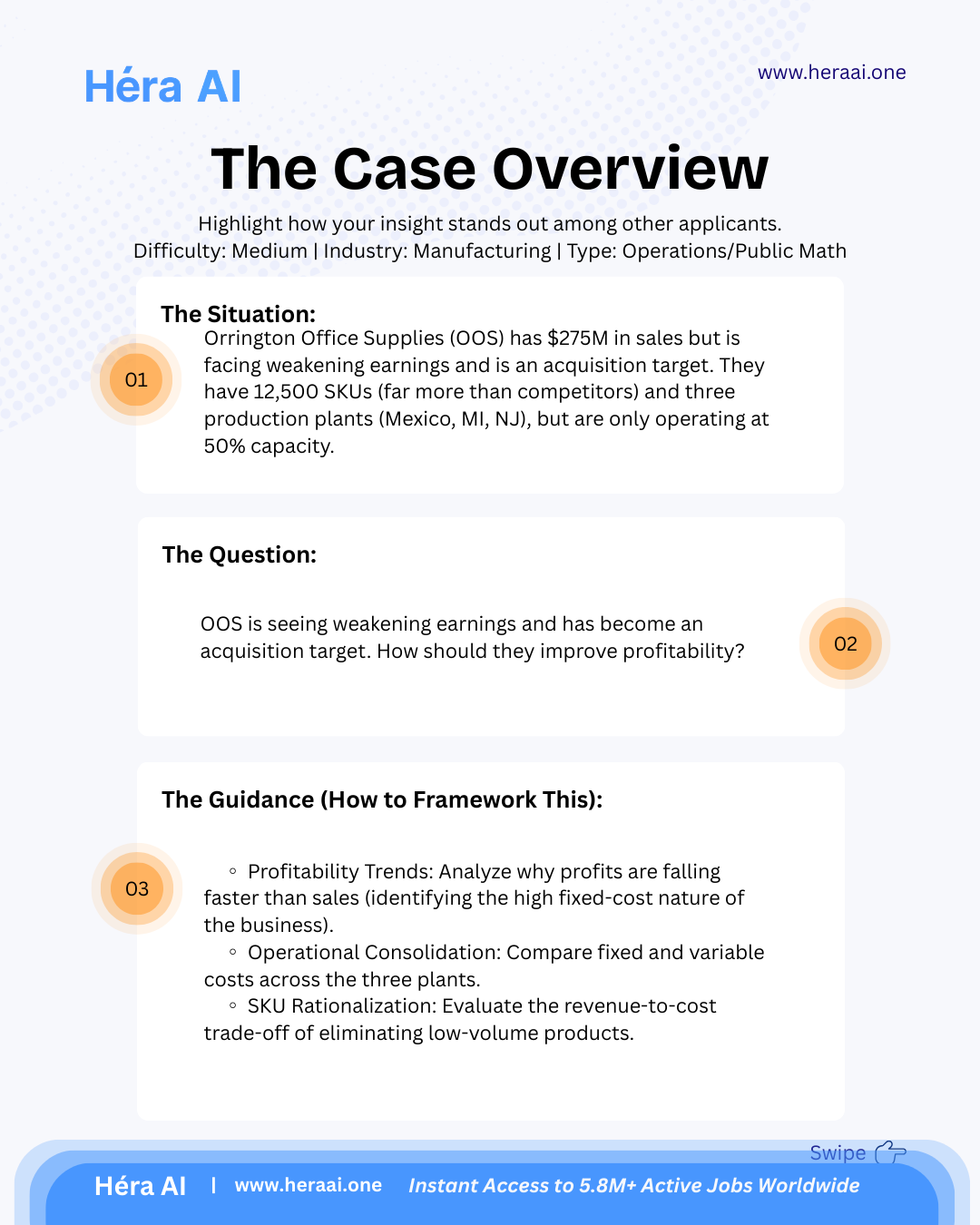
Orrington Office Supplies is a $275M manufacturer with 12,500 SKUs and three production plants in Mexico, Michigan, and New Jersey. All three plants are running at approximately 50% capacity. Profit is thin and deteriorating. The company is approaching acquisition target territory. The question is not how to grow OOS — it is how to restructure it so that the revenue it already has generates a defensible margin.
This is Case 28 in HéraAI's Case Strategy Chamber series. The answer involves closing two of the three plants, rationalizing the SKU catalog, and centralizing production in Mexico. Pre-tax profit triples from $25M to $82M — without a single dollar of revenue growth. Here is how to structure the analysis.
Step 1 — Diagnosing the High Fixed-Cost Trap
The first analytical move in any manufacturing profitability case is to separate fixed costs from variable costs — and then determine whether the fixed cost structure is sized for the actual volume level the business is running at. In OOS's case, the answer is stark: the company is paying for three full-scale manufacturing plants while running each at 50% utilization.
This is not a revenue problem. Revenue at $275M is stable. It is a structural cost problem — one that cannot be solved by selling more product unless revenue can be grown fast enough to fill capacity across all three plants simultaneously, which is an aggressive assumption in a mature office supply market. The table below maps the P&L to the diagnostic.
The diagnostic question that reframes the entire case: At what utilization level does the current fixed cost structure become viable? In OOS's case, the fixed costs are sized for a business running at close to 100% capacity across three plants. At 50%, the company is carrying approximately $42M in excess fixed cost annually — the cost of one full plant that adds no incremental production value. That is the gap the consolidation closes.
Step 2 — SKU Rationalization: Clearing the Path for Consolidation
Before any plant can be closed, the production complexity that requires three plants must be addressed. OOS operates 12,500 SKUs — a catalog that is significantly broader than most competitors in the office supply space. That breadth means frequent production changeovers, complex scheduling, distributed inventory, and a manufacturing footprint that requires multiple facilities to manage effectively.
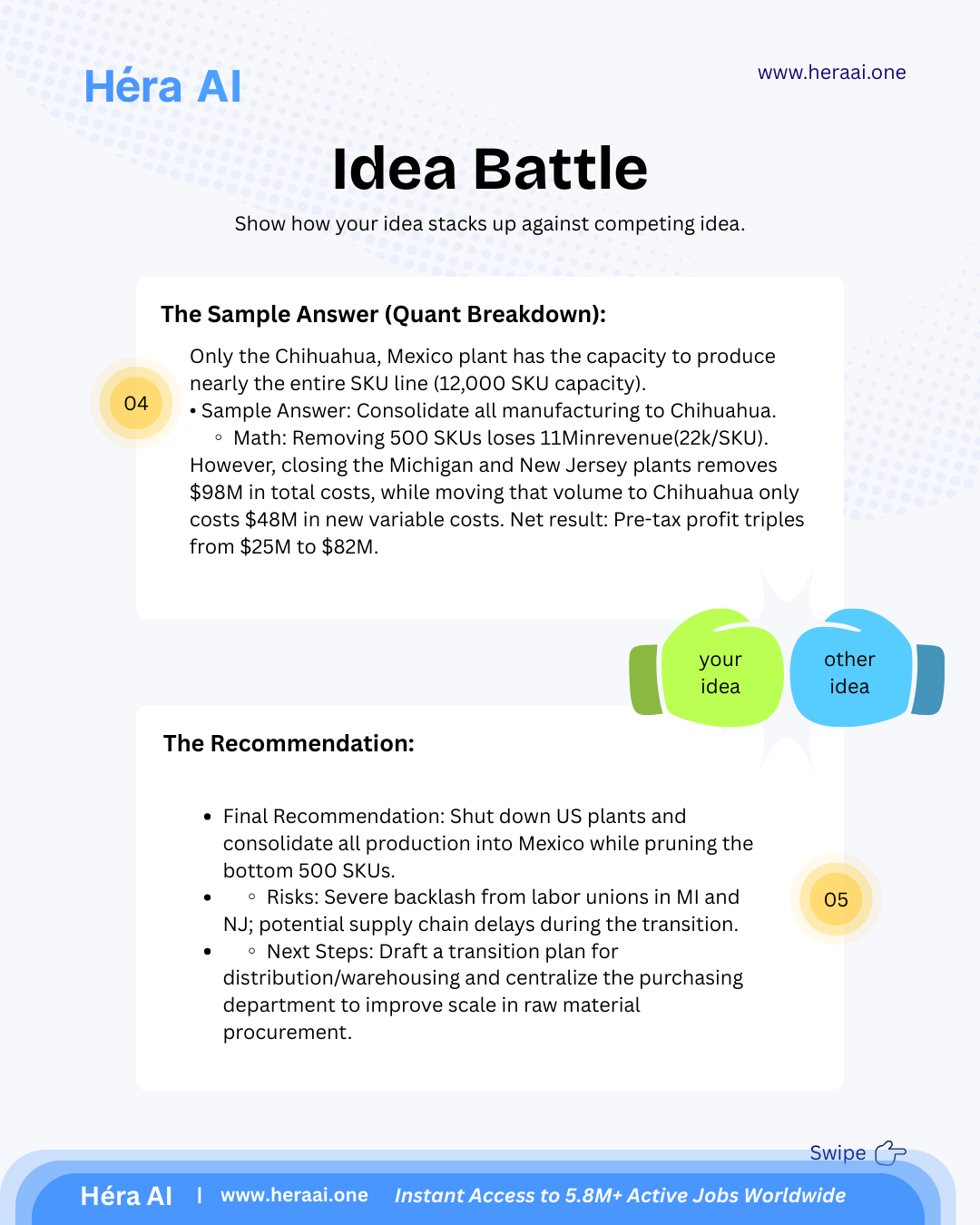
The 80/20 analysis reveals that the bottom 500 SKUs — approximately 4% of the catalog — represent a disproportionate share of operational friction for a small share of total revenue. Removing them costs $11M — acceptable in the context of a $57M profit improvement — and directly enables the consolidation by reducing catalog complexity to a level the Chihuahua plant can absorb alone.
The sequencing insight that separates good from great: SKU rationalization must come before plant consolidation in the analysis — not as an afterthought. A candidate who recommends closing the US plants without first confirming that the Mexico plant can handle the full catalog complexity is presenting a recommendation with an unvalidated execution assumption at its core. The sequence is: simplify the catalog → confirm Mexico can absorb it → then close the US plants.
Step 3 — Evaluating the Three-Plant Network
With the SKU catalog rationalized to 12,000 products, the question becomes which plant or plants to retain. The network evaluation considers cost structure, capacity, geographic positioning, and workforce risk. The answer points clearly to Chihuahua as the consolidation hub — but understanding why Michigan and New Jersey must close, and what the closure risks are, is what the interviewer is probing.
The critical validation step before recommending closure of the US plants: confirm that Chihuahua's actual capacity — not assumed capacity — can absorb the consolidated volume across 12,000 SKUs at the required service levels. This is not a financial modeling question. It is an operational due diligence requirement. The recommendation is only as sound as this validation.
Step 4 — The P&L Bridge: From $25M to $82M
The profit improvement story is most powerfully told as a bridge — a line-by-line walk from the current $25M baseline to the $82M post-consolidation outcome. Each line has a specific driver and a specific calculation logic. Walking through it explicitly, rather than announcing the result, demonstrates both analytical rigor and communication clarity.
The net economics of the consolidation: $98M in fixed cost savings from the US plant closures, minus $48M in incremental Mexico variable costs to handle the additional volume, minus $11M in revenue from SKU rationalization, plus the $25M baseline = $82M. The Mexico variable cost is lower than the US fixed cost removal because the marginal cost of incremental production at an already-operational, lower-cost facility is fundamentally different from the full fixed cost burden of maintaining a separate plant. This is the geographic arbitrage at the heart of the case.
The arithmetic that interviewers probe: Why is the Mexico incremental cost only $48M when we're moving the equivalent of two US plants worth of volume? Because Chihuahua already has the fixed cost infrastructure in place. The $48M represents only the variable cost increment — materials, labour hours, and logistics for the additional volume. There is no new rent, no new machinery, no new plant management. The fixed cost of the Mexico plant is already embedded in the baseline. This distinction is the crux of the geographic arbitrage argument.
Step 5 — The Risks That Can Sink a Mathematically Sound Recommendation
The P&L bridge shows a compelling financial outcome. The question the interviewer is waiting for is whether the candidate understands that financial models don't close plants — people, unions, regulators, and supply chains do. The risks below are not edge cases. They are execution conditions that determine whether the $82M outcome is achievable in practice.
The labor union risk deserves the most airtime in the board presentation — not because it is the largest financial risk, but because it is the risk with the most asymmetric downside. A poorly managed union negotiation can result in work stoppages at the US plants during the transition period, damaging customer relationships and potentially triggering contract penalties that dwarf the severance cost. The CEO who announces the closures without a pre-negotiated transition plan is presenting a strategy, not an execution plan.
The Five-Step Interview Framework
The table below consolidates the full case structure for interview preparation. Each step includes the analytical action, the common trap, and the framing that demonstrates the judgment difference between a good answer and a consulting offer.
The principle that governs every manufacturing turnaround case: You cannot grow your way out of a broken cost structure. When fixed costs are too high relative to the revenue the business generates, the only solutions are to increase volume significantly (hard and uncertain), reduce fixed costs structurally (consolidation), or accept a declining margin trajectory. OOS cannot grow fast enough to justify three underutilized plants. The consolidation is not the aggressive option — it is the only analytically defensible one. The candidate who sees that clearly, before being prompted, is demonstrating exactly the commercial judgment that MBB firms are hiring for.