The Pricing Surgery: Unlocking Alpha in Mature Wholesale Markets
A global food wholesaler. Flat GDP-rate growth. A North American duopoly and a fragmented Asia. The answer isn't a price change — it's a portfolio of elasticities.
In a mature industry growing at the rate of GDP, most executives exhaust two options before calling a consultant: cut costs and market harder. Both are table stakes. Neither addresses the actual source of hidden profitability in a mature business — the pricing architecture applied to an unevenly elastic product catalog.
Case 27 puts you in the seat of a consultant advising a global food wholesaler serving hotels and restaurants across North America and Asia. Revenue growth is flat, tied to macroeconomic conditions. The client has been applying regional average pricing across its full product range. The insight that unlocks the case — and the one most candidates miss — is that a single pricing strategy applied across thousands of SKUs in two structurally different market environments is not a pricing strategy. It is pricing negligence.
The solution is micro-elasticity mapping: plotting every SKU on a demand elasticity versus gross margin matrix and applying a different pricing lever to each quadrant. The result is a portfolio of pricing moves that simultaneously expands margin on sticky products and captures market share on elastic ones — without requiring a single unit of new revenue from new customers.
The Competitive Physics: Why One Strategy Cannot Serve Two Markets
Before any SKU is plotted or any price is changed, the case requires establishing that North America and Asia are not the same type of market. This is not a geographic observation — it is a structural one. The competitive physics of a duopoly and a fragmented market are fundamentally different, and any pricing move that ignores that difference will either underperform or actively damage the client's position.
The market structure insight the interviewer is waiting for: In a duopoly, you have one competitor to model and one set of responses to anticipate. Price cuts can be surgical and targeted. In a fragmented market, you have dozens of competitors with different cost structures and different levels of price discipline. A list price cut in Asia is not a competitive move — it is an invitation to a race to the bottom where only the lowest-cost operator wins. Naming this distinction before the interviewer prompts it demonstrates market-level strategic thinking.
The Elasticity-Margin Matrix: A Portfolio of Pricing Levers
The analytical core of this case is a two-axis matrix. The horizontal axis plots demand elasticity — how sensitively volume responds to a price change. The vertical axis plots current gross margin per SKU. The four quadrants that result each represent a different pricing opportunity, and each requires a different strategic action. Applying the same action across quadrants destroys value in at least two of the four.
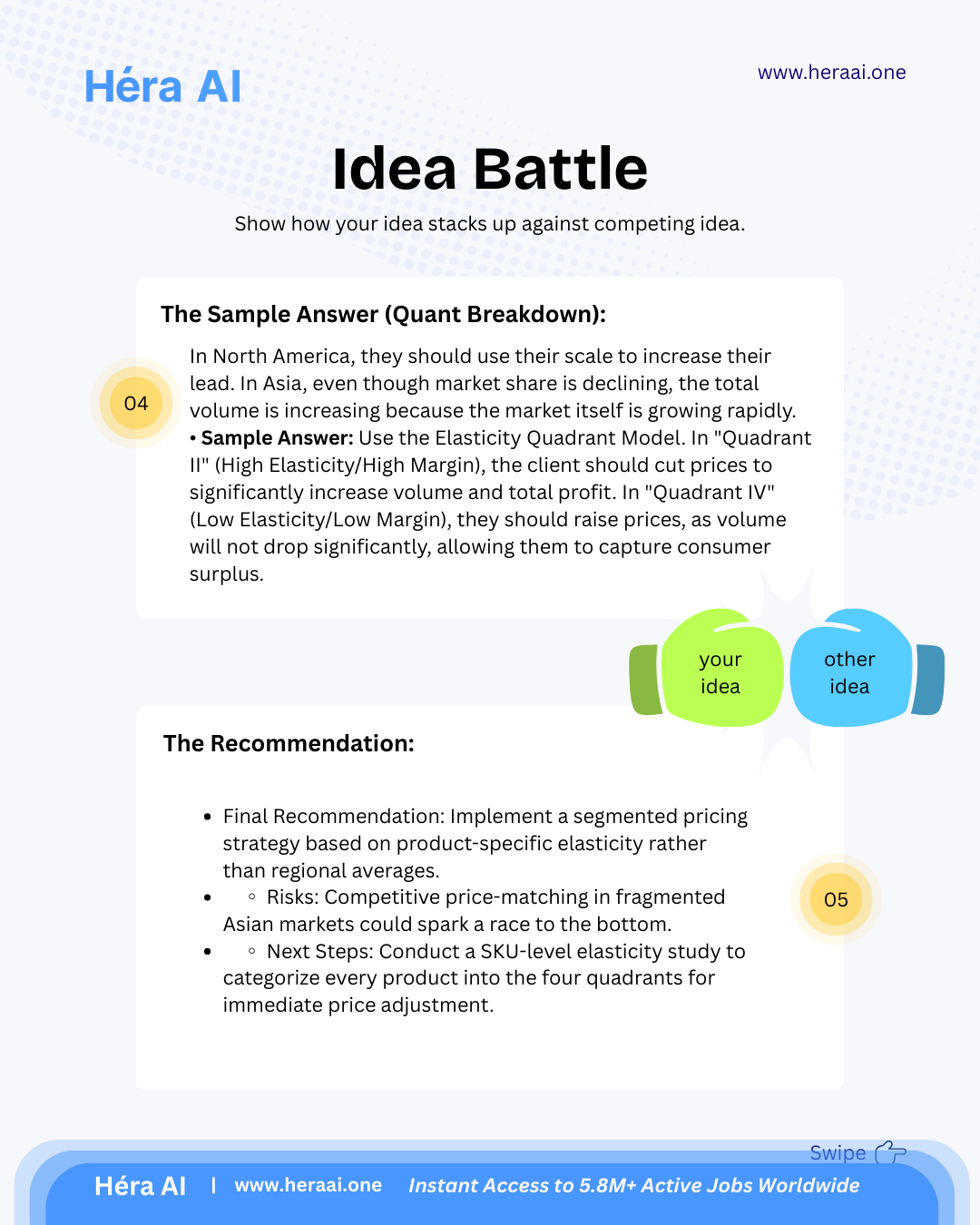
The counter-intuitive insight that separates a good answer from a great one: the highest-priority pricing action in this case is not the one that cuts prices to gain volume — it is the one that raises prices on sticky, low-margin SKUs to capture consumer surplus that the current cost-plus pricing model has been leaving on the table for years.
The consumer surplus concept is the microeconomic foundation of the Quadrant IV recommendation. Consumer surplus is the gap between what a buyer would be willing to pay for a product and what they are actually charged. For a specialty condiment that a chef considers non-negotiable in a signature dish, the willingness to pay may be substantially higher than the current list price — especially if the price is small relative to the dish's overall cost and the switching friction is high. Cost-plus pricing systematically underprices these SKUs. The elasticity matrix identifies them precisely.
The experience curve compounding mechanism — the senior-level close: The North America price-cut strategy creates a self-reinforcing advantage over time. Volume growth from share capture increases the client's purchasing scale, which enables COGS renegotiation with suppliers, which improves the underlying unit economics, which funds further price cuts. A competitor who matches the price cut does not also receive the COGS improvement — only the higher-volume operator does. This is the experience curve feedback loop, and naming it transforms the pricing recommendation from a tactical move into a structural competitive moat argument.
Implementation Risks: Where Consultants Fail
The elasticity-margin matrix is a compelling framework. Its credibility in a board presentation — and in a case interview — depends on whether the candidate has thought through the conditions under which it fails. There are five implementation risks specific to this case. Addressing them proactively is what separates an expert-level answer from a good-level one.
The data granularity risk is the most foundational. A client that tracks profitability by category — fresh produce, dry goods, proteins — cannot execute a SKU-level pricing strategy. The matrix requires SKU-level price sensitivity data, which most food wholesalers do not currently have in a form that supports elasticity estimation. The first action in the recommendation must always be the data audit — not the price change.
The Sequenced Recommendation
The recommendation is not a single pricing action. It is a sequenced program that builds from a data foundation through short-term margin improvement to medium-term market share capture. The sequence matters: each phase creates the conditions for the next, and executing out of order — beginning with North America price cuts before the cash reserve from Quadrant IV price increases has been built — exposes the client to margin risk before the share gains materialize.
Why the sequence is the recommendation: A candidate who presents the correct moves but in the wrong order — cutting North America prices before raising Quadrant IV prices — is recommending a strategy that creates short-term margin pressure before the offsetting gains arrive. The interviewer will ask: 'How do you fund the North America price cuts while waiting for volume to grow?' The answer is: you fund them with the margin improvement from Quadrant IV. That sequencing logic is what makes the recommendation internally consistent.
The Five-Step Interview Framework
The principle that governs every mature market profitability case: In mature markets, you do not find profit by doing something new. You find it by pricing what you already have more intelligently. The client has been treating its entire product catalog as one business, applying regional average pricing that leaves consumer surplus on every sticky SKU and misses share-capture opportunities on every elastic one. The elasticity-margin matrix does not create new value — it reveals the value that the current pricing architecture has been systematically destroying. That reframe is the analytical contribution of the consulting engagement.