The Energy Transition: Balancing Court Mandates with Market Returns
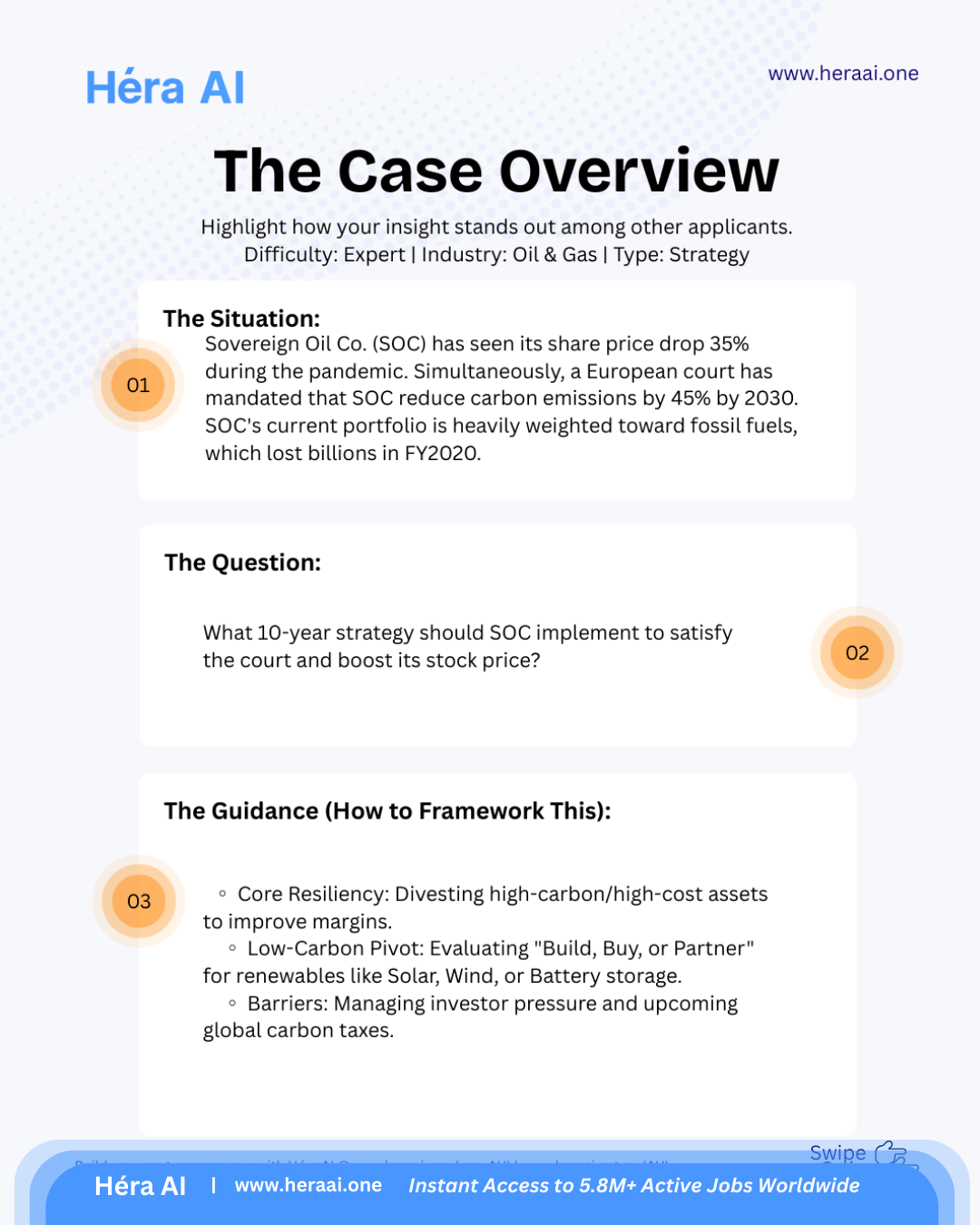
A European oil major faces a 45% emissions cut by 2030 and a stock price down 35%. The answer is not green vs. oil — it is resiliency through transformation.
Expert-level strategy cases are designed to expose a specific cognitive failure: the tendency to treat two simultaneous constraints as inherently in conflict when a deeper analysis reveals they converge. Case 26 is built on exactly this structure. Sovereign Oil Co. faces a court-mandated 45% carbon reduction and a stock price down 35%. Most candidates spend the case trying to balance these two forces. The insight that earns the offer is recognising that they do not need to be balanced — they need to be synthesised.
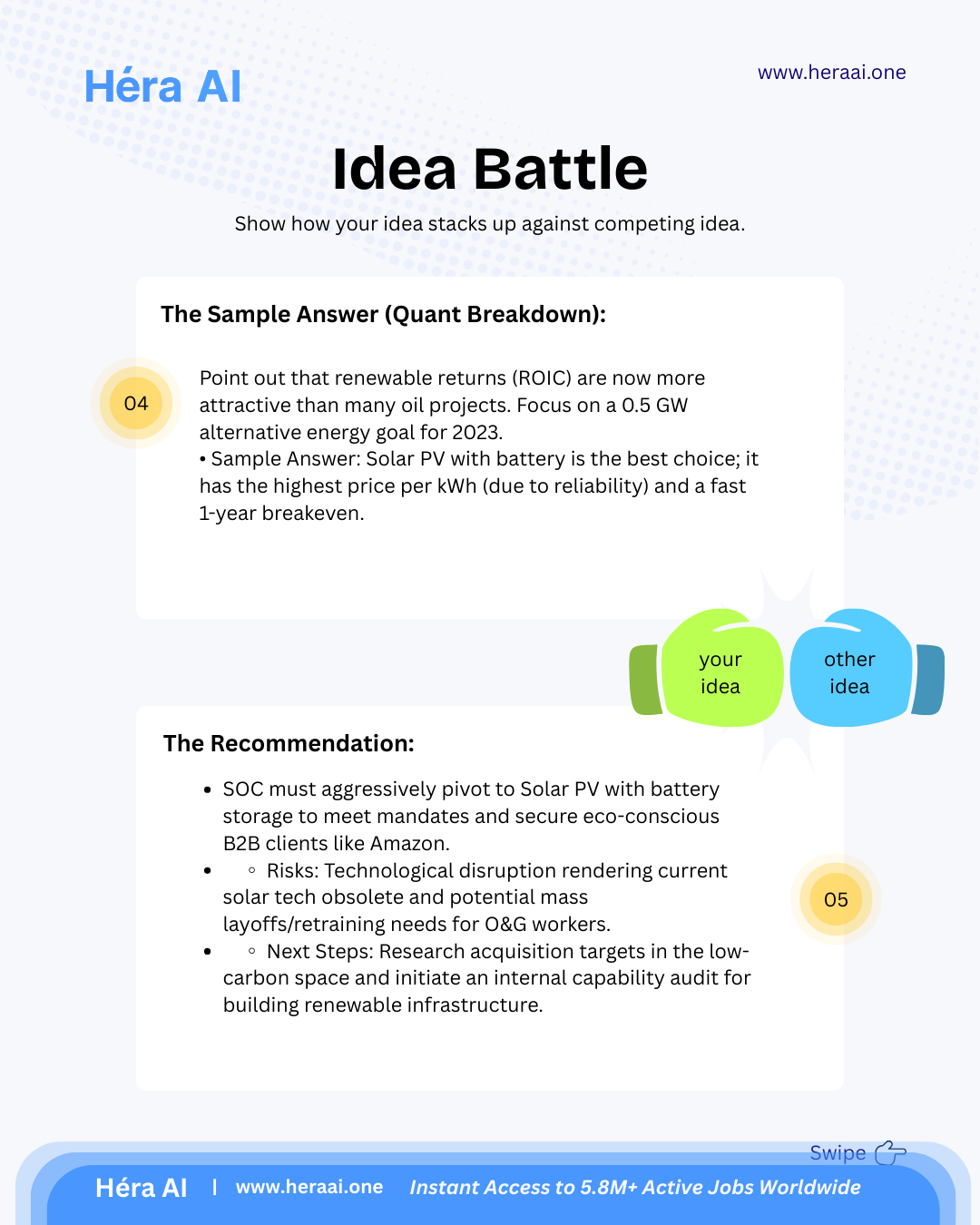
The synthesis: the same capital reallocation that satisfies the court mandate — divesting high-carbon assets and deploying proceeds into solar PV with battery storage — also generates the ROIC improvement and ESG-aligned revenue growth that restores institutional investor confidence and recovers the share price. The legal constraint and the shareholder constraint converge at the renewable investment thesis.
This is Case 26 in HéraAI's Case Strategy Chamber series. It requires command of capital markets logic, energy sector economics, ESG regulatory frameworks, and workforce transition strategy simultaneously. Here is how to structure it.
The Dual Constraint: Why This Case Is Expert-Level
The reason Case 26 is classified as expert-level is not the technical complexity of the renewable energy analysis. It is the requirement to hold two simultaneous constraints — a legal mandate and a shareholder value obligation — without sacrificing one for the other. Most candidates default to one of two failure modes: they optimise for compliance at the cost of shareholder return, or they optimise for shareholder return while treating the mandate as a cost centre. Neither produces a defensible recommendation.
The table below maps both constraints across six dimensions, with a final row that identifies where they converge. That convergence is the strategic premise of the entire recommendation.
The synthesis that defines the expert answer: Renewable ROIC now frequently exceeds new O&G project returns — particularly for solar PV with battery storage in markets with strong B2B demand. This means the asset that satisfies the court mandate is also the highest-return capital allocation available to SOC. The legal constraint and the shareholder constraint are not in tension. They are pointing at the same investment.
The Technology Selection: Why Solar PV + Battery Storage
The court mandate requires actual emissions reduction, not offset accounting. That means SOC must build or acquire generating capacity that displaces fossil fuel production in its revenue mix. The technology selection must be defended on three dimensions that matter in a capital allocation context: ROIC relative to O&G alternatives, breakeven timeline relative to the 2030 mandate deadline, and commercial alignment with the demand profile of SOC's target B2B customers.
The carbon offset option deserves explicit rejection rather than omission. Purchased carbon offsets do not reduce SOC's actual emissions — they compensate for them on paper. European courts and regulators are increasingly treating offset-reliant strategies as non-compliant with the spirit of emissions reduction mandates. More critically, institutional investors with genuine ESG mandates are applying a discount to companies whose sustainability claims rest on offset purchases rather than operational decarbonisation. Recommending offsets as a primary strategy in this case signals a failure to understand the regulatory and market direction.
The B2B premium argument — the commercial case for the technology choice: Solar PV with battery storage enables 24/7 firm power delivery — always-on, dispatchable clean energy that intermittent wind or solar-only systems cannot provide. Hyperscale data centres, which have committed to 100% carbon-free energy on an hourly matching basis, require firm power not spot-market renewable certificates. SOC's ability to offer guaranteed clean supply, backed by battery storage, enables it to charge a premium above spot market rates through long-term power purchase agreements. The reliability of the technology is not just an engineering characteristic — it is the commercial justification for the price premium.
The Three-Phase Resiliency Framework
The recommendation is not a single investment decision — it is a sequenced transformation programme. The sequence matters because each phase creates the financial and operational conditions that make the next phase viable. A strategy that begins with renewable investment before completing the divestment has an underfunded capital base. A strategy that completes the divestment without beginning the capability build has a compliance gap in the final years before the 2030 deadline.
The build-buy-partner trifecta and why it is faster than organic development: SOC's primary capability gap in the transition is not capital — it is operational expertise and permitted project pipeline. Building organically from scratch requires years of permitting, grid connection queue navigation, and operational learning. Acquiring established renewable developers brings permitted capacity, grid connections, operational teams, and project management experience immediately. Partnering with joint venture developers allows SOC to gain operational knowledge before committing full capital. The three-mode approach compresses the transition timeline by 2–3 years compared to organic development alone — which matters when the compliance deadline is fixed at 2030.
The B2B Commercial Strategy: Securing the Revenue Premium
SOC's transition from fossil fuel revenue to renewable revenue requires more than building the right technology — it requires building the right customer relationships. The revenue premium that makes solar PV with battery storage financially compelling relative to spot-market renewable generation depends on securing long-term power purchase agreements with corporate buyers who have their own ESG commitments and need verified clean energy supply.
The B2B strategy is not a marketing decision — it is a project finance decision. Long-term PPAs with investment-grade counterparties (Amazon, Microsoft, major logistics operators) provide the revenue certainty that enables SOC to finance renewable projects at lower cost of capital. A project backed by a 10-year PPA with a creditworthy counterparty carries significantly lower financing risk than a project selling into the spot market, which directly improves the project's ROIC and the company's overall financial profile.
The Transition Risks the Board Must Address
A transformation of this scale and speed carries execution risks that can derail a financially sound strategy. The expert-level candidate addresses these proactively rather than waiting to be prompted.
The workforce dislocation risk is the one most candidates mention but few develop fully. The insight that distinguishes expert-level thinking is recognising that O&G workers are not simply a cost to be managed in the transition — they are a competitive asset to be retrained and redeployed. Large-scale renewable infrastructure projects require exactly the project management expertise, safety culture, and remote operations capabilities that O&G workforces possess. A retrained O&G workforce gives SOC a talent advantage over pure-play renewable developers who are competing in the same labour market.
The Five-Step Interview Framework
The principle that defines the expert answer in this case: In expert-level strategy cases, the answer is never 'Green vs. Oil.' It is resiliency through transformation. SOC's 35% stock price decline is not caused by the court mandate — it is caused by investors repricing a fossil-fuel-heavy portfolio in a world where the regulatory, carbon tax, and customer demand environment is structurally shifting against it. The transition is not the threat to shareholder value. The failure to transition is. A candidate who sees that clearly, and builds a recommendation around the convergence of the compliance obligation and the investment thesis, has answered the case at the level that consulting interviews are designed to find.