Case 25: The $20,000 Harvest — Yield vs. Reality in Agribusiness
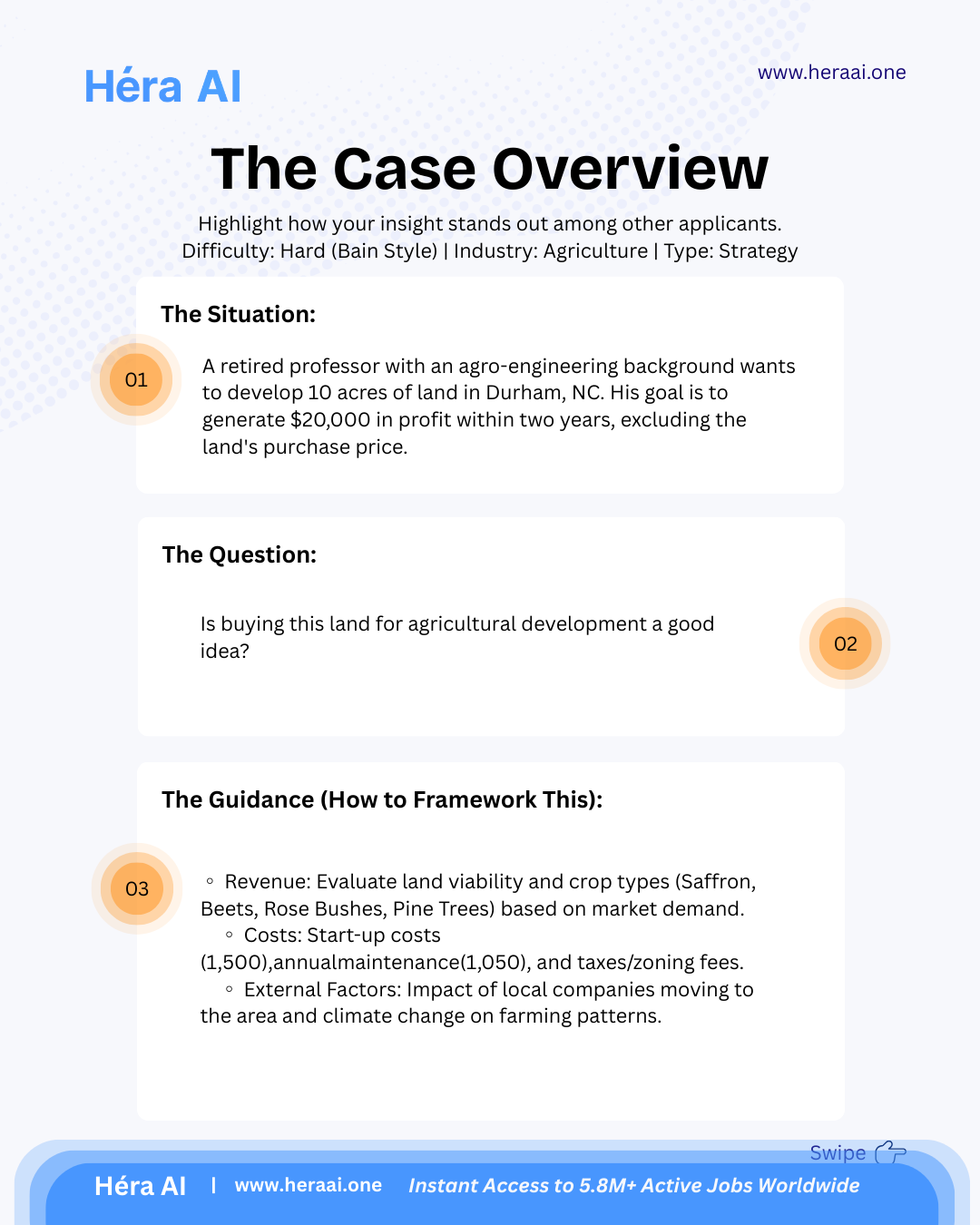
A retired professor. Ten acres in Durham, NC. A two-year deadline. The numbers almost work — which is exactly what makes this case dangerous.
This case is designed to look like an optimisation problem. Assign the right crops to the right acreage, maximise yield per acre, hit $20,000. Most candidates approach it exactly that way — and most candidates get it wrong, not because their arithmetic is off, but because they are solving the wrong problem.
The real question in Case 25 is not 'what is the optimal crop mix?' It is 'does this investment meet its hurdle rate, and what is the risk-adjusted return?' The $20,000 target is not a revenue target — it is the minimum acceptable profit required to justify the investment. The moment you reframe it as an ROI problem rather than an optimisation problem, the entire analytical structure changes.
The case is further complicated by two embedded traps. The first is the saffron trap: high yield per acre but a regional market that may not absorb five acres of supply at the assumed price point. The second is the cost omission trap: the surface-level gap between crop revenue and target profit is $3,500, but full cost accounting including start-up and maintenance expenses produces a true gap of $7,100 — more than double. Candidates who reach a 'Do Not Invest' recommendation without catching the cost omission have reached the right answer via incomplete analysis.
The Crop Mix: Revenue Potential and Market Constraints
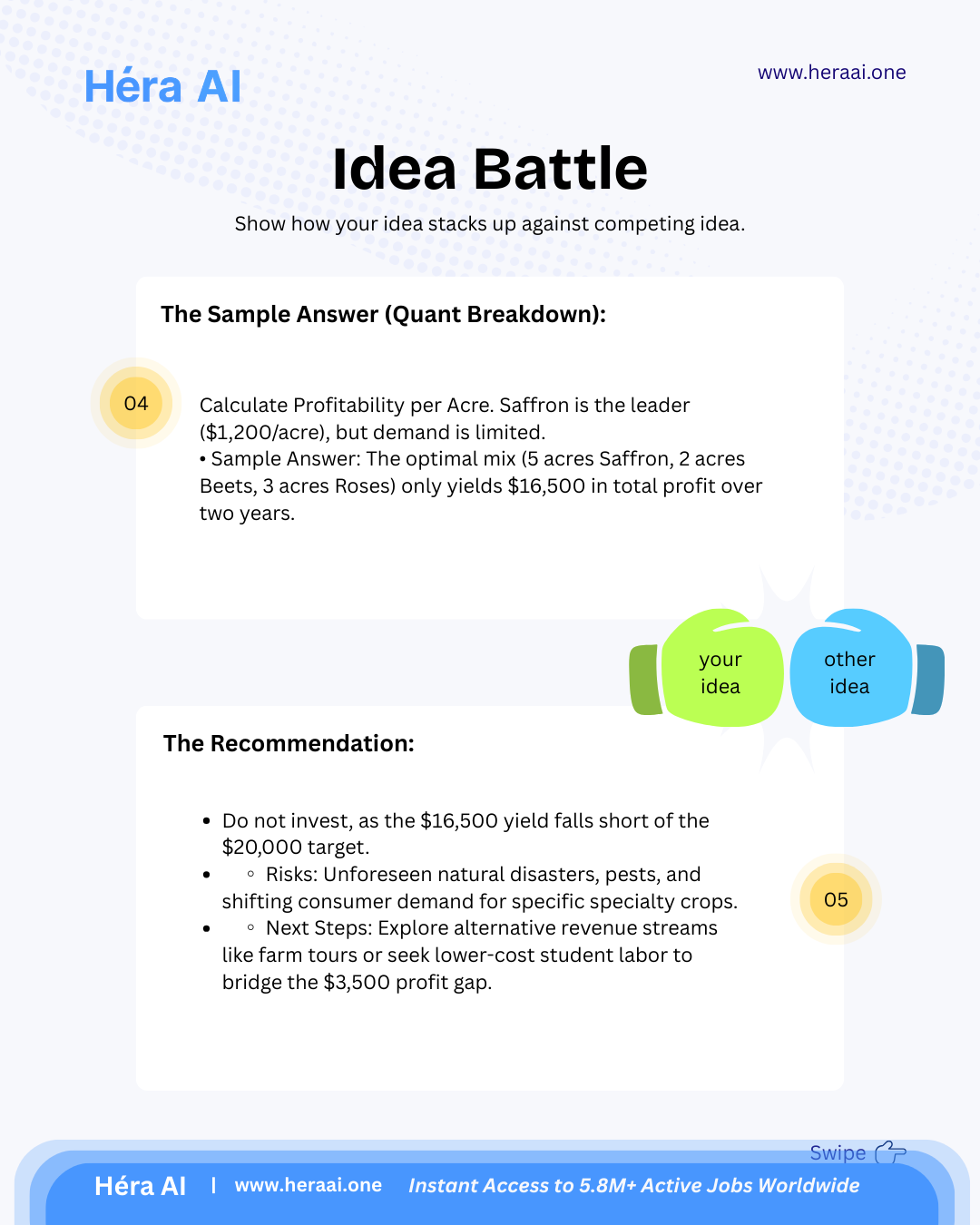
The four crops available — saffron, beets, rose bushes, and pine trees — vary dramatically in yield per acre, market demand, and time horizon. The optimal crop mix for a 2-year profit window allocates aggressively toward the highest-yield viable crops while respecting the market absorption constraint that limits saffron allocation. Pine trees are excluded from any serious 2-year analysis: their harvest cycle of 8–15 years makes them structurally irrelevant to the stated objective.
The saffron trap — and the market absorption question interviewers are waiting for: Saffron yields $1,200 per acre in a controlled analysis — the highest per-acre return in the mix. The instinctive response is to maximise saffron acreage. The senior response asks: 'What is the local market's absorption capacity for saffron at this price point?' Durham, NC is not a specialty spice trading hub. A single producer introducing 5 acres of saffron into a regional market may depress the local price below $1,200/acre before the first harvest is complete. The analysis assumes full price realisation — an assumption that must be challenged, not accepted.
Full Cost Accounting: The Gap Is Larger Than It Appears
The $3,500 shortfall between optimal crop revenue ($16,500) and the profit target ($20,000) is the number most candidates cite in their recommendation. It is not the right number. The correct gap analysis deducts start-up costs and two years of maintenance from gross revenue to produce net profit — and the result changes the recommendation materially.
The cost omission is the most common error in this case, and it is the error that separates a candidate who can follow a framework from a candidate who can apply financial rigour. Consulting interviewers use this case to identify candidates who check their own assumptions — who ask 'have I included all costs?' before presenting a recommendation — rather than candidates who stop at the first plausible number.
The land value alternative that most candidates never mention — and that changes the entire recommendation: Durham's technology sector expansion has been materially increasing residential and commercial land values in the surrounding area. A candidate who raises the question — 'What is the current market value of 10 acres in Durham, and what is the expected appreciation over two years?' — has identified an investment alternative that may dominate the farming plan with zero risk. If the land appreciates by $2,000–$4,000 per acre over two years with no capital outlay or execution risk, selling the land generates $20,000–$40,000 with certainty. The farming plan is competing not just against a hurdle rate, but against a risk-free alternative.
Risk Analysis: The Variables That Make the Gap Insurmountable
Even if the optimal crop mix is implemented perfectly and costs remain at their estimated levels, the recommendation is Do Not Invest. With five identified risk factors that could each independently cause the investment to miss the hurdle rate, there is no reasonable confidence interval under which the expected return justifies the investment. The risk table below documents each factor and its business implication.
The Strategic Pivot: If the Client Will Not Accept 'No'
In a live case interview, 'Do Not Invest' is the correct primary recommendation — but the interviewer will frequently follow with: 'The client is committed to using this land. What would you recommend?' This is the test of whether a candidate can shift from evaluation mode to creative problem-solving mode without abandoning financial rigour. The answer is not to force the original farming plan to work — it is to redesign the revenue model around the asset's real competitive advantages.
Why agri-tourism is the highest-confidence recommendation — not a fallback: Agri-tourism is not a consolation prize for a failed farming plan. It is a fundamentally different business model applied to the same asset. The farm's location near a growing technology hub creates genuine demand from knowledge-economy workers for authentic rural experiences — a market that did not exist ten years ago in Durham. Farm tours require near-zero capital investment beyond basic safety infrastructure, are not subject to weather or pest risk, and generate revenue in Year 1 rather than waiting for harvest cycles. Combined with a reduced crop programme, the agri-tourism model can close the $7,100 gap with lower risk than the full 10-acre farming commitment.
The 5-Step Framework
The meta-lesson that Case 25 is designed to teach: Strategy is as much about knowing when to say 'No' as it is about finding the 'Yes.' The best consultants are not optimists who find a way to make every plan work — they are analysts who can distinguish between a plan that is viable under realistic assumptions and one that only appears viable under optimistic ones. Case 25 is solvable on paper. It is not investable in practice. The candidate who explains that distinction clearly, with the numbers to support it, and then proposes a genuinely better alternative, is the candidate who passes.