Case 24: Solving the Talent Drain — Strategic Retention in Education
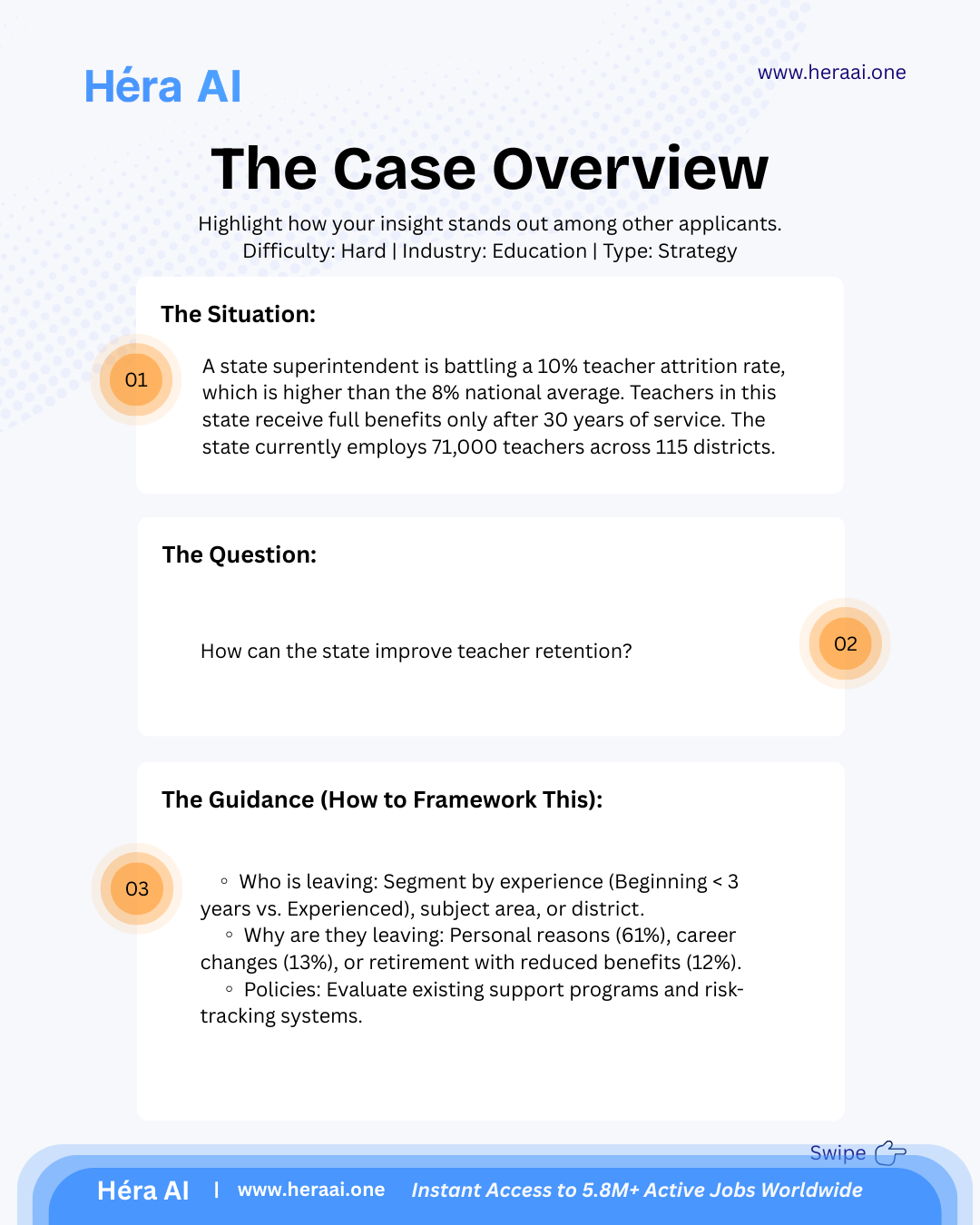
A 10% attrition rate across 71,000 teachers. The instinct is to raise salaries. The data says otherwise — and the gap between those two responses is what the case is testing.
Case 24 is presented as a human resources problem. It is not. It is a human capital optimisation problem — and the distinction matters more than it might appear. An HR problem asks: what policy change reduces the attrition number? A human capital optimisation problem asks: which segment of the workforce is failing, at which lifecycle stage, for which underlying reason, and what intervention produces the best return on that specific failure?
The instinctive answer — raise teacher salaries — is not wrong. But it is incomplete, and in a case interview context, incomplete is functionally incorrect. A uniform salary increase applied across 71,000 teachers addresses the compensation gap for the STEM segment competing with private sector offers. It does nothing for the beginning teacher in a rural district who is leaving because she has spoken to no colleague outside her own classroom for three weeks. These are different problems requiring different solutions.
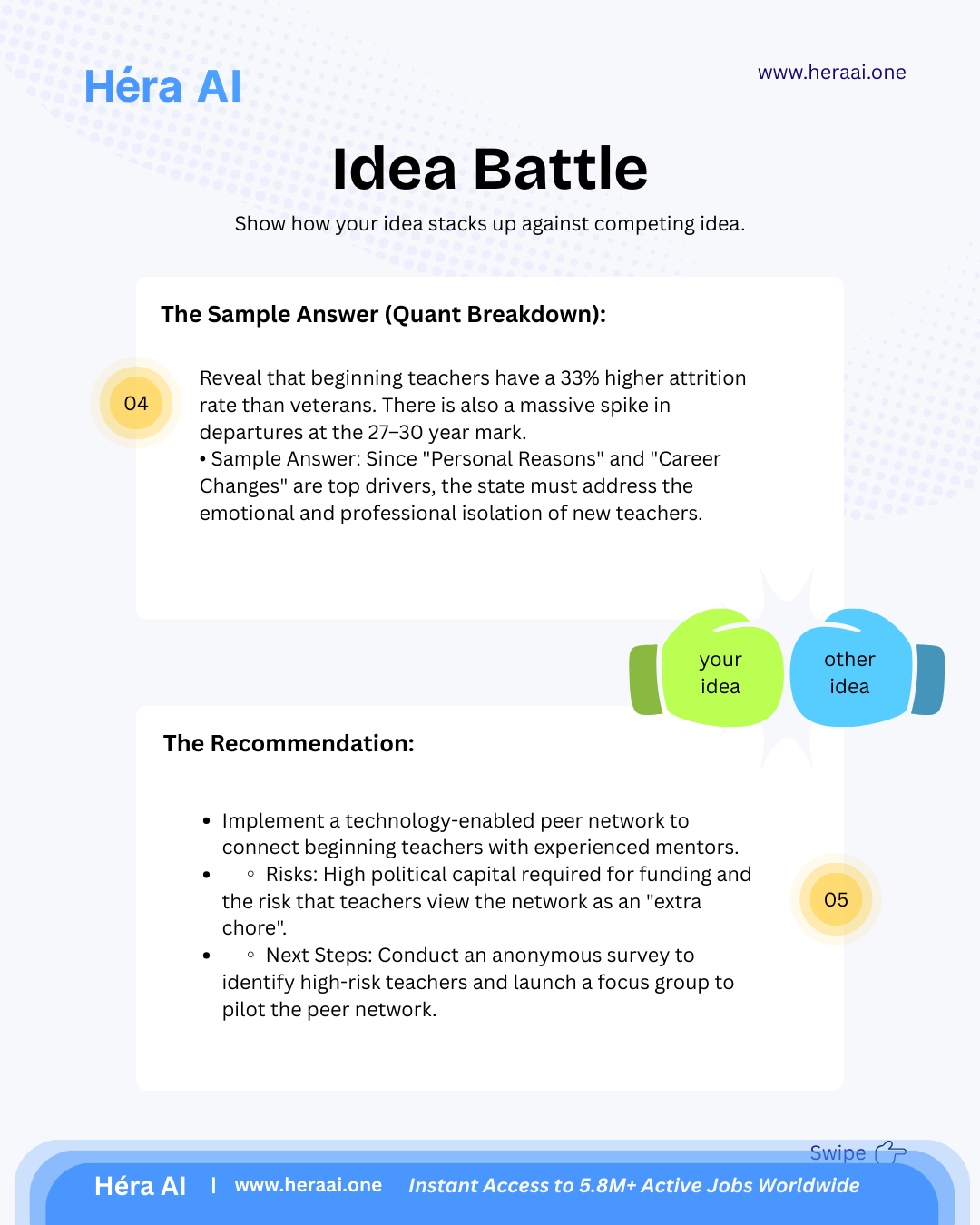
The case reveals two attrition spikes hidden within the aggregate 10% rate: a beginning-teacher burnout spike driven by professional isolation, and a veteran benefits cliff concentrated at the 27–30 year tenure mark. Identifying both, explaining the distinct mechanisms behind each, and recommending targeted interventions for each is the structure that constitutes a strong answer. This post breaks down each component.
Reframing the Problem: From HR to Human Capital
The first 60 seconds of a case interview response establish whether the candidate has understood the actual problem. Candidates who begin with 'we need to improve teacher satisfaction' have accepted the HR framing. Candidates who begin with 'this is a lifecycle failure — we need to identify which stage of the teacher lifecycle is producing the highest attrition and why' have made the reframe that the interviewer is scoring for.
The reframe that changes the entire analytical direction: Retention is not about stopping people from leaving. It is about making them want to stay — and the conditions that make a beginning rural STEM teacher want to stay are different from the conditions that make a 28-year veteran want to stay. A single retention strategy that addresses both with the same intervention is not strategic; it is averaged. The case is testing whether you can resist the averaging impulse and design for the actual distribution of the problem.
Segmentation: The MECE Decomposition of 71,000 Teachers
The workforce of 71,000 teachers across 115 districts is not a monolith. Treating it as one produces the kind of averaged, uniform recommendation that consulting interviewers are trained to reject. The MECE segmentation below identifies five distinct cohorts with meaningfully different attrition profiles, root causes, and strategic implications.
The segmentation insight that most candidates miss — and that changes the recommendation: By the time a teacher reaches Year 27, the retention battle has already been won. They have invested 27 years in the profession; the benefits cliff is the only structural incentive that could pull them out before Year 30. The real battle — the one that determines whether the 10% attrition rate improves or stays — is fought and won or lost in the first 36 months. Every teacher who makes it through Year 3 has a dramatically lower lifetime attrition probability. This means the highest-ROI intervention target is not the largest group or the most vocal group: it is the newest cohort, in the most isolated districts, in the first three years.
Departure Reasons: What the Data Actually Says
The departure reason data is the most commonly misread component of this case. The 61% 'personal reasons' category looks like a terminal answer — the kind of soft, non-actionable data that produces a recommendation to 'improve work-life balance.' It is not. It is a segmentation prompt: personal reasons among whom, in which context, at which career stage?
The 14% 'other / unknown' category is the most analytically valuable one if the state commits to improving its data collection. An anonymous exit survey — short, voluntary, launched at the point of departure notice — converts this unclassified 14% into actionable intelligence over time. The cost is negligible; the policy value is substantial. A candidate who recommends this data collection step in addition to the intervention programme is demonstrating the rigour that senior case interviews are designed to find.
The Strategy: Technology-Enabled Mentor Network and Benefit Redesign
The retention strategy has two distinct components — one for the beginning-teacher attrition spike and one for the veteran benefits cliff — and they should be presented as such. Conflating them into a single 'retention programme' is a structural error. The four programme components below address the two spikes through different mechanisms, with a pilot design that enables evidence-based statewide rollout.
The 5-Step Framework
The principle that Case 24 is designed to teach — and that applies to every public sector case: In public sector cases, the instinctive policy lever — raise pay, add resources, issue a mandate — is almost always correct in direction but insufficient in precision. The consulting value is in the targeting: which segment, at which lifecycle stage, with which intervention, measured by which metric. A superintendent who increases the entire teacher payroll by 5% has spent money. A superintendent who deploys a targeted peer network in the 20 highest-attrition rural districts, measures Year-3 retention in the pilot cohort, and expands only the interventions that produce measurable improvement has built a system. Case 24 is about the difference between those two answers.