Case 23: Streaming vs. Cinema — Risk Mitigation or Brand Equity?
A streaming platform offers $150M guaranteed. The theatrical upside is $5M more — on a good day. Most candidates choose theaters. Most candidates are answering the wrong question.
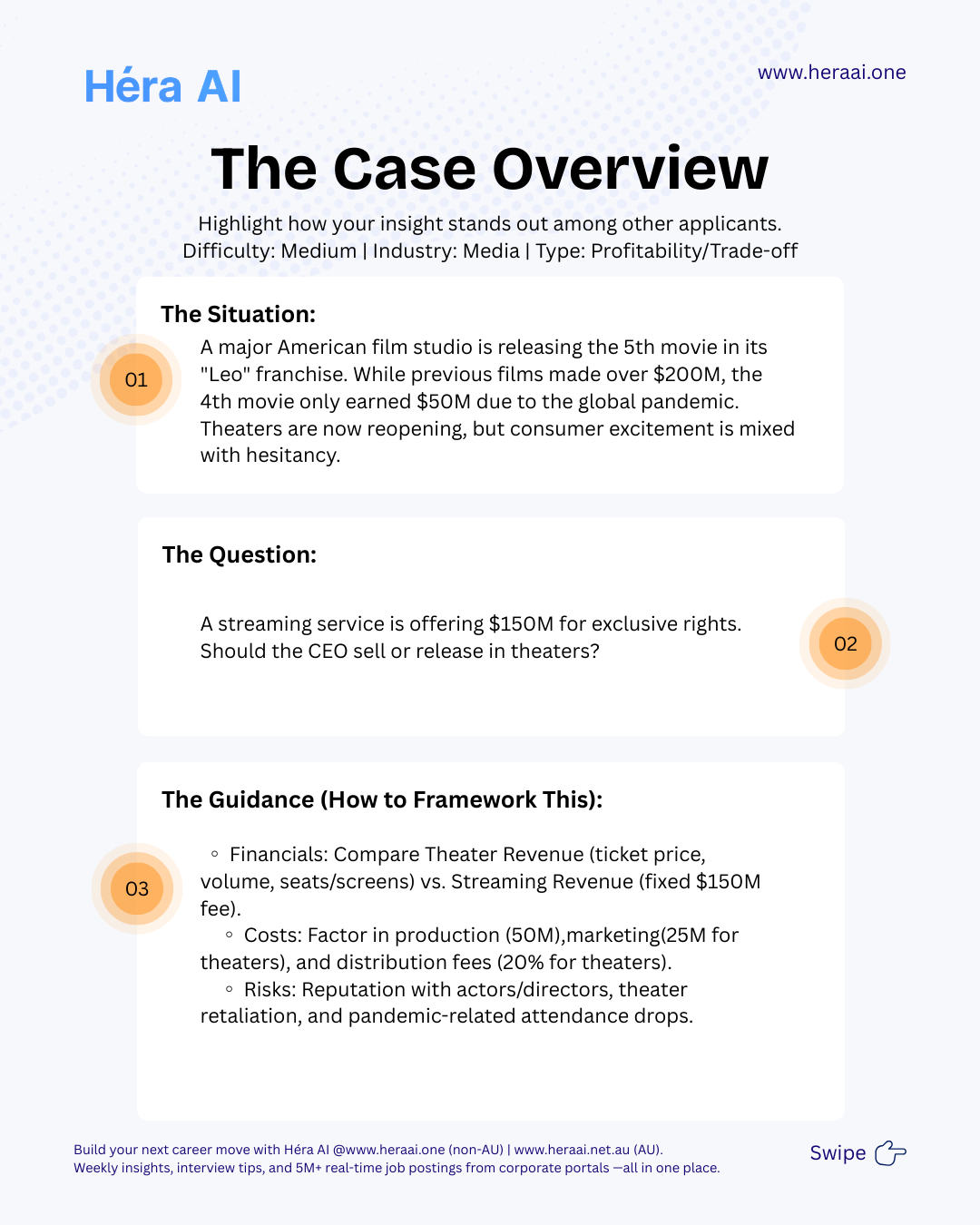
Case 23 is presented as a financial comparison: streaming deal versus theatrical release. Calculate the profit for each path, pick the higher number, present the recommendation. Candidates who approach it that way are solving the surface problem — and missing the case entirely.
The real question is not which path generates more profit on the best-case spreadsheet. It is which path produces a better risk-adjusted outcome given the studio's financial position, stakeholder ecosystem, and franchise value trajectory. The $5M theatrical upside over streaming is not the interesting number. The $120M range between the theatrical upside and the theatrical downside is the interesting number — and it is the number that determines the recommendation.
This is also a franchise strategy case disguised as a profitability case. The decision the studio makes for this film is not contained to this film. It sets the distribution precedent for the sequel, signals the studio's commitment to the theatrical window to talent and exhibition chains, and either preserves or permanently reclassifies the franchise's cultural status. Those downstream consequences are where the consulting value in this case lives.
The P&L Comparison: Why $5M Is a Trap
The financial comparison between the two paths produces a result that appears to favour theatrical release by a narrow margin. Most candidates stop at the base case and recommend theaters for the extra $5M. The interviewer is waiting for the candidate who calculates the downside — and finds that the extra $5M is purchased with a $120M range of outcome risk.
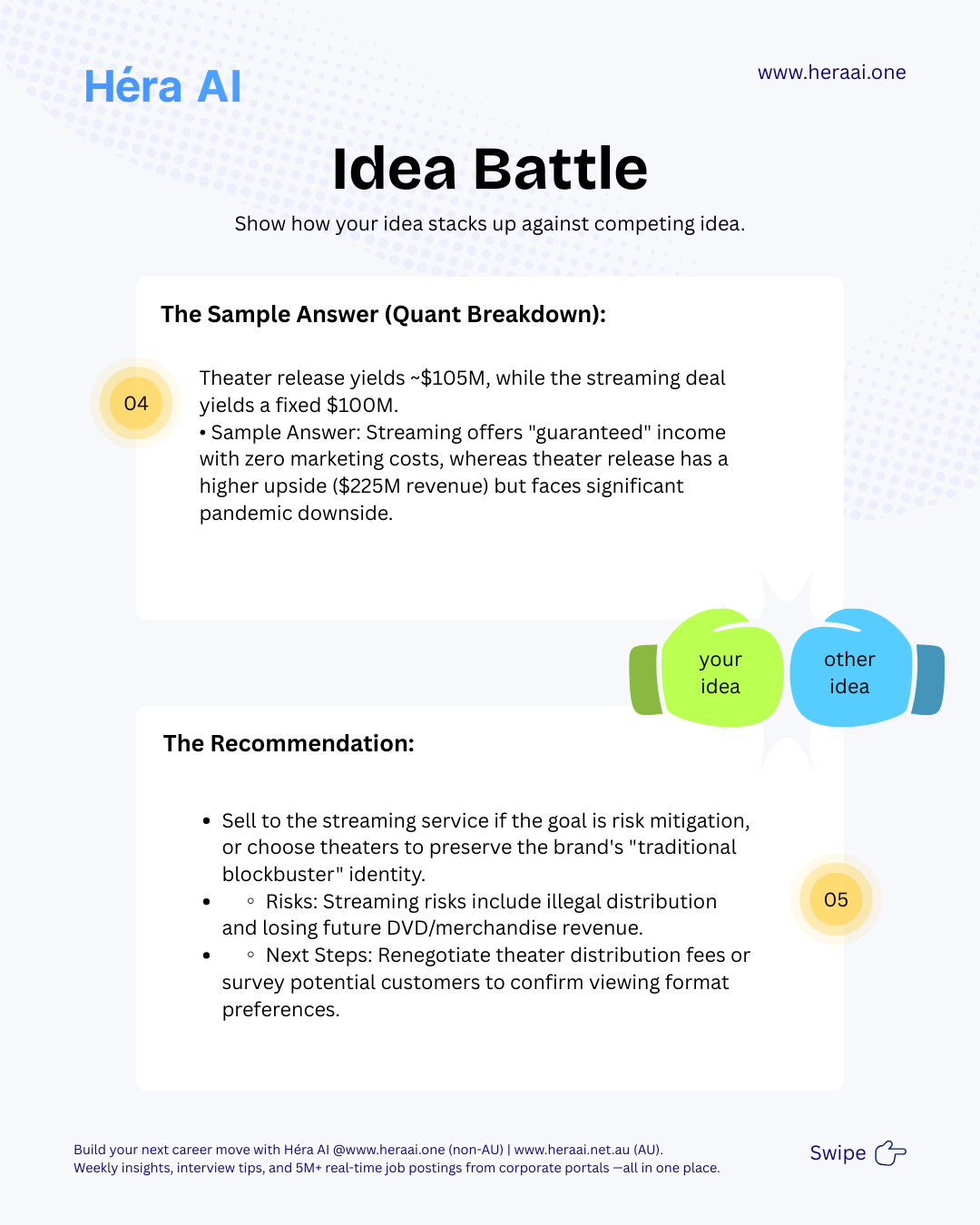
The downside calculation that most candidates omit — and that changes the recommendation: If theatrical revenue comes in at $100M in a weak post-pandemic recovery: $100M revenue − $20M distribution fee − $50M production − $25M marketing = $5M net profit, not a loss. But at $80M theatrical: $80M − $16M dist − $50M prod − $25M mktg = −$11M. The streaming deal's $100M floor means the studio must believe theatrical revenue will exceed approximately $105M just to break even on the comparison — and must exceed $225M to justify the brand equity and relationship risks of a theatrical-first bet. That is the framing the interviewer wants to hear.
Beyond the Spreadsheet: The Brand Equity Stakes
The financial comparison is necessary but not sufficient. A case that stops at the P&L has answered the math question without addressing the strategy question. The five brand equity risks below each have measurable long-term value implications that are absent from the current-film P&L — and each one applies specifically to franchise properties like Leo, where the decision made on Film 5 sets the conditions for Films 6 through 10.
The franchise valuation principle that converts the brand equity argument from qualitative to quantitative: A major franchise's theatrical window is not a distribution preference — it is a valuation multiplier for the entire intellectual property ecosystem. Box office performance is the benchmark input for merchandise licensing negotiations, theme park partnership valuations, and sequel greenlight decisions. A franchise that moves to streaming loses its box office benchmark and negotiates the entire downstream ecosystem at a discount. The current film's P&L shows a $5M theatrical upside. The franchise's 10-year P&L may show a $200M–$500M differential between 'blockbuster event' and 'streaming content' positioning. Naming that asymmetry is what separates a senior answer from a junior one.
The Decision Matrix: Conditional on Studio Objective
There is no single correct recommendation in Case 23 — there is a correct framework for arriving at the recommendation that fits the studio's actual situation. The matrix below presents three paths conditional on the studio's primary objective. The hybrid option is the one most candidates miss, and the one most interviewers are hoping to hear.
The hybrid path — theatrical release with a negotiated distribution fee reduction and a streaming fallback trigger — is the structural answer that demonstrates both financial fluency and creative problem-solving. It reframes the decision from a binary choice to a structured option: the studio retains the theatrical upside and the brand equity benefits while capping the scenario where a weak opening weekend converts a near-miss into a loss. This kind of conditional structure is the output consulting interviewers associate with senior analytical thinking.
The 5-Step Framework
The meta-lesson that Case 23 teaches about certainty vs. prestige trade-offs: The 'certainty trap' is one of the most reliable patterns in case interviews involving guaranteed offers against uncertain upside. The instinct is to take the guaranteed money. The consulting analysis asks: what does the certain option cost in the currency of the uncertain option's upside — and is the certainty premium worth that cost? In Case 23, the certainty premium is $100M guaranteed vs. a range of −$20M to $200M+. Whether that premium is worth paying depends entirely on the studio's financial position and strategic time horizon. A candidate who names both conditions — and explains which recommendation follows from each — has produced the answer the case is designed to extract.