Case 22: The Climate Crisis on the Balance Sheet — Beantown Co.'s Profitability Play
A property insurer losing margin to Southeast climate losses in a market where they cannot raise prices. The instinct is cost-cutting. The data says geographic hedging through M&A.
Case 22 is a profitability case with an unusual constraint: the client cannot use the lever that most candidates reach for first. Beantown Co. is a U.S. property insurer with a 2% operating margin in a market where the best-positioned competitor posts 4%. The gap is two percentage points. The cause is not inefficiency, excessive overhead, or product mix — it is geographic concentration in a region where climate-related losses are accelerating faster than any organic cost reduction can offset.
The constraint that changes the entire analytical structure: Beantown is a price taker. In a fragmented property insurance market with many competing providers, Beantown cannot unilaterally raise premiums without losing policyholders to cheaper competitors. The mechanism that turns a cost problem into a pricing problem — and then uses pricing to restore margins — does not exist in this market structure. Every candidate who opens with 'they should raise premiums' has failed the first filter.
The correct path to margin recovery requires rebalancing the company's risk geography, not managing its existing geography more efficiently. This case is about understanding when the correct answer to a profitability problem is not 'reduce costs' or 'increase revenue' but 'change the underlying risk profile of the business' — and executing that change through the only lever fast enough to be relevant: M&A.
The Price-Taker Constraint: Why the Obvious Lever Doesn't Exist
The first structural insight in this case is market structure. Understanding why Beantown cannot raise premiums — and why that constraint eliminates the most intuitive profitability lever — is the analytical prerequisite that determines which solutions are worth evaluating. Candidates who skip this step and proceed directly to revenue improvement recommendations have not understood the case.
The question that unlocks the correct analytical direction: 'What does it mean that Beantown is a price taker, and what does that eliminate from the solution space?' Answering this question in the first 90 seconds demonstrates that you understand the market structure before proposing interventions. It eliminates premium increases, narrows the revenue lever to product mix and geographic expansion, and focuses the cost analysis on whether efficiency gains are large enough to close a 2-point margin gap driven by climate-related claims — which they are not.
The Three-Lever Framework: Why M&A Dominates
With premium increases eliminated by market structure, Beantown's profitability improvement options reduce to five distinct levers across the revenue, cost, and inorganic growth dimensions. The table below evaluates each lever on impact potential, mechanism, and strategic assessment — including the speed-of-impact constraint that determines which lever is relevant to the current crisis.
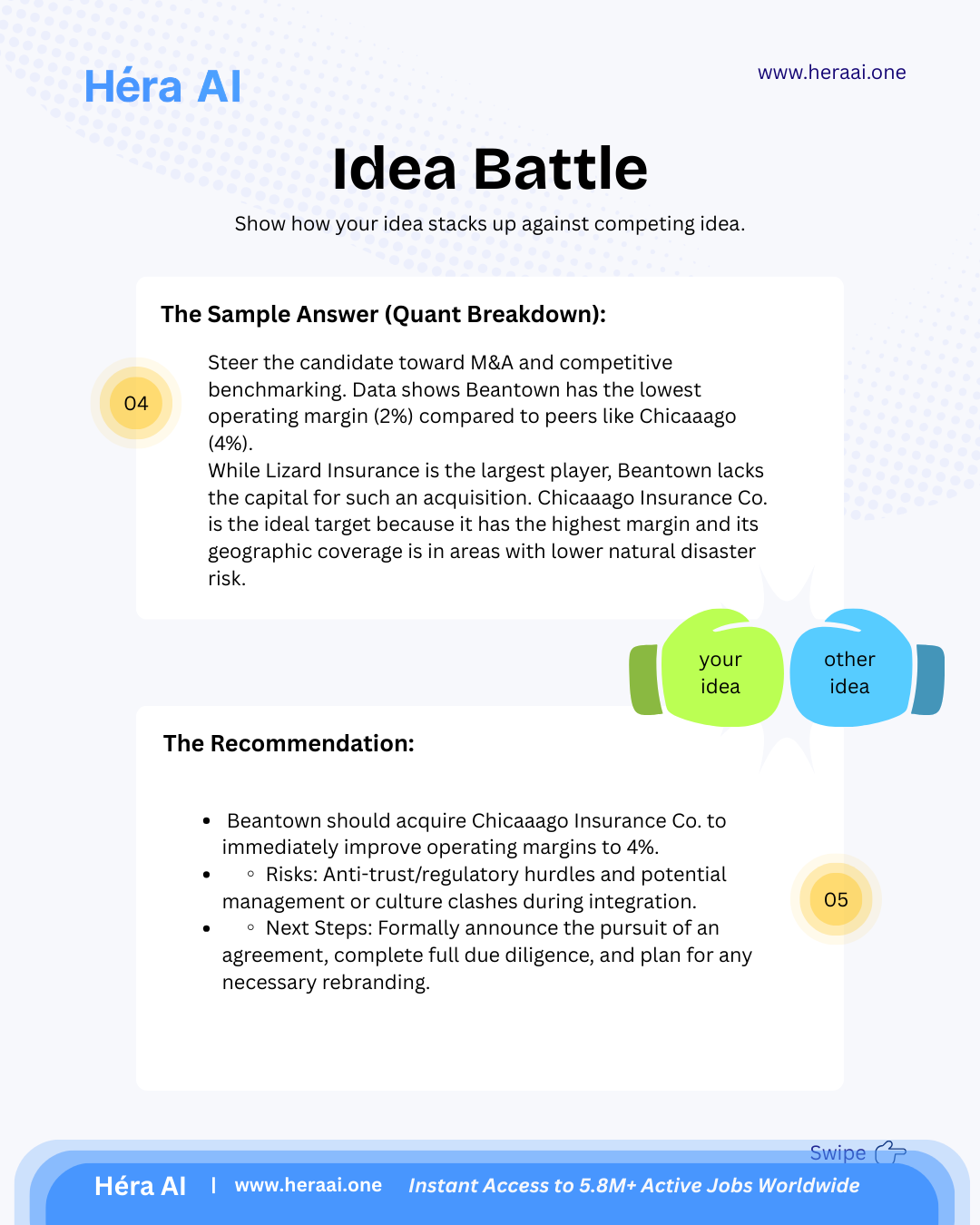
The key insight that separates a strong answer from a surface one: M&A is not the recommendation because it is the most dramatic option. It is the recommendation because it is the only option that solves both components of the problem simultaneously — margin improvement and geographic diversification — in a timeframe relevant to a company whose losses are compounding annually. Organic geographic expansion is the right direction but the wrong speed. Digital efficiency is the right discipline but the wrong magnitude. The acquisition is not a growth strategy; it is a risk management strategy executed through a financial instrument.
The Acquisition Target: Why Chicaaago Is the Goldilocks Answer
The fragmented property insurance market contains many potential targets — but most are either too large (triggering antitrust review) or too small (insufficient margin and geographic diversification to move the needle). Chicaaago Insurance Co. is the Goldilocks target: large enough to provide meaningful margin improvement and geographic hedging, small enough to be acquirable without regulatory obstruction.
The benchmarking logic is important to present explicitly: Beantown's 2% margin against Chicaaago's 4% defines the 'size of the prize.' A weighted average blended margin — accounting for the relative premium volume of the two companies — produces the expected post-acquisition operating margin, which becomes the financial justification for the deal price. This calculation is what converts the M&A recommendation from a qualitative argument to a quantitative one that the client's CFO can evaluate.
M&A Risk Assessment
Recommending an acquisition without a risk assessment is structurally incomplete in a case interview and strategically incomplete in practice. The five risks below are not arguments against the acquisition — they are conditions that must be managed for the acquisition to deliver its expected margin improvement.
The climate risk caveat that demonstrates long-term strategic thinking: The acquisition of Chicaaago is not a permanent solution to Beantown's climate exposure problem — it is a margin and diversification bridge. The Southeast climate trajectory is structural: hurricane frequency, flood zone expansion, and sea level rise will continue to increase Beantown's property loss ratios regardless of who they acquire. The acquisition buys 5–10 years of margin headroom and diversification buffer. The permanent solution requires actuarial repricing as state insurance regulators permit, selective non-renewal of the highest-risk Southeast exposure, and ongoing geographic rebalancing as the climate risk map continues to shift. A candidate who names this long-term dynamic — rather than treating the acquisition as a complete answer — is demonstrating the strategic perspective that senior consulting cases are designed to surface.
The 5-Step Framework
The principle that Case 22 is designed to teach — and that applies to every profitability case: Profitability cases almost always have an obvious first lever that the interviewer expects you to eliminate before moving to the correct one. In Case 22, the obvious lever is premium increases — and it does not exist in a price-taker market. In Case 28 (Orrington), the obvious lever was revenue growth — but the problem was fixed-cost structure. In every case, the consulting value is in the structural diagnosis that determines which levers exist before evaluating how hard to pull each one. Always diagnose market structure, root cause, and lever availability before proposing a solution.