Case 21: The "Impossible" Interview — Mastering Brain Teasers and Guesstimates
Four problems that top-tier consulting and tech interviewers use to test structured thinking under pressure. The final answer is almost never the point.
Brain teasers and Fermi estimation problems have a reputation for being arbitrary — questions designed to make candidates uncomfortable rather than to surface genuine skill. That reputation is mostly wrong. The firms that still use these questions are not looking for candidates who happen to know that a ping-pong ball has a 4cm diameter or who have memorised the number of JFK runways. They are looking for candidates who, when confronted with a question they cannot immediately answer, do something specific: decompose it, state their assumptions, build a structured path to an estimate, and check whether the answer makes sense.
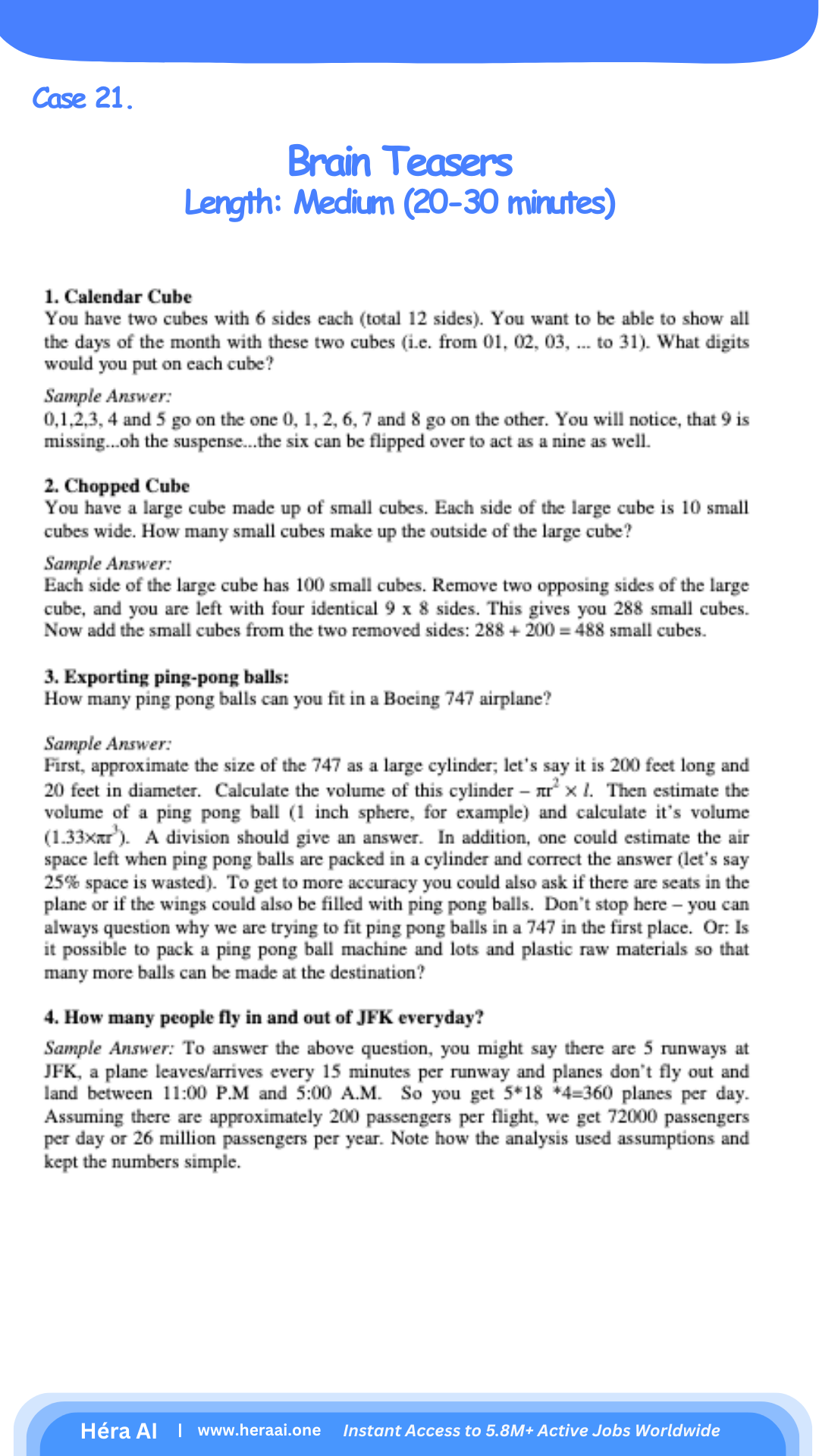
Case 21 covers four problems that span the two main types of brain teaser used in consulting and technology interviews. The first two — the Calendar Cube and the Chopped Cube — are logic and spatial reasoning problems with definitive correct answers that require a specific insight to unlock. The second two — the 747 Ping-Pong Ball problem and the JFK passenger volume problem — are Fermi estimation problems with no single correct answer but with clear standards for what constitutes a well-constructed estimate. Both types are testing the same underlying capability: structured thinking under ambiguity.
This post works through all four problems in full — including the common traps, the correct solution paths, and the specific signals each problem sends to an interviewer about how a candidate thinks.
The Four Problems: Full Solution Paths
Each problem below is presented with its structure, the trap that catches most candidates, the correct solution path, and the specific signal the interviewer reads from the approach.
The meta-principle across all four problems: In every case, the wrong approach is to attempt a direct calculation of the final answer. The right approach is to identify the structure of the problem — what type of question is this, what are the constraints, what sub-questions need to be answered first — before doing any arithmetic. The candidate who states their approach before executing it gives the interviewer a window into their thinking. The candidate who silently calculates and presents a number gives the interviewer nothing to evaluate.
What Interviewers Are Actually Scoring
Brain teasers and Fermi problems are not scored by whether the candidate produces the right number. They are scored by whether the candidate demonstrates five specific capabilities, each of which maps directly to a skill required in consulting and analytical roles.
The single most common failure mode — and how to avoid it: The most common failure in brain teaser interviews is silence. Candidates who do not immediately see the answer go quiet while they think — and interviewers score that silence as an inability to think out loud. The correct response to uncertainty is narration: 'I do not immediately see the solution, so let me start by identifying the constraints I am working within.' That sentence is a better answer than 90 seconds of silence followed by a correct number. The interviewer is watching your process. Make it visible.
The Fermi Method: A 5-Step Protocol
Fermi estimation problems — JFK passengers, 747 ping-pong balls, windows in Manhattan — all respond to the same five-step protocol. This protocol produces a well-structured, defensible estimate regardless of prior knowledge of the specific domain.
Why brain teasers matter even if your target firm does not use them: Practising structured estimation problems builds a specific cognitive habit: the ability to start from nothing and construct a reasonable answer through a series of auditable steps. That habit — not the ability to solve any specific riddle — is what transfers to consulting work. Every market sizing question, every financial model built without historical data, every strategic recommendation made under time pressure draws on the same capability. The brain teaser is a compressed, explicit test of a skill you will use every week of a consulting career. Treat it as practice for the job, not as a hurdle to the job.