Case 20: SoapCo's $10M Dilemma — Can a Legacy Brand Pivot to Liquid?
A $5M niche leader. A stagnant core market. A mandate to triple revenue in five years. The answer is not 'sell more soap.' It is 'change which soap you sell, and where.'
Growth strategy cases follow a predictable failure pattern: the candidate recognises that growth is needed, proposes to grow harder in the current market, and produces a recommendation that falls short of the target because the market is simply too small to support the goal. Case 20 is engineered to surface that failure pattern and test whether the candidate can move past it.
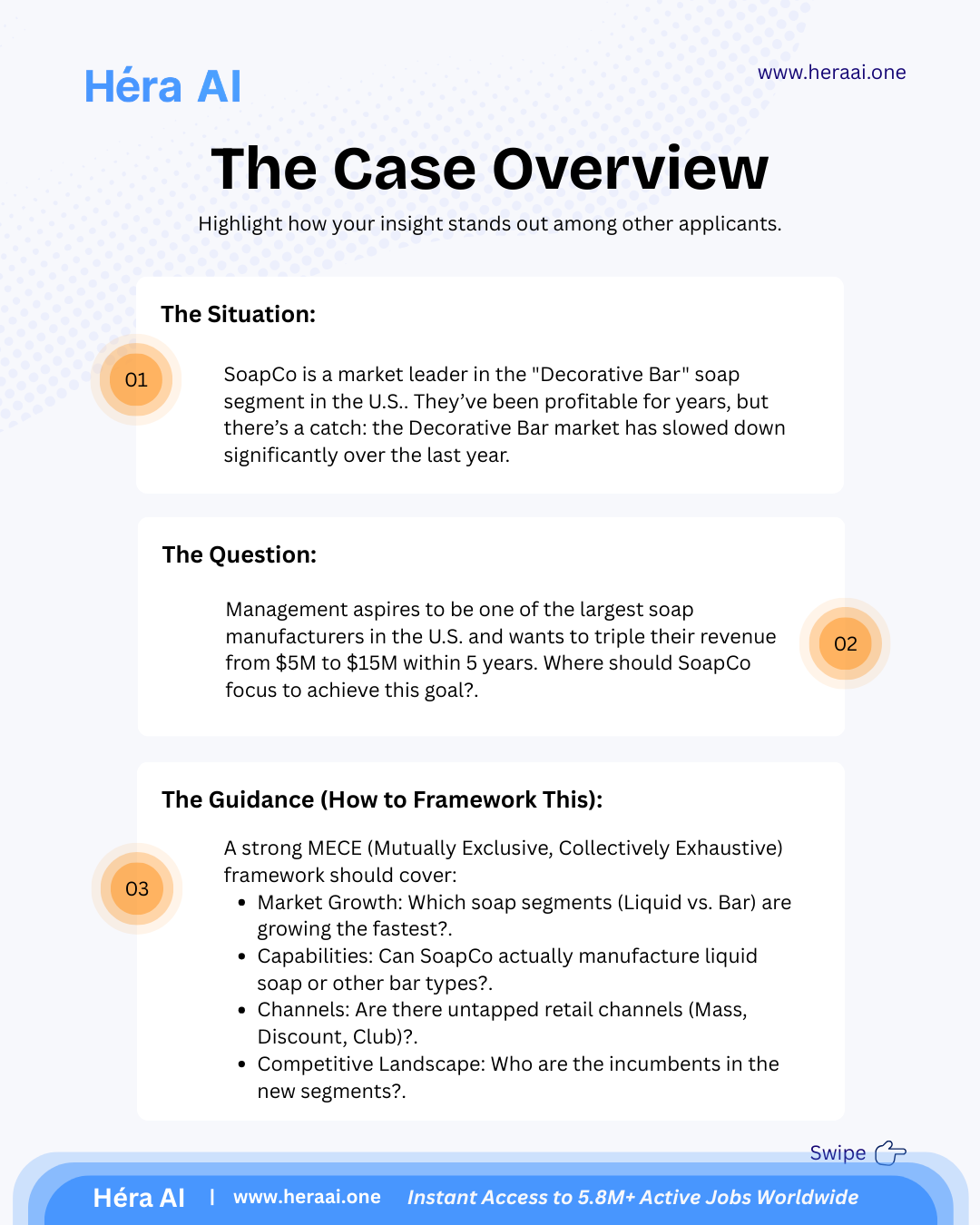
SoapCo is a market leader in U.S. Decorative Bar soaps — a real achievement in a niche product category. The problem is that niche leadership in a stagnant market generates $2M in annual revenue on a 10% share of a $20M total market. The 5-year target of $15M requires adding $10M. Growing Decorative Bar market share from 10% to the theoretical maximum of 50% would yield $8M in revenue — still short, and achievable only by eliminating every competitor in the category, which is not a strategy.
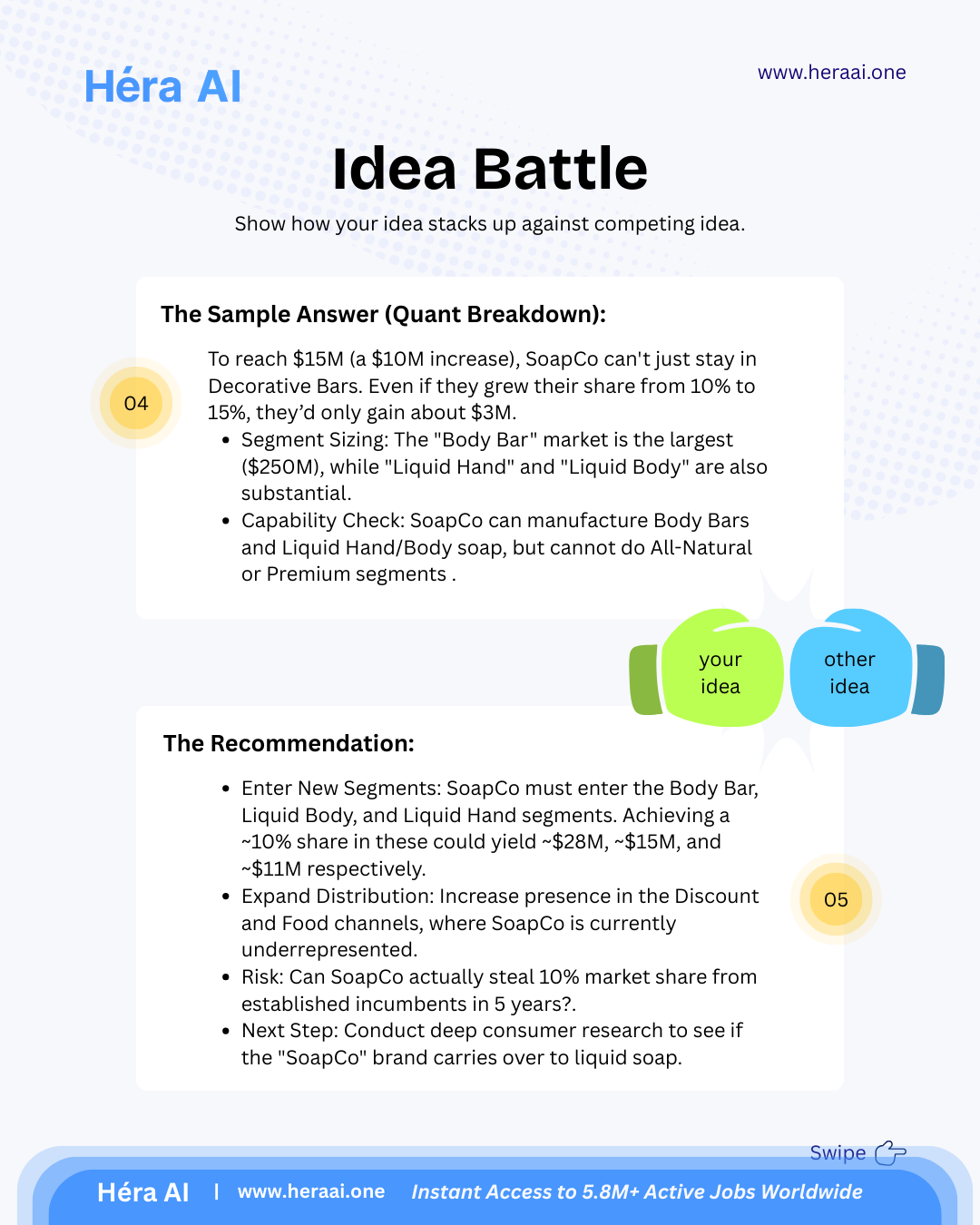
The correct analytical move is one that many candidates delay too long: disqualify the current market as a vehicle for the growth goal, then identify adjacent markets large enough that a small market share generates the required incremental revenue. The Decorative Bar market cannot close the $10M gap. The Body Bar market ($250M), Liquid Hand Soap ($100M+), and Liquid Body Wash ($100M+) each can — and the question then shifts from whether to enter to how to enter, in what sequence, and with which capabilities.
Market Sizing: Why the Current Sandbox Is Too Small
The first analytical task is not to propose a growth strategy — it is to prove that the current market cannot deliver the growth target. This step is the one most candidates skip, and skipping it means the adjacent market recommendation arrives without the quantitative justification that makes it compelling. The market sizing below establishes both the ceiling of the current market and the floor of the adjacent ones.
The core insight that separates this case from a standard market entry question: Operational excellence cannot fix a market size problem. SoapCo could achieve best-in-class manufacturing efficiency, perfect customer service, and flawless brand execution in the Decorative Bar segment — and still be structurally unable to reach $15M in revenue, because the entire market is worth $20M. A 100% market share of $20M is $20M. The goal requires $15M from a starting base of $2M. The math closes only through adjacent market entry, not through performance improvement in the existing market.
The Revenue Bridge: Quantifying the Growth Path
The revenue bridge translates the market sizing into specific revenue targets for each entry scenario. This is the quantitative backbone of the growth strategy recommendation — and the step that converts 'SoapCo should enter adjacent markets' from a directional argument into a financially substantiated recommendation.
The key number that reframes the entire analysis — and that most candidates miss: A 5% share of the Body Bar market ($12.5M) exceeds the entire Decorative Bar market ($20M × 100% = $20M). This means that capturing one-twentieth of a larger adjacent market is more valuable than owning the entire current one. When a single adjacent market share scenario dominates the total value of the current market, the case for entry is structurally self-evident — and the analytical energy should shift from 'whether to enter' to 'how to enter responsibly.'
Capability Assessment: What SoapCo Can and Cannot Do
Identifying attractive adjacent segments is necessary but not sufficient for a growth strategy recommendation. The recommendation must be feasible — and feasibility is determined by SoapCo's existing capabilities, production infrastructure, and brand positioning. The capability assessment below distinguishes between segments that are both attractive and accessible, segments that require investment, and segments that are currently inaccessible for structural reasons.
Channel Strategy: Where the Volume Lives
Entering the Body Bar and Liquid Soap segments requires distribution access to the channels where those products generate volume at the price points that support SoapCo's margin requirements. SoapCo's current specialty retail channel is appropriate for Decorative Bars — it is not the channel where $250M in Body Bar revenue is generated. The channel strategy is part of the growth recommendation, not a post-entry operational detail.
The 5-Step Framework
The principle that Case 20 is designed to teach — and that applies to every growth strategy case: Growth strategy cases test whether a candidate can recognise the difference between a performance problem and a market size problem. Performance problems are solved by doing the current thing better. Market size problems are solved by changing which market you compete in. SoapCo does not have a performance problem — it is the market leader in its segment. It has a market size problem. Every growth case that presents a stagnating core market is testing this distinction. Candidates who miss it recommend performance improvements that cannot close the gap. Candidates who catch it recommend market entry strategies that can.