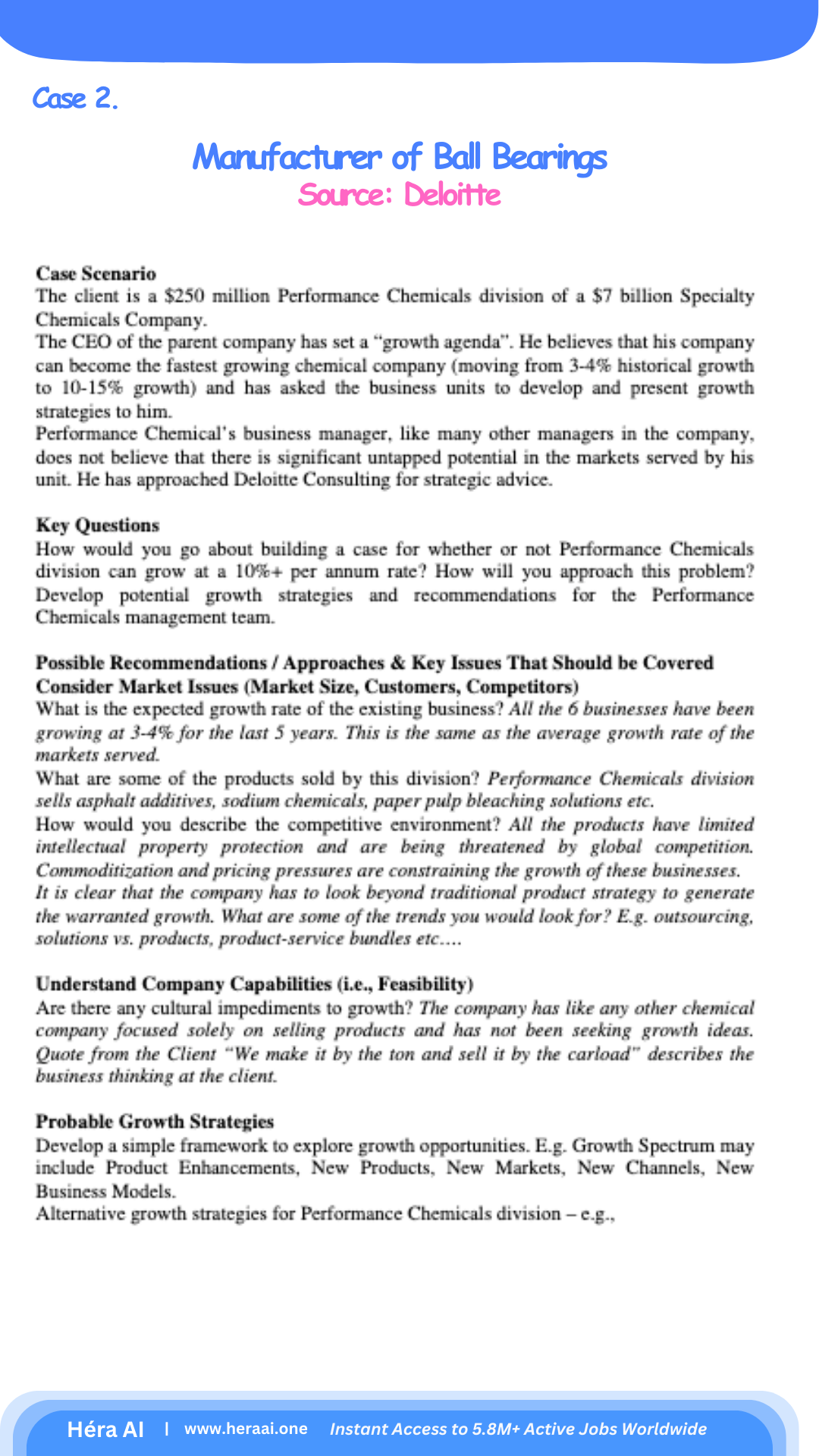
Case 2: Can a Mature Chemicals Business Really Grow at 10%+?
$250M revenue. Six businesses all growing at 3–4%. A CEO demanding 10–15% growth. A division head who thinks the core markets are tapped out. The gap between ambition and economics has to be quantified before strategy can be built.
Case 2 is a Deloitte-style growth strategy case with a clear central tension: a CEO has set a 10–15% annual growth target for a Performance Chemicals division that has grown at 3–4% for five consecutive years, in line with the overall market. The division head is skeptical — he believes the core markets are largely tapped out — and has brought in external advisors to either validate his skepticism or identify a credible path to the target.
The analytical discipline this case requires is the opposite of the instinctive response to a growth challenge. The instinct is to generate ideas: new markets, new products, new channels. The correct starting point is to quantify the growth gap and demonstrate why the core business cannot close it. Only after that demonstration is complete does the search for new growth vectors become productive — because the analysis has established what the new vectors must deliver and why.
The case also introduces a dimension that growth strategy cases frequently underweight: organisational feasibility. The business explicitly self-describes as 'we make it by the ton and sell it by the carload' — a manufacturing-oriented, product-centric culture with limited experience in solution-based selling or innovation-led growth. The highest-upside growth path (solutions and services bundling) is also the one that requires the most significant capability transformation. Recommending it without naming the capability gap is not a complete answer.
Quantifying the Growth Gap: Why the Core Cannot Get There
Before any growth vector is proposed, the size and source of the gap must be established. The table below maps the three dimensions of the growth challenge — historical rate, CEO target, and implied gap — with the strategic implication of each.
The analytical move that earns full marks in growth cases: 'Before I explore new growth vectors, I want to establish that the core business cannot deliver the target organically. All six divisions have grown at 3–4% for five years — this mirrors market growth, which means the division is holding share in a flat competitive position. In a market with limited IP, global competition, and strong customer pricing power, outgrowing the market through product improvement alone is not a credible expectation. The 10–15% target requires structural change, not incremental improvement. I will now structure the growth vectors that could close the gap.'
The Growth Spectrum: Five Vectors, Assessed for a 'Made by the Ton' Business
The growth spectrum runs from incremental product enhancement to full business model transformation. Each vector offers a different risk/upside profile — and each must be assessed against the specific capability of a manufacturing-focused chemicals business.
The capability assessment that elevates the answer: 'The solutions and services path offers the highest upside — but it requires a capability transformation in a business that describes itself as product-focused and manufacturing-oriented. Before recommending it as the primary growth vector, I would assess: does the organisation have the technical service capability to deliver solutions? Does it have the customer relationship model built around problem-solving rather than product transactions? Does it have the sales capability to sell outcome-based contracts? If the answers are no, the solutions path is the long-term destination, not the immediate recommendation. The sequencing matters as much as the direction.'
The 5-Step Framework
The meta-lesson that Case 2 is designed to teach — applicable to every growth strategy case in a mature industry: The most important lesson is not which growth strategy to choose, but how to reason about growth under constraints. When a mature business is asked to grow at 10%+, the right starting point is not creativity — but realism. Quantify what the core can deliver. Acknowledge the competitive dynamics. Assess organisational readiness. Only then can a credible growth strategy be built. Ambitious targets do not change industry economics. But they do force better strategic thinking — and that is the consulting value being tested.