Case 19: The BoxCo Challenge — The Wax Lever
A competitor launches a $500K rebate. You have a 5% margin target you cannot miss. The answer is not in the sales department — it is in the procurement office.
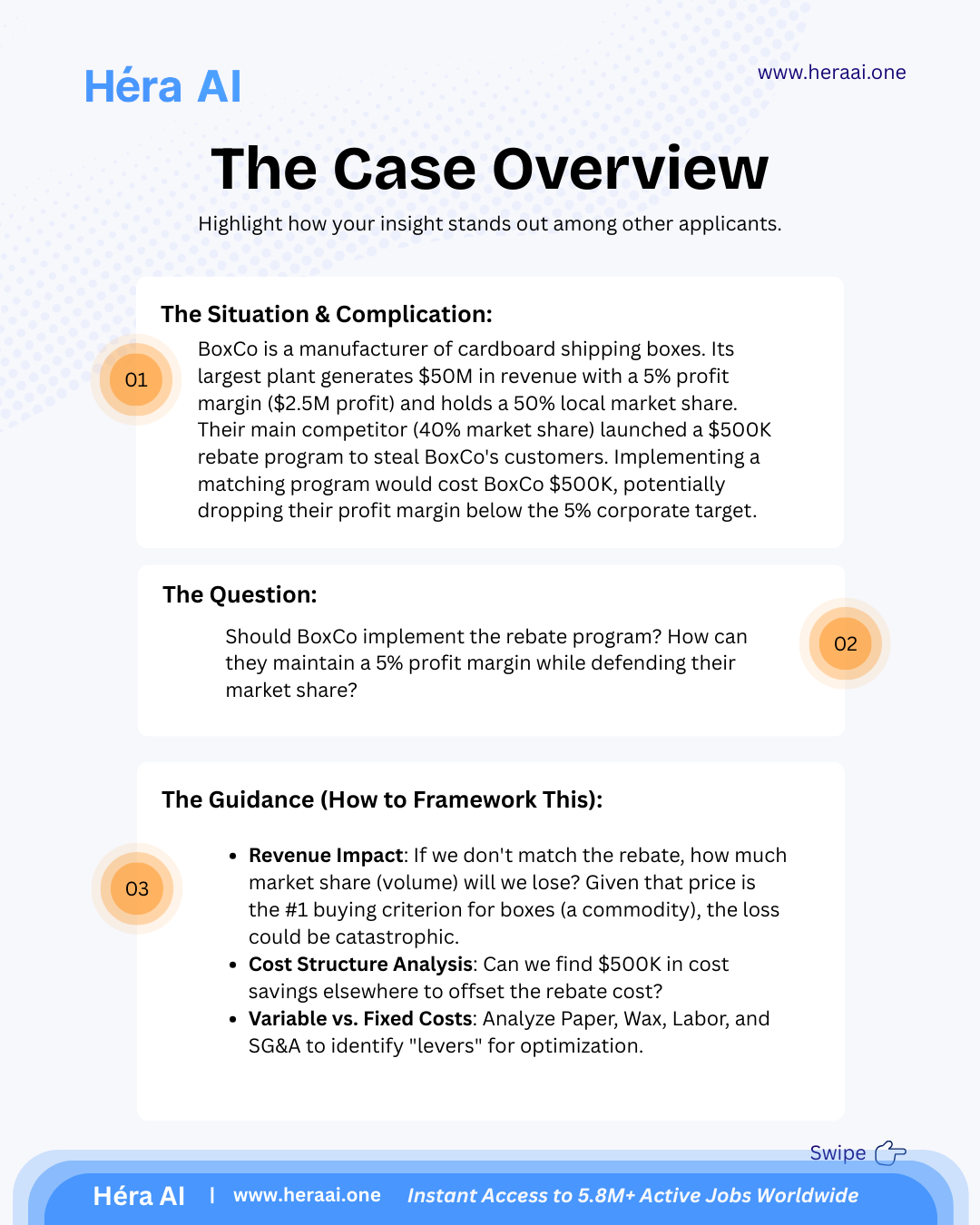
Case 19 presents a commodity market dilemma designed to surface a specific analytical failure: the tendency to accept a false binary when the correct answer is to find the third path. BoxCo is a cardboard manufacturer with 50% market share, a 5% corporate profit margin target, and a $2.5M annual profit. A competitor has launched a $500K rebate programme aimed directly at BoxCo's customer base. The question is how to respond.
The case is framed as a choice between two unattractive options: match the rebate and miss the margin target, or hold the price and lose market share. Most candidates accept this framing and argue for whichever option seems less damaging. That is the wrong move — and it is the move the case is designed to punish.
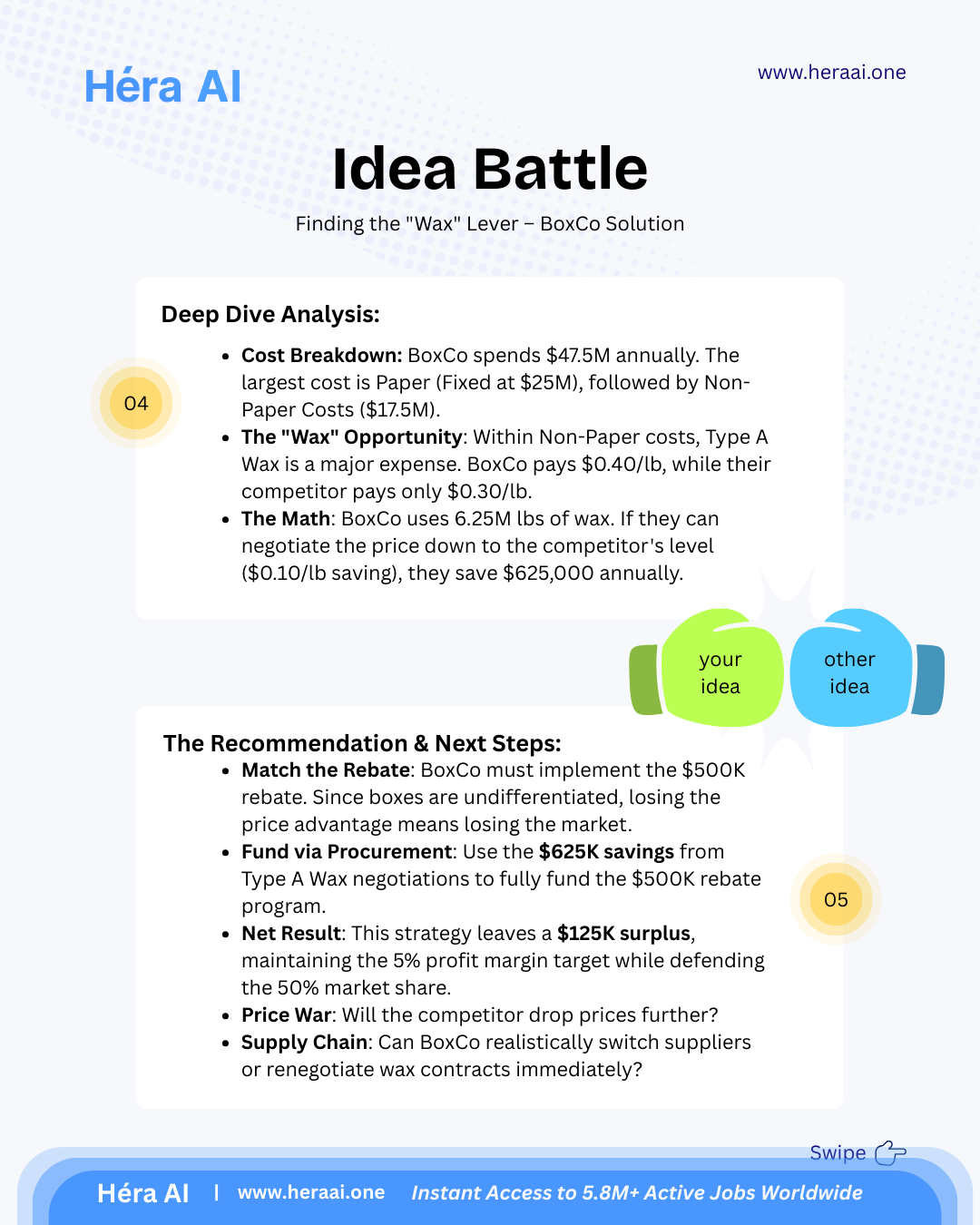
The correct response is to reject the binary before it constrains the analysis. In a commodity market, the only sustainable path that defends both profit and market share simultaneously is to find the cost reduction that funds the competitive response. The case provides the data to do exactly that — a Type A Wax procurement rate that is $0.10 per pound above the competitor's rate on a consumption base of 6.25 million pounds per year. The solution is $625,000 in annual savings found in the procurement office, funding a $500,000 rebate with $125,000 to spare.
The False Binary: Why Both Obvious Paths Are Wrong
The first step in Case 19 is to resist the structure of the question. The case presents two options — match the rebate or refuse to match — and most candidates begin by evaluating which is less harmful. The correct structure begins earlier: by questioning whether these are actually the only two options, and identifying what a third path would require.
The move that separates a structured response from a reactive one: State explicitly, in the first 90 seconds, that there is a third path: 'The question is not whether to match the rebate — it is whether there is a cost reduction available that funds the rebate without touching profit. I'd like to examine the COGS structure before recommending.' This one sentence signals to the interviewer that you have not accepted the framing of the problem as the constraint on your analysis.
COGS Decomposition: Finding the Wax Lever
A full COGS decomposition is the analytical tool that makes the third path visible. By examining each cost line against the constraint — 'which of these can be reduced fast enough and by enough to fund a $500K rebate?' — the analysis narrows from a general cost reduction exercise to a specific procurement opportunity. The Type A Wax line is the answer, but it is only visible if the decomposition is systematic.
Why the wax line is the answer — and how to find it in any COGS analysis: The wax line stands out for two reasons: it is a variable cost (meaning it scales with volume and is renegotiable), and it is above the competitor's known rate (meaning it represents an identifiable, quantifiable overpayment). These two conditions — variable and benchmarkable — are the signals that identify a cost lever in any COGS analysis. Fixed costs and costs at market rate are not levers; they cannot be moved within the required timeframe. The wax line is both variable and above market, which is why it is the answer.
The Wax Lever: Full Calculation
The wax savings calculation is straightforward once the input data is assembled. The critical step is not the arithmetic — it is identifying that the price differential exists and that the volume is large enough to make the unit saving material at the aggregate level.
Generalising the Wax Lever: The Procurement Principle
The wax lever in Case 19 is a specific instance of a general analytical principle: when a company faces a competitive cost pressure that it cannot absorb from revenue, the first place to look for funding is variable input costs that are above market rate. This principle applies in any commodity or near-commodity industry where input costs are a significant share of COGS and supplier contracts are not continuously renegotiated.
The 5-Step Framework
The meta-lesson that Case 19 is designed to teach — and that applies to every cost-structure case: In commodity market cases, the right answer is almost never a choice between the two options presented. It is a third option that requires looking one level deeper into the cost structure than the surface analysis suggests. The wax lever is that third option in Case 19 — but the principle generalises: whenever a case presents a binary that both seem unacceptable, the consulting move is to ask 'what would need to be true for neither of these to be necessary?' and then go find whether that condition can be created. In Case 19, the condition is a cost saving that funds the defensive response. The COGS decomposition is the tool that surfaces it.