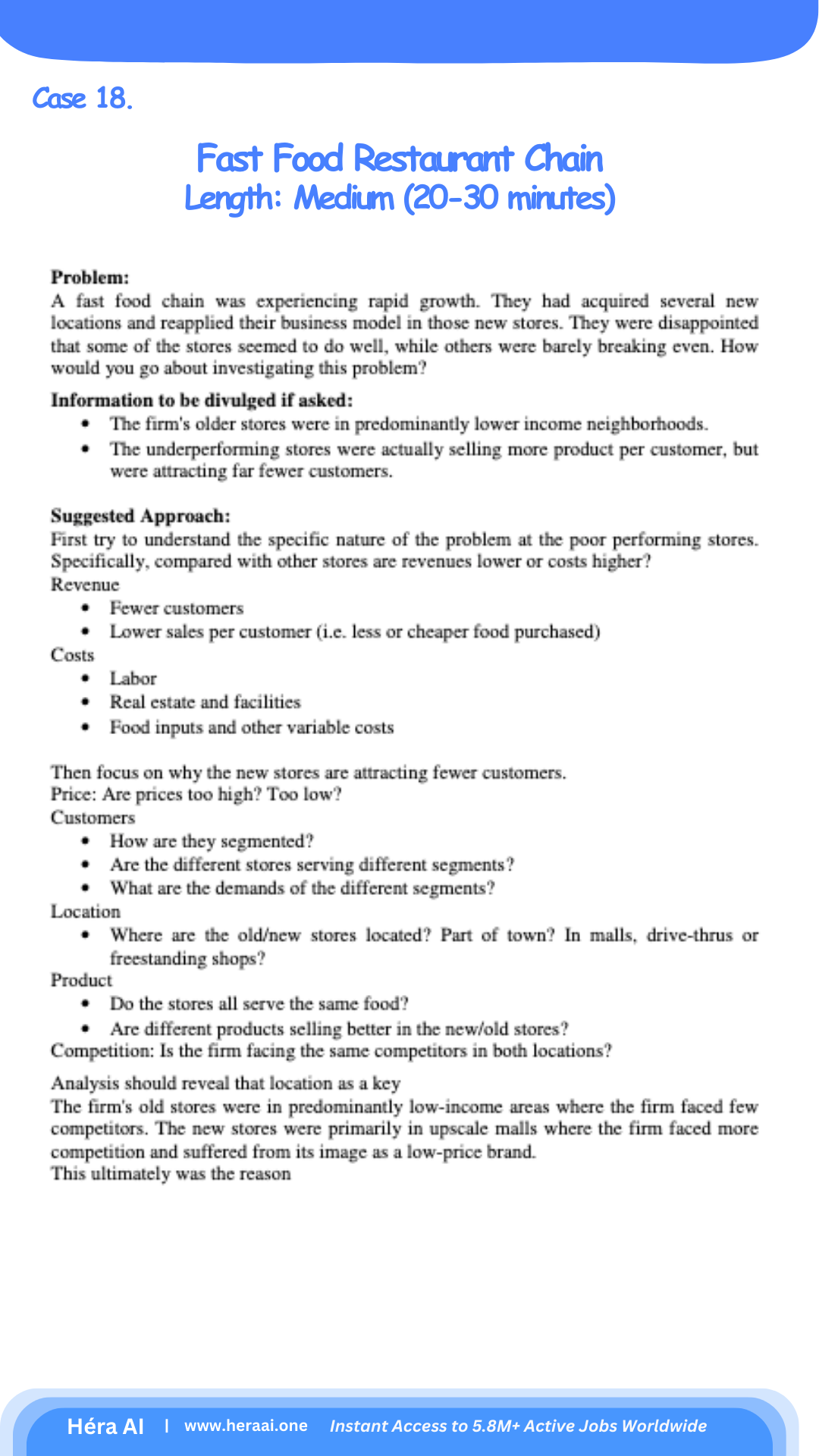
Case 18: The Scaling Paradox — Why "Copy-Paste" Is a Strategy Killer
New stores generating higher spend per customer. Profits still collapsing. The data looks like a win. It is not. This case is about what happens when you change the zip code but not the brand.
Case 18 is designed to surface one of the most common and most costly failures in retail and franchise expansion: the assumption that a proven business model scales automatically to a new location. The case presents a fast-food chain that has built a profitable, defensible position in low-income suburban markets — high volume, consistent foot traffic, no meaningful competition — and then expanded into upscale shopping malls, where the stores are barely breaking even.
The immediate diagnostic instinct is to look at operations: labour costs, supply chain efficiency, menu pricing, store layout. These are the wrong places to look. The operations of the new stores are not materially different from the original stores. What is different is the context — and in a context where the brand's defining characteristic (low price) is a social liability rather than a competitive advantage, operational excellence cannot restore the unit economics.
This is a brand-market fit case, not a profitability optimisation case. The distinction matters because it determines the correct analytical framework, the correct diagnostic questions, and the correct recommendation. A candidate who diagnoses it as an operations problem will produce a recommendation that cannot work. A candidate who diagnoses it as a brand positioning failure will produce a recommendation that addresses the root cause.
The Context Shift: What Changed Between Original and New Stores
The original stores and the new stores sell the same products, operate with the same processes, and carry the same brand. The unit economics are completely different. The gap is entirely explained by the context change — and the eight dimensions below make that gap visible.
The diagnostic principle that this comparison establishes: A business model is not portable. It is a system that works within a specific set of contextual conditions — customer demographics, competitive environment, and brand perception. When those conditions change materially, the model's outputs change with them. The chain's model was not 'high-quality operations' — it was 'high-volume, low-margin, in an underserved market with no competition.' That model does not transfer to a premium mall environment, regardless of how well it is executed.
The Data Paradox: Why High Spend Per Customer Is a Warning Sign
The single most important analytical move in Case 18 is reading the spend-per-customer metric in conjunction with the foot traffic metric — not in isolation. The case is designed to present the spend-per-customer data first, as a hook. The candidate who responds positively to that data has accepted the framing. The candidate who immediately asks 'what does foot traffic look like?' has demonstrated the diagnostic instinct the case is testing.
The self-selection insight that converts the data paradox into a root cause diagnosis: The customers who enter the new stores are not representative of the available customer population in the mall. They are a self-selecting minority who are either indifferent to brand perception, are in a hurry and accept the trade-off, or are regular customers who follow the chain regardless of location. Their higher spend reflects the mall's general price environment and their willingness to order more in a sit-down context — not a signal that the brand has found a new premium audience. The foot traffic gap represents the many more who walk past because the brand signals exactly what they are trying to avoid on a leisure shopping day.
Brand-Market Fit Diagnostic: Five Questions
The brand-market fit diagnostic translates the context shift into five questions that the analysis must answer before a recommendation is possible. Each question is designed to surface a specific dimension of the mismatch between the chain's brand identity and the new location's customer expectations.
Strategic Pivot Options
The recommendation should not be 'close the stores.' That is the minimum viable response — a retreat without a strategy. The full recommendation addresses the root cause and charts a path that either fixes the brand-market fit failure or redirects growth toward markets where the fit is already proven. The four options below are not mutually exclusive; they operate on different timescales and address different components of the problem.
The 5-Step Framework
The meta-lesson that Case 18 is designed to teach — and that applies to every market entry and expansion case: The most dangerous words in a growth strategy are 'proven model.' A proven model is proven in a specific context, not universally. The moment the context changes — different demographics, different competitive environment, different customer motivations — the model must be re-validated, not assumed to transfer. The chain in Case 18 did not fail because it expanded. It failed because it expanded without asking whether the thing that made the original model work — a low-price brand in an underserved market with no competition — would still be true in the new location. It was not. Every expansion case in a consulting interview is testing whether the candidate asks that question before recommending growth.