Case 17: When Share Price Falls — Think Like the Market, Not the Company
A military aircraft manufacturer's stock is declining. The instinct is to look at operations. The answer is in investor expectations — and there is only one move that changes them.
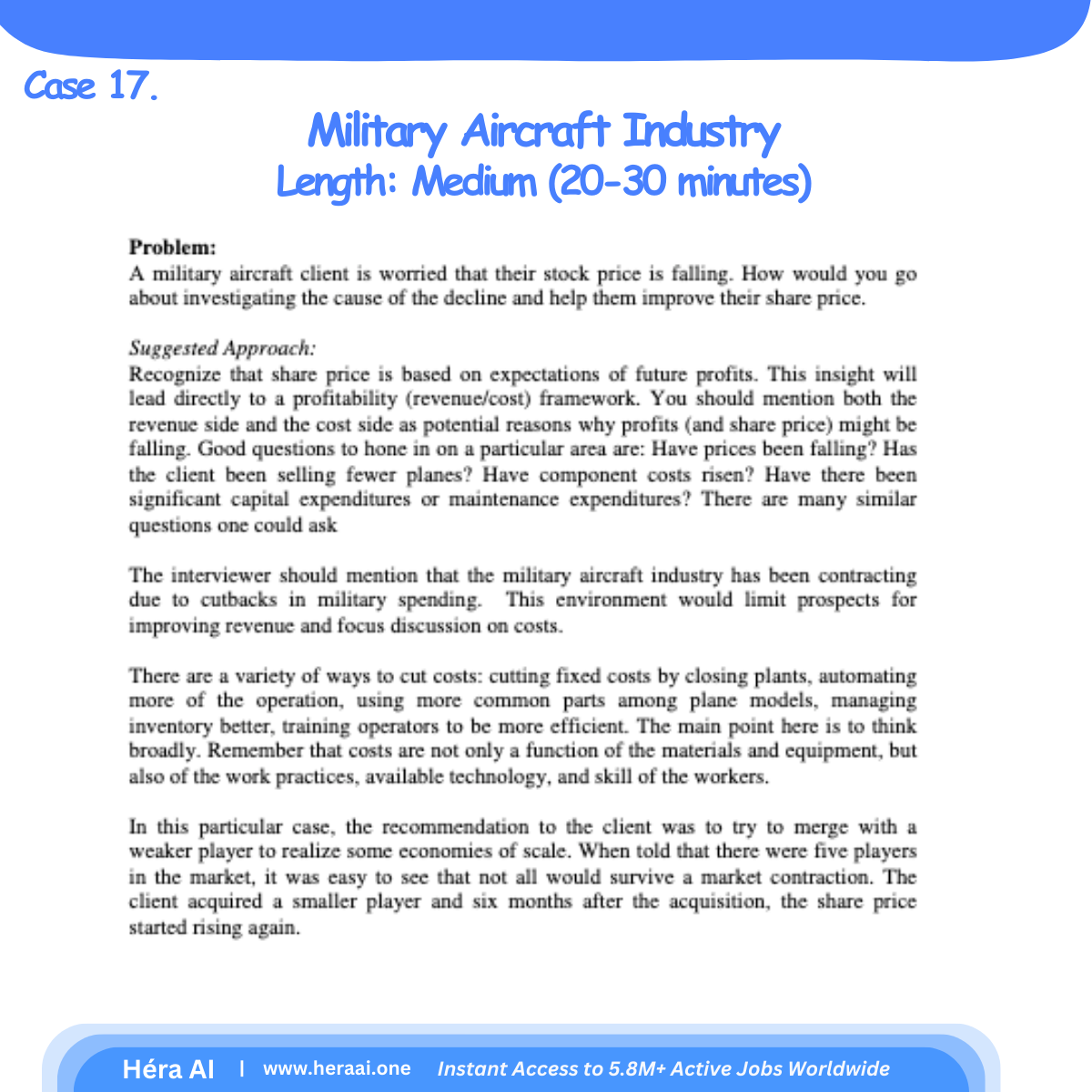
Case 17 is a share price case — a category that trips up candidates precisely because it sounds like a profitability case and is not. The presenting problem is a falling stock price. The instinctive response is to examine the income statement: find the revenue shortfall or the cost overrun, fix it, and the share price recovers. This logic is wrong, and the case is designed to expose it.
Share price does not reflect current-period profitability. It reflects the market's assessment of expected future profitability, discounted to the present. A company can be profitable today and still have a falling share price — if the market has concluded that future profitability will be lower than previously expected. The correct analytical starting point is not 'what is wrong with operations now' but 'what has the market revised in its forecast of this company's future earnings — and why?'
In Case 17, the answer is structural: the military aircraft market is contracting. Government defence budgets are being reduced. The number of aircraft programmes being funded is declining. With five players competing for a shrinking pool of contracts, the forward revenue outlook for every participant has deteriorated — and the market has repriced all of them accordingly. The share price is not wrong. It is a correct reflection of a worse expected future. The question is what the company can do to improve that expected future, and the answer is not a cost efficiency programme.
Reframing the Problem: Investor Expectations, Not Operations
The single most important analytical move in Case 17 is the reframe: establishing that a share price case requires thinking from the perspective of the capital market, not the operating manager. The table below makes the distinction explicit across the six dimensions that determine where the analysis should begin.
The sentence that signals correct framing to the interviewer — say it in the first 60 seconds: 'Share price reflects the market's expectation of future profitability. Before examining internal operations, I'd like to understand what has changed about the market's expectation of this company's future earnings — specifically, what is happening at the industry level that might have caused investors to revise their forecast.' This one sentence demonstrates capital market literacy, redirects the analysis to the right starting point, and signals that you will not be trapped by the operational framing the case presents.
Revenue Diagnostic: Why the Ceiling Is Structural
In a standard profitability case, the revenue diagnostic asks: which product lines are underperforming, which customer segments are churning, and which pricing decisions are compressing margin? In a contracting defence market, these questions have a different character — because the revenue problem is not a mix or execution issue, it is a structural demand decline that no internal action can reverse.
The pivot that the industry context forces — and that most candidates are slow to make: When the interviewer confirms that the military aircraft market is contracting due to government budget reductions, this is not background information — it is the analytical signal to pivot from revenue optimisation to cost management and strategic positioning. Continuing to discuss revenue levers after this signal has been given suggests the candidate has not understood that the revenue ceiling is structural. The strongest response names the pivot explicitly: 'Given that industry demand is structurally contracting, the revenue opportunity is constrained. The analysis should shift to identifying the cost levers that can protect margin under lower volume — and then the strategic options for improving long-term competitive positioning in a consolidating market.'
Cost Structure Analysis: Beyond Materials and Labour
Cost reduction in a defence aerospace manufacturer is a systems problem, not a line-item problem. The candidates who distinguish themselves in this section are those who move beyond the obvious cost lines — direct materials and direct labour — and identify the structural cost levers that produce durable margin improvement in a declining-volume environment.
The Strategic Move: Consolidation as the Investor Confidence Lever
Internal cost reduction can improve current-period margin — but it does not change the investor narrative. Investors watching a company in a contracting market implement efficiency programmes are not reassured: they see a company managing its own decline. What changes the narrative is a strategic move that demonstrates the company is positioning to be the survivor in a consolidating market, not just a participant managing the decline. In a five-player market with contracting demand, the correct move is acquisition.
The 5-Step Framework
The meta-lesson that Case 17 is designed to teach — and that applies to every share price and capital markets case: Stock price cases are not profitability cases. They are investor expectation cases. The correct diagnostic question is not 'where are we losing money?' but 'what has the market revised in its model of our future earnings — and what would cause it to revise upward?' In a contracting industry, the answer to the second question is rarely an operational efficiency programme. It is a strategic move that changes the investor's assessment of whether this company will be a winner or a loser as the market consolidates. Thinking like an investor — rather than like an operating manager — is the analytical posture that this case category rewards.