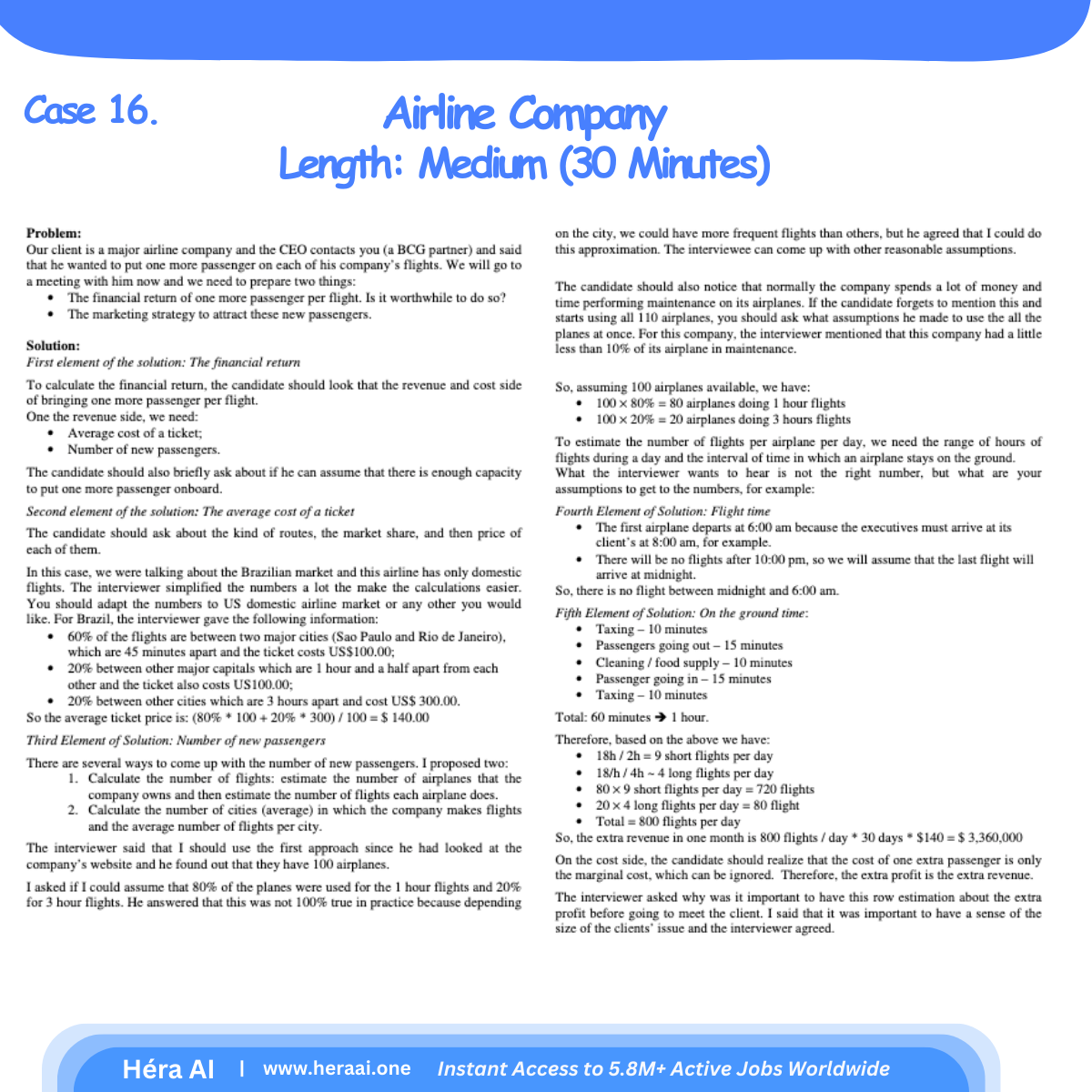
Case 16: The "One More Passenger" Trap — Why Simple Math Still Fails Interviews
The question is trivial. The traps are everywhere. Every wrong assumption compounds — and the interviewer is watching you decide whether to validate them first.
Case 16 is an estimation case with a simple question and a sophisticated scoring rubric. 'What is the financial impact of adding one extra passenger per flight?' The question takes thirty seconds to read and three years of structured thinking to answer well. Most candidates begin calculating within two minutes. Most candidates fail the case within those two minutes — not because their arithmetic is wrong, but because the assumptions they are calculating with have never been validated.
The case is a trap for candidates who have learned that speed signals competence. In a guesstimate or estimation case, the interviewer is not timing how fast you produce a number. They are watching how you decide which questions to ask before you produce any number at all. The candidate who asks for a weighted route mix before requesting a ticket price has already outperformed the candidate who requests 'the average ticket price' and moves immediately to multiplication.
There are four distinct decision points in this case where the structured candidate separates from the fast one: the ticket price approach, the fleet utilisation adjustment, the flight frequency derivation, and the marginal cost insight. Getting all four right — or even three of four — with clear reasoning produces a strong performance regardless of whether the final number is precise.
Two Candidates, Same Question: Where They Diverge
The table below maps the six key decision points in Case 16 and shows what the fast candidate does versus what the structured candidate does. The difference at each step is not mathematical — it is a choice about whether to validate an assumption before using it.
The single most important question in the entire case — and why it must come first: 'Before I calculate a ticket price, can you tell me what the route mix looks like — specifically the proportion of short, medium, and long-haul flights?' This question does three things simultaneously: it signals that you know a simple average will be wrong; it establishes that you understand the revenue calculation requires a weighted average; and it gives you the data to compute that weighted average correctly. The candidate who asks this question unprompted has already passed the first filter.
Step 1: Weighted Ticket Price — Why a Simple Average Is Wrong
The interviewer provides a route mix of 60% short-haul, 20% medium-haul, and 20% long-haul — and ticket prices that differ significantly across these categories. Using a simple average of the three prices produces a number that is materially different from the correctly weighted result. The table below illustrates the calculation with illustrative price assumptions.
Why the simple average error matters more than the arithmetic: A candidate who uses the simple average ($317) instead of the weighted average ($250) has introduced a 27% overestimate into the revenue calculation — before any other assumption has been applied. At scale, this compounds: a $41M estimate becomes a $52M estimate, not because of a calculation error but because of an assumption error. The interviewer is watching whether you catch this. The question 'what's the route mix?' is the catch.
Steps 2–4: Fleet Utilisation, Flight Frequency, and Total Annual Flights
Once the weighted ticket price is established, the revenue calculation requires two more derived inputs: the number of aircraft available on a given day (adjusted for maintenance downtime) and the number of flights each aircraft completes per day (derived from operating hours and route-length mix). Neither of these numbers should be guessed — both should be derived from stated assumptions.
Step 5: The Marginal Cost Insight — The One Sentence That Changes Everything
After calculating the revenue impact, the case requires a cost assessment. Most candidates discuss fuel, crew, catering, and airport fees as costs that would increase with an additional passenger. This is the final trap. The correct insight requires understanding which costs are fixed for the flight (committed the moment the aircraft departs) and which are truly marginal (incurred only because of the additional passenger).
The one sentence that demonstrates consultant-level cost thinking: 'Fuel and crew costs are committed the moment the flight departs — they do not change for one additional passenger. The only meaningful marginal cost is catering, approximately $8–15 per passenger. This means the net incremental contribution of one extra passenger is approximately 95–99% of the ticket price — the additional revenue is almost entirely pure profit.' Say this sentence. It signals that you understand the difference between fixed costs and marginal costs in an operational context.
What Interviewers Are Actually Scoring
Case 16 is not scored on the accuracy of the final revenue estimate. It is scored on five observable behaviours — each of which demonstrates a different dimension of consulting readiness. The table below translates each scoring criterion into the specific behaviour the interviewer is watching for.
The meta-lesson that Case 16 is designed to teach — and that applies to every estimation case: Consulting interviews are not exam simulations. They are executive conversation simulations. An executive does not want a number — they want a structured assessment of a business question, with clearly stated assumptions, a range of defensible outcomes, and an identification of which variables matter most. A candidate who produces a precise number from unvalidated assumptions has given the executive a false sense of certainty. A candidate who produces a range from explicitly stated assumptions has given the executive something they can actually use — and has demonstrated exactly the analytical posture that makes consulting work trustworthy.