Case 14: The Private-Label Peril — Defending Your Brand Against the Store Brand Surge
A branded cookie leader. A flat market. A private label growing from 0% to 20% in five years. This is not a case with one right answer — it is a case that tests whether you can take a position and defend it under conditions that are deliberately ambiguous.
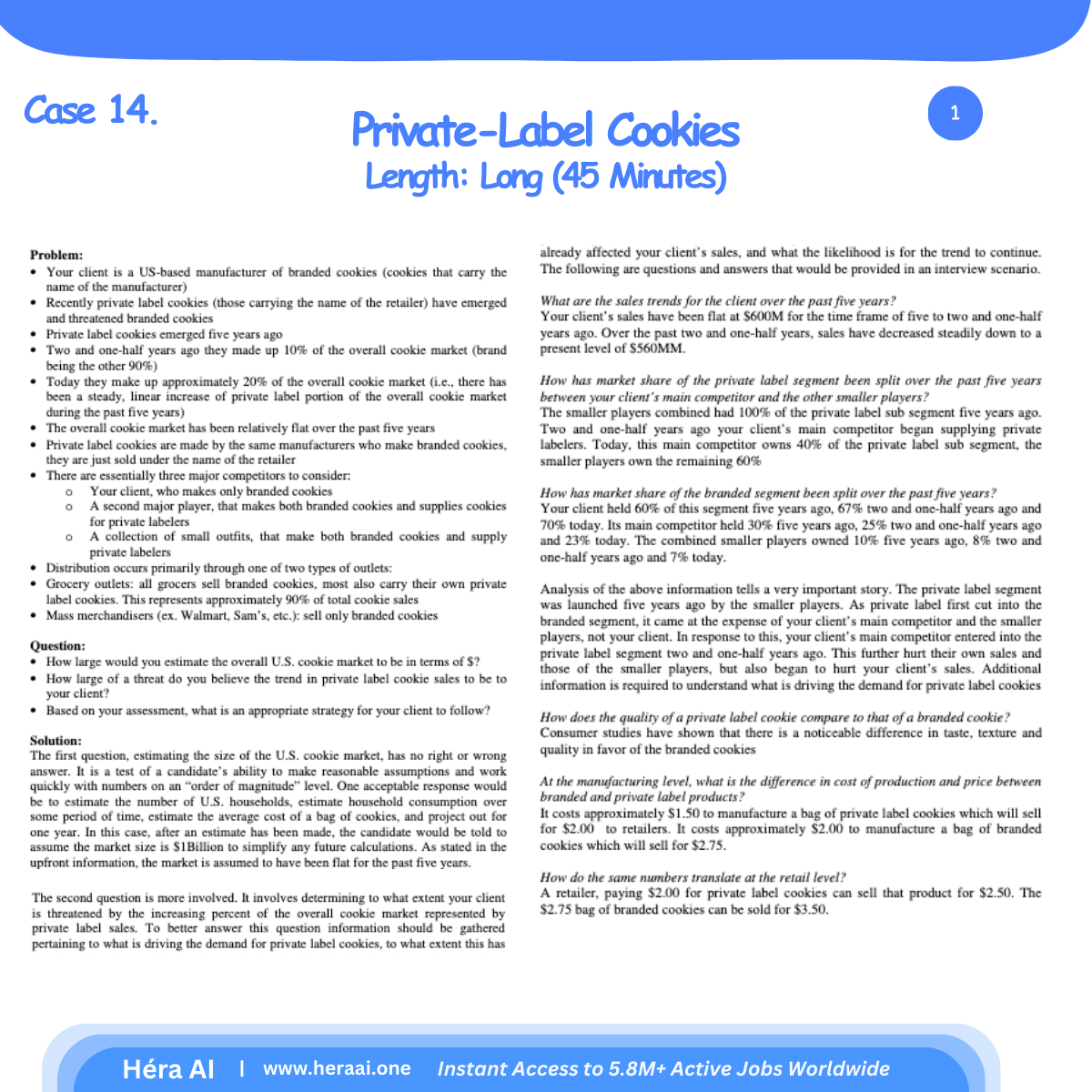
Case 14 is a grey-area case — a category designed not to test whether the candidate can find the correct answer, but whether they can commit to a defensible position when the data supports more than one conclusion. The client is a leading U.S. branded cookie manufacturer whose sales have declined from $600M to $560M over the past two and a half years, in a market that has been flat for five years. The cause is clear: private label cookies have grown from zero to 20% market share in that time. The question is what to do about it.
The case has two strategic options — supply private labels yourself (Option A) or defend the branded position through innovation and marketing (Option B) — and the data supports both. What makes this case genuinely difficult is that the same piece of competitor data that seems to argue against Option A also reveals the conditions under which Option A can work. Candidates who read the data at surface level miss the synthesis that the case is designed to test.
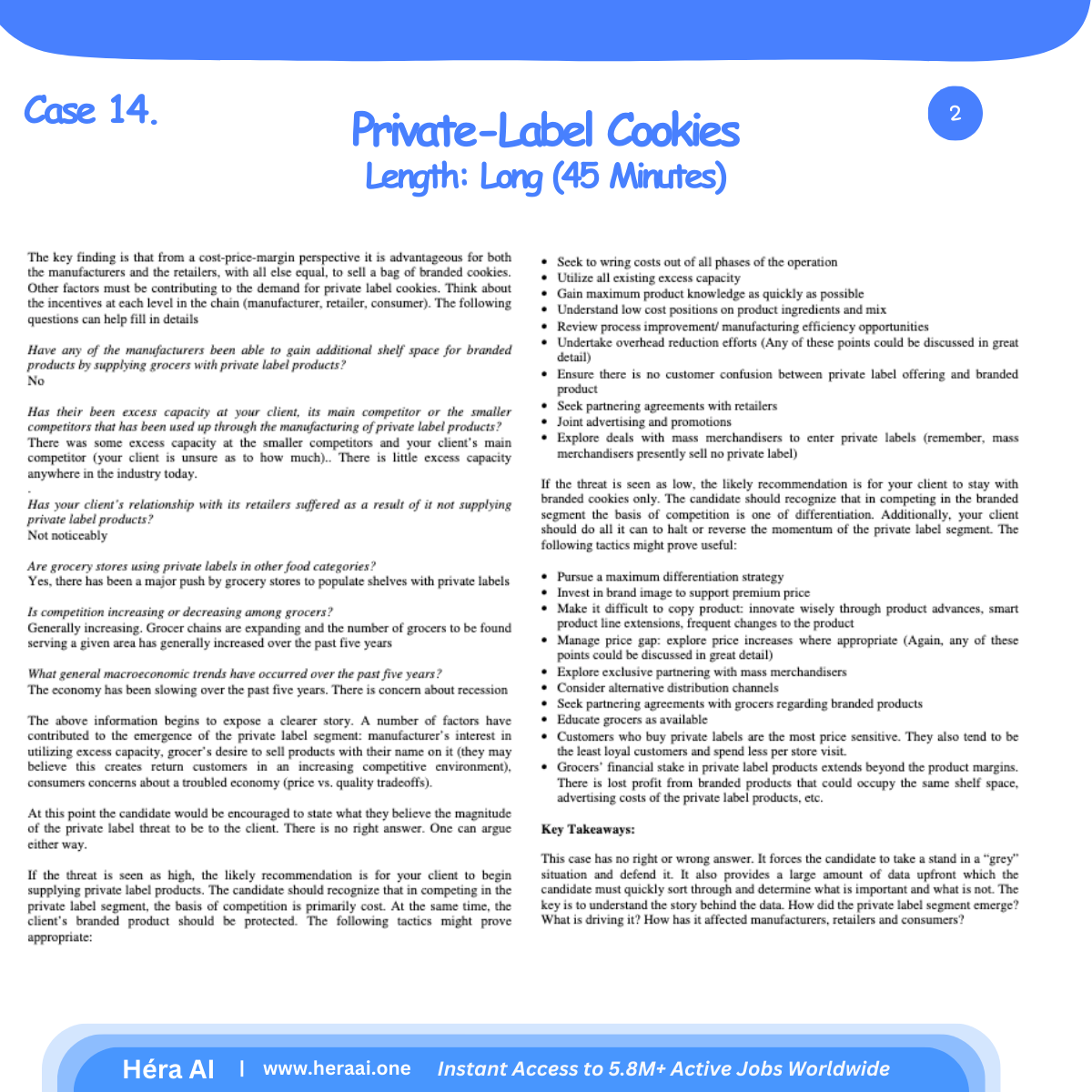
The other key analytical layer is the value chain. Most candidates focus on the consumer price sensitivity dimension of the private label trend. The more important driver is retailer economics: retailers earn higher net margins on private label products when co-op advertising and promotional costs are factored in. Understanding that retailers are actively pushing private labels — not simply responding to consumer demand — reframes the strategic problem from 'how do we retain consumer loyalty' to 'how do we maintain retailer shelf space allocation.'
Value Chain Economics: Why Retailers Are Driving This Shift
The instinctive diagnosis of the private label trend is consumer price sensitivity — recessionary conditions are making the $1.00 premium for branded cookies harder to justify. This is true but incomplete. The more powerful driver is retailer economics. Understanding the full value chain — what each participant gains and what they risk — is the foundation of any credible strategic recommendation.
The analytical reframe that most candidates miss — and that changes the strategic recommendation: The client's primary strategic audience is not the end consumer — it is the retailer. Retailers are actively allocating more shelf space to private labels because it improves their economics. A branded defence strategy that focuses entirely on consumer marketing and product quality, without addressing the retailer's economic incentive to shift shelf space, is incomplete. Any credible Option B recommendation must include a retailer-facing component: what does the client offer retailers to maintain premium shelf placement? Exclusive terms, co-branded promotions, or guaranteed sell-through rates are the levers — not consumer advertising alone.
The Strategic Crossroads: Option A vs. Option B
Neither option is obviously correct. The right choice depends on two judgements that the data does not definitively resolve: whether the private label trend is structural or cyclical, and whether the client has the manufacturing efficiency to compete as a private label supplier without contaminating its brand. The table below maps the six dimensions of the choice.
The Critical Synthesis: Reading the Competitor Data Correctly
The case provides one piece of data that most candidates either ignore or misread: competitors who entered private label supply saw their own branded sales decline more than the client's. This is the key synthesis challenge in Case 14 — extracting the conditional insight from this data rather than using it as a simple argument against Option A.
The insight that separates a strong candidate from an average one — say it in exactly these terms: 'Private labels thrive on commodity thinking. If our product is just another cookie, we lose on price every time — because a $2.50 alternative that is noticeably but acceptably different will always win on value in a cost-conscious environment. The brand's only sustainable defence is to make the quality difference impossible to ignore, not just claim it in advertising. That means innovation that is genuinely difficult to copy, distributed through channels where the brand has exclusivity, and priced at a level that the retailer has an incentive to maintain on shelf.'
The 5-Step Framework
The meta-lesson that Case 14 is designed to teach — applicable to every grey-area competitive response case: Grey-area cases are not testing whether you can find the right answer. They are testing whether you can take a position and defend it under ambiguity — while simultaneously demonstrating that you understand the conditions under which the other option would be correct. The ideal answer to Case 14 is not 'Option B is clearly better.' It is: 'I recommend Option B under the assumption that the trend has a cyclical component and brand equity remains intact for the core consumer. If private label market share growth continues above X% for Y consecutive years, the strategy requires reassessment. If we were to pursue Option A, brand contamination prevention would be the non-negotiable condition. Here is why I believe the current data favours Option B.' Commitment plus conditionality plus competitor data synthesis. That is the full answer.