Case 13: The Prestige Trap — When Brand Dilution Meets Operational Decay
A 25-year premium brand. A growth strategy that chased volume into the wrong segments. A distribution decision that destroyed the channel relationship that made the business viable. This is a two-front war — and it requires a two-front recovery.
Case 13 is one of the more demanding cases in the series — not because the individual analytical steps are complex, but because the problem has two independent root causes that must both be diagnosed before any recovery plan can be constructed. A candidate who focuses on costs misses the revenue diagnosis. A candidate who focuses on brand dilution misses the operational decay. The case is designed to test whether you can hold both problems in your analytical frame simultaneously.
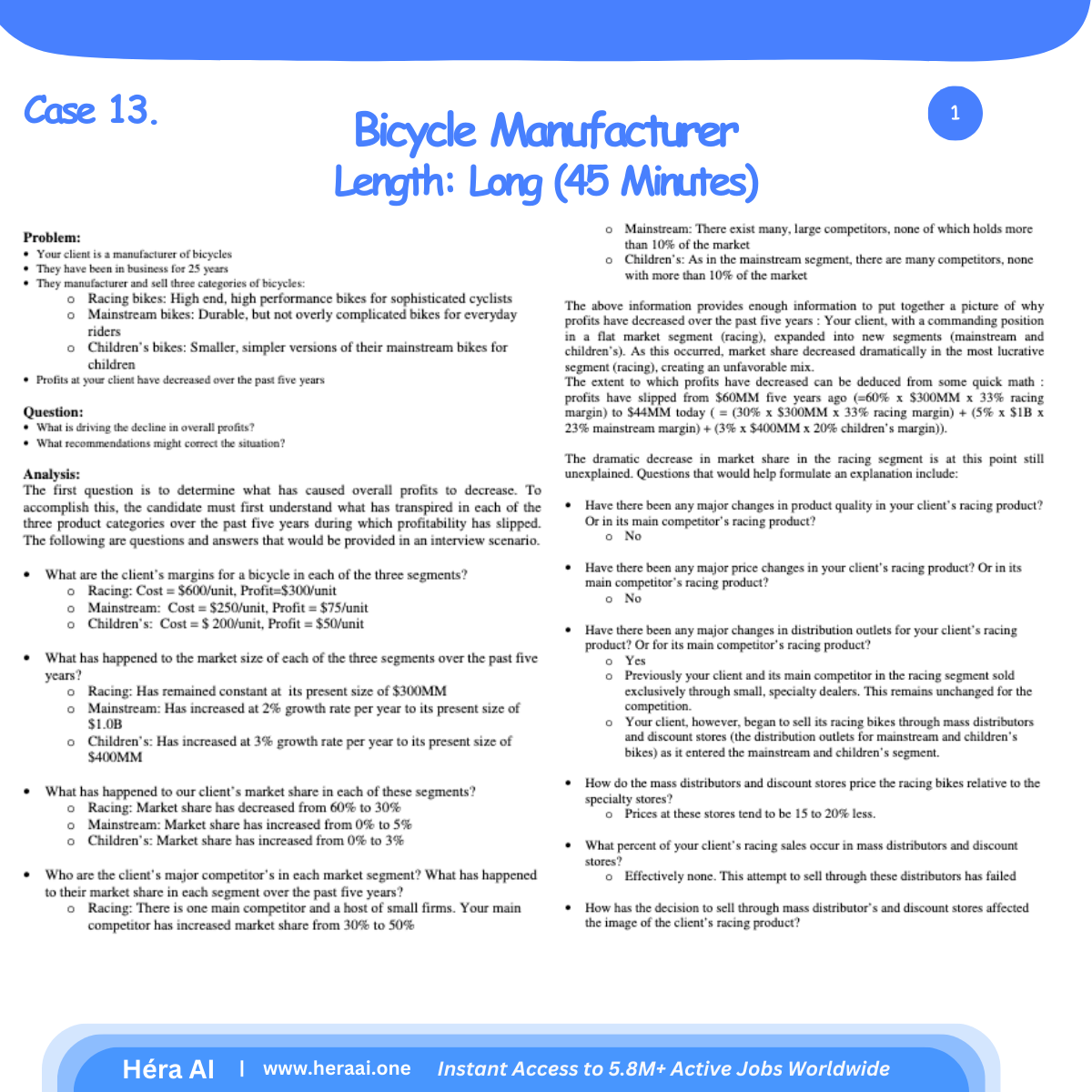
The client is a premium bicycle manufacturer with a 25-year legacy in the Racing segment. Five years ago, facing a maturing Racing market, management made the decision to extend into Mainstream and Children's bike categories to capture volume. This decision — in itself — was not wrong. The execution was catastrophic.
The two failures are distinct and require separate diagnoses. First, the company attempted to sell its elite Racing bikes through the same mass distributors used for its Children's bikes — destroying the specialty retailer relationships that are the only viable channel for premium racing products. Second, while competitors invested in automation and modern maintenance practices, the client chose to 'maximise equipment life' through deferred maintenance, creating a self-inflicted 10% year-over-year cost spiral. Neither problem caused the other. Both problems must be fixed.
Product Mix: Why Volume Growth Destroyed Profitability
The first analytical step is to quantify the product mix destruction — establishing that the Mainstream and Children's segment entries could not mathematically compensate for the Racing segment losses, regardless of the volume achieved. This calculation is the foundation of the recommendation to prioritise Racing segment recovery over further mass-market expansion.
The product mix arithmetic that the interviewer is listening for: 'To replace the profit from one Racing unit at $300, the client would need to sell six Children's units at $50 each. As Racing market share declined from 60% to 30%, the Children's segment would have needed to grow by six units for every Racing unit lost — just to break even on profit. In practice, the new segments did not grow at this rate, and Racing volume continued to decline. The expansion created a negative profit mix shift that compounded over five years.'
The Distribution Blunder: How One Channel Decision Destroyed a 25-Year Relationship
The Racing segment's market share decline is not a product failure. The Racing bike remained competitive on specification, quality, and performance. The cause was a single distribution decision that made it impossible for specialty retailers — the only credible channel for premium racing bikes — to continue selling the client's product.
The channel conflict principle that applies to every premium brand case: 'Channel decisions are brand decisions. Where a product is sold tells consumers and channel partners what the product is worth and who it is for. A premium product in a discount channel does not maintain its premium positioning — it loses it. And the loss is not contained to the discount channel: it contaminates every other channel where the same brand appears. The specialty retailer's response was rational. The only available protection for their own premium positioning was to replace the contaminated brand with a competitor's product. The client created the incentive for its own displacement.'
Operational Decay: The Self-Inflicted Cost Spiral
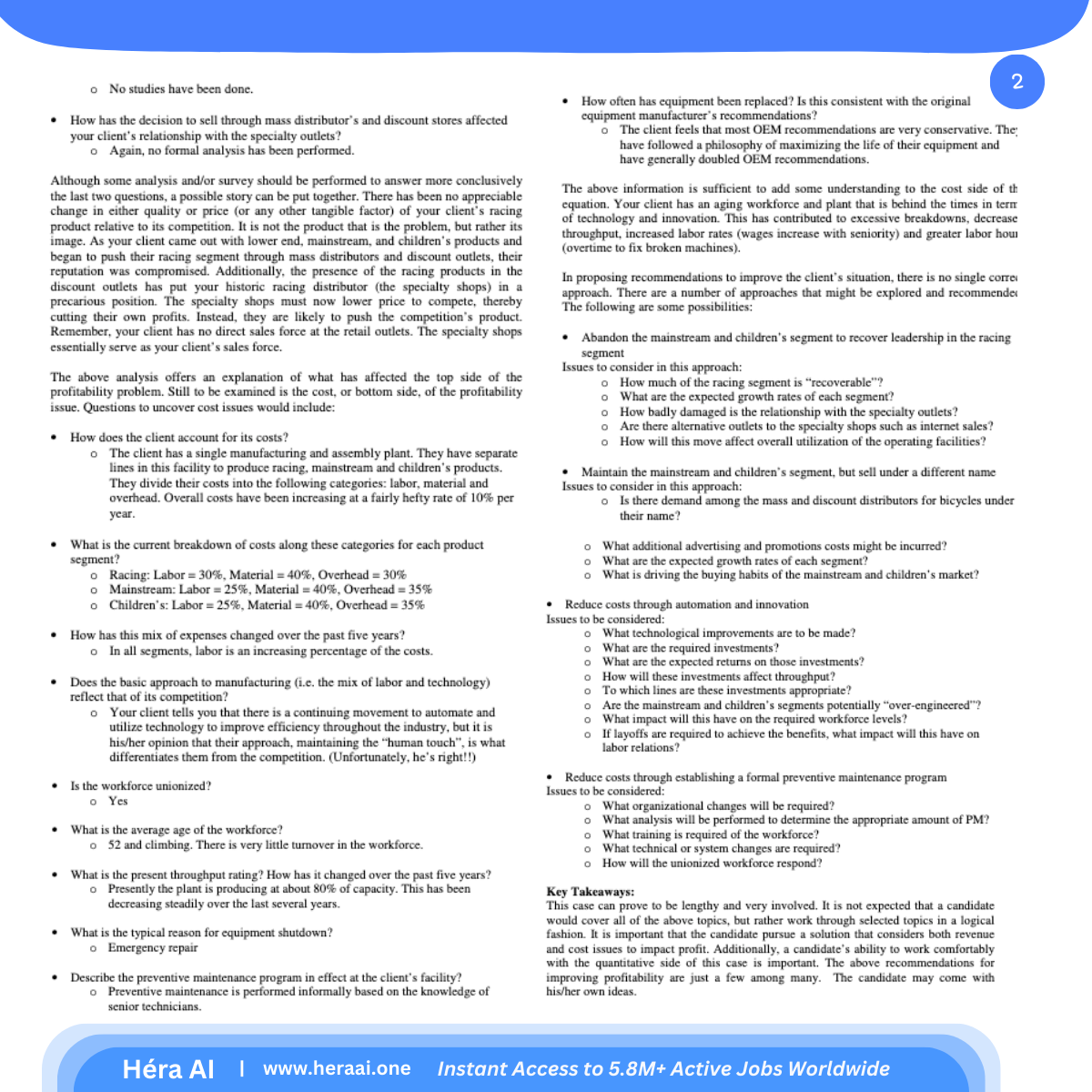
The cost side of the profit decline is independent of the brand and channel problems — but it is equally structural. The 10% year-over-year cost increase is not driven by input price inflation or volume-driven overhead; it is driven by two management decisions that converted manageable costs into compounding liabilities.
Recovery Levers: Sequenced by Priority
The recovery plan must address both the revenue problem (channel repair and brand protection) and the cost problem (maintenance and automation) in the correct sequence. Some actions are prerequisites for others — specifically, Racing must be removed from discount channels before any specialty retailer re-engagement can be attempted. The table below sequences the six recovery levers by timeline and priority.
The 5-Step Framework
The meta-lesson that Case 13 is designed to teach — applicable to every brand extension and premium segment case: Growth for the sake of growth is a death trap when the growth strategy requires compromising the conditions that make the core business viable. The client's Racing segment was the golden goose — the highest-margin product, sold through a channel that required brand exclusivity to function. The growth strategy did not just fail in the new segments; it killed the golden goose. Strategy is as much about deciding what not to do as it is about where to grow. A candidate who articulates this principle — and names the specific decision that violated it — has demonstrated the strategic maturity that Case 13 is designed to test.