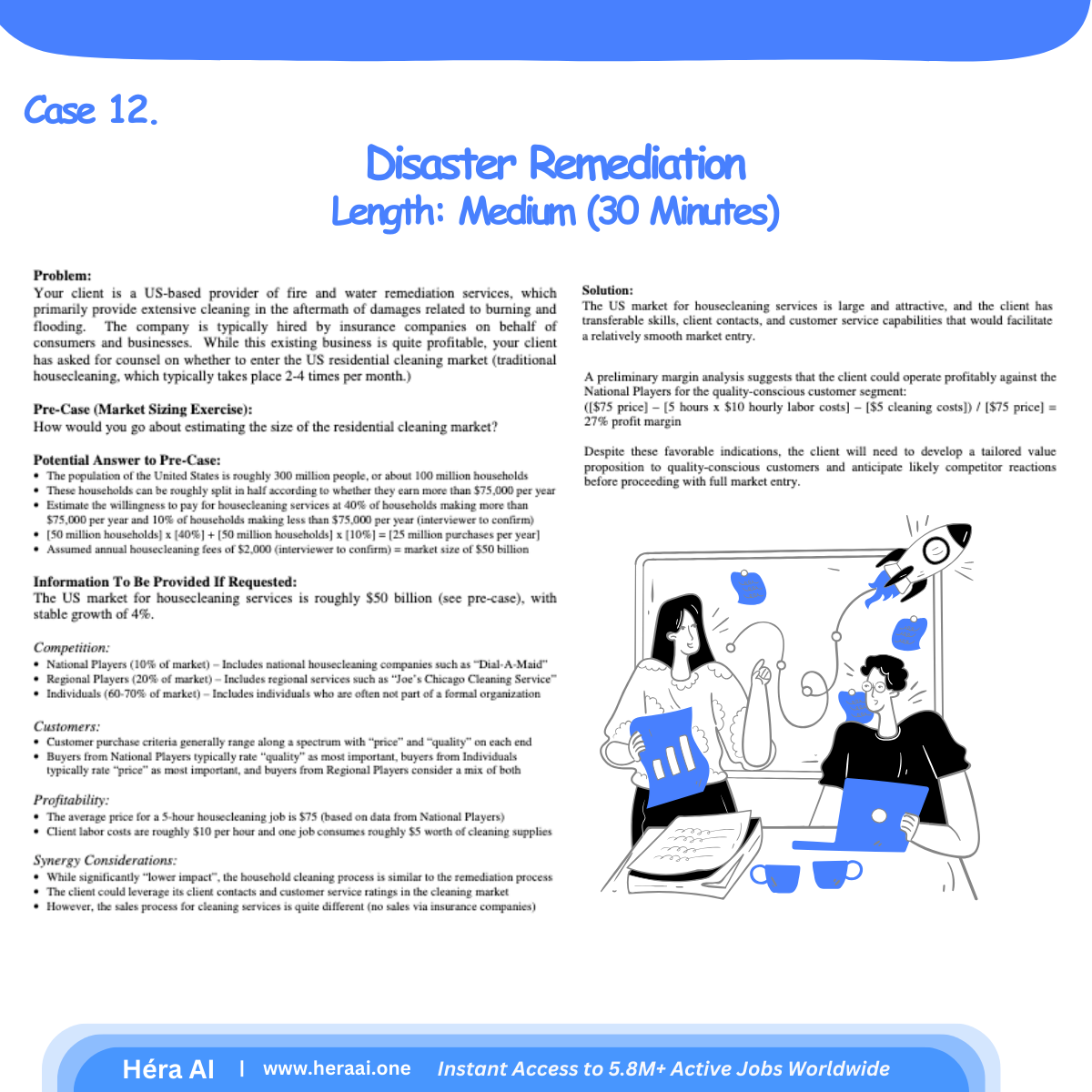
Case 12: Disaster Remediation — Should We Enter the Residential Cleaning Market?
A profitable disaster services company. A $50B adjacent market. Attractive math on paper. The real test: separating operational synergies from go-to-market reality — and knowing which one determines whether the entry succeeds.
Case 12 is a market entry case with a specific structural trap. The surface-level analysis — large market, feasible margins, some transferable capabilities — points toward 'yes.' The deeper analysis reveals that the capabilities that would make entry difficult are precisely the ones the client does not have. Adjacent market cases are rarely risky because the market is unattractive. They are risky because companies overestimate how much of their advantage actually transfers.
The case follows a natural four-step sequence: size the market, validate unit economics, assess the competitive landscape, and evaluate capability transfer. The sequencing matters — candidates who jump to capability assessment before doing the math are working without the permission structure that makes the recommendation credible. The market size and unit economics establish that entry is worth considering; the capability transfer analysis determines whether entry is viable.
The analytical distinction that separates strong answers from average ones in this case is the difference between operational capabilities (which transfer) and go-to-market capabilities (which do not). The work of residential cleaning is similar to disaster remediation. The business model is not. A candidate who conflates these two levels of analysis has missed the case.
Step 1 — Market Sizing: The $50B Foundation
Market sizing is not a formality in this case — it is the first analytical gate. If the market were small or structurally unattractive, the entry question would be resolved before capability assessment begins. The top-down sizing approach below walks through each assumption and explains why it matters for the credibility of the final estimate.
The sizing principle that interviewers are testing: Interviewers are not evaluating whether you arrive at exactly $50B. They are evaluating whether your assumptions are defensible, whether the steps connect logically, and whether you can explain what would change the estimate if the assumptions shifted. A candidate who arrives at $45B through a clearly articulated approach scores higher than a candidate who states $50B without showing the work.
Step 2 — Unit Economics: What the Math Shows and What It Misses
The per-job unit economics check is straightforward: $75 revenue, $55 in direct costs, $20 gross margin per job (27%). The more important analytical move is naming what the gross margin calculation excludes — because those excluded costs are what determine whether the business is actually profitable at scale.
Step 3 — Competitive Landscape and Positioning
The residential cleaning market is fragmented across three tiers: national players (approximately 10% share, quality-focused), regional players (approximately 20%, mixed positioning), and individual/informal operators (60–70%, price-driven). The positioning question is not whether the client can enter the market — the market is large enough to absorb new entrants. The question is where to play and why the client can win there.
The positioning answer that demonstrates strategic clarity: 'The client cannot compete on price with individual operators — their cost structure and overhead are categorically different. The natural competitive position is quality-focused, competing with national players on trust, reliability, and service consistency. The client's disaster remediation heritage is a genuine differentiator in a market where the primary purchase criterion is whether you can trust a stranger in your home. The positioning should make that heritage explicit.'
Step 4 — Capability Transfer: The Make-or-Break Analysis
The most important analytical step in Case 12 is the rigorous separation of what transfers from the existing business and what does not. Most candidates identify some transferable capabilities and some gaps. The insight that separates strong answers is understanding that the go-to-market gap — not the operational gap — is the determinant of whether entry succeeds.
The insight that turns a competent answer into a strong one: 'The key analytical distinction is between the work and the business model. The work of residential cleaning is operationally similar to disaster remediation — the same physical capabilities, the same service standards, the same commitment to quality. But the business model is completely different. Disaster remediation customers are acquired through insurance companies; residential cleaning customers must be acquired directly. That single difference changes the marketing model, the unit economics, and the operational infrastructure required. Operational synergies are real but not sufficient. The go-to-market gap is the risk that determines the recommendation.'
The 5-Step Framework
The meta-lesson that Case 12 is designed to teach — applicable to every adjacent market entry case: Adjacent expansion is seductive because it looks like growth with reduced risk — familiar capabilities, similar customers, related markets. The risk is not market attractiveness. It is capability overestimation. Good consultants validate the math. Great consultants question the assumptions underneath it — specifically, which capabilities will actually transfer and which ones will need to be built from scratch. Building from scratch costs time and money that the market size estimate never accounts for. The recommendation should acknowledge this gap explicitly and propose a sequenced approach that builds the missing capabilities before committing to full-scale entry.