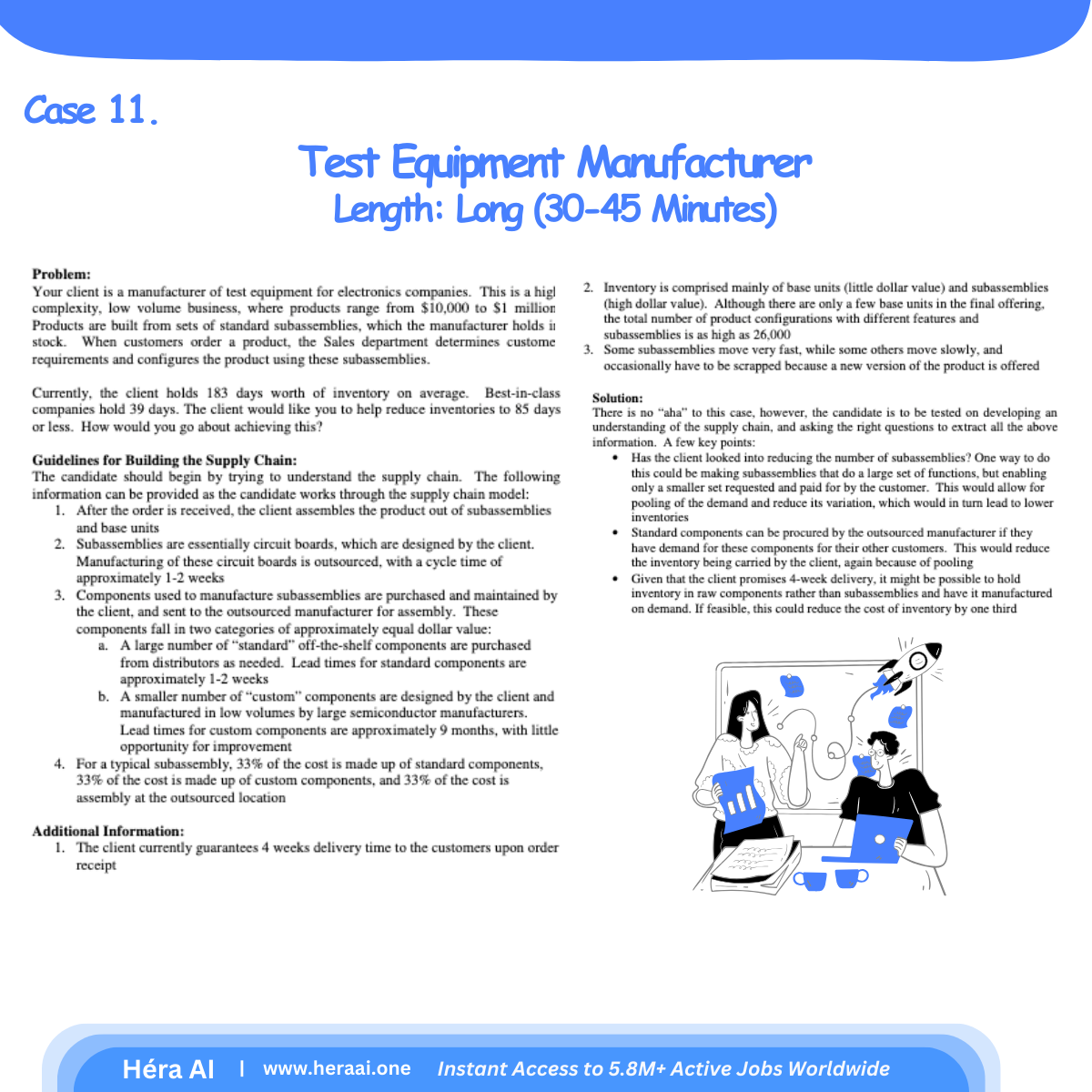
Case 11: Test Equipment Manufacturer — Redesigning the System That Creates Inventory
183 days of inventory. A best-in-class benchmark of 39 days. A 4-week delivery promise. And a 9-month custom component lead time. The inventory problem is visible — but the root cause is structural, and most candidates miss it entirely.
Case 11 is an operations case with a structural trap. The surface problem — 183 days of inventory versus a best-in-class benchmark of 39 days — looks like an operational efficiency problem. The actual problem is a supply chain architecture problem: the client holds this much inventory because the system was designed in a way that makes it rational to do so. The path from 183 days to the management target of 85 days requires system redesign, not inventory management optimisation.
The case is long (30–45 minutes) and rewards candidates who resist the urge to propose solutions before understanding the system. The first move is always to map the supply chain end-to-end: what is held, where it is held, why it is held there, and what constraints prevent it from being held further upstream or not held at all. Only after that mapping is complete does the root cause analysis become possible.
Three structural features of the supply chain explain the 183-day inventory level: 26,000 possible product configurations driven by subassembly combinatorics, a 9-month custom component lead time with low flexibility, and a 4-week delivery promise that mechanically pushes inventory upstream of demand. None of these can be resolved by better demand forecasting. Each requires a deliberate strategic choice.
Understanding the Supply Chain: Mapping Before Solving
The first analytical requirement in this case is a complete supply chain map — from customer order to component procurement. Without this map, any proposed solution risks conflicting with a hard constraint that the candidate has not yet identified. The table below traces the full chain and identifies the strategic implication at each stage.
The operational question that reveals whether a candidate has mapped the supply chain correctly: 'If I wanted to hold zero subassembly inventory, what would have to be true about lead times and delivery promises?' The answer forces the candidate to calculate: custom component procurement (9 months) + subassembly manufacturing (1–2 weeks) + final assembly (1–2 weeks) = a delivery promise of approximately 10 months. The current 4-week promise is only possible because inventory is pre-built across the entire product range. This calculation makes the relationship between the delivery promise and the inventory level explicit — and it is the foundation of the recommendation.
Why Inventory Is So High: Three Structural Root Causes
The 183-day inventory level is not a management failure. It is the rational output of a supply chain designed around three structural features. Understanding each one — and why forecasting improvement alone cannot resolve any of them — is the analytical core of Case 11.
Reduction Levers: What Works, What Doesn't, and Why
Not all inventory reduction levers are viable within the case's hard constraints. The table below evaluates each lever against the structural realities of the supply chain — distinguishing genuine solutions from attractive-sounding ideas that conflict with the binding constraints.
The lever evaluation principle that interviewers are testing: 'Every proposed solution must be tested against the hard constraints before it is recommended. A lever that works in the abstract but conflicts with the 4-week delivery promise or the 9-month custom component lead time is not a viable recommendation — it is a wish. The discipline of testing each lever against the constraints is what distinguishes structured operational thinking from surface-level brainstorming. Name the constraint each lever is working with or around, and the recommendation becomes credible.'
The 5-Step Framework
The meta-lesson that Case 11 is designed to teach — applicable to every operations and supply chain case: Inventory is rarely the root problem. It is the visible outcome of earlier strategic choices — product design architecture, delivery promise commitments, and supply chain structure. Great consultants do not just reduce inventory. They redesign the system that creates it. In Case 11, the system was designed to promise 4-week delivery on 26,000 configurations while holding 9-month custom component lead times. Reducing inventory to 85 days without changing any of those parameters is not feasible at the recommended level. A strong recommendation names which parameter must change — and quantifies what becomes possible when it does.