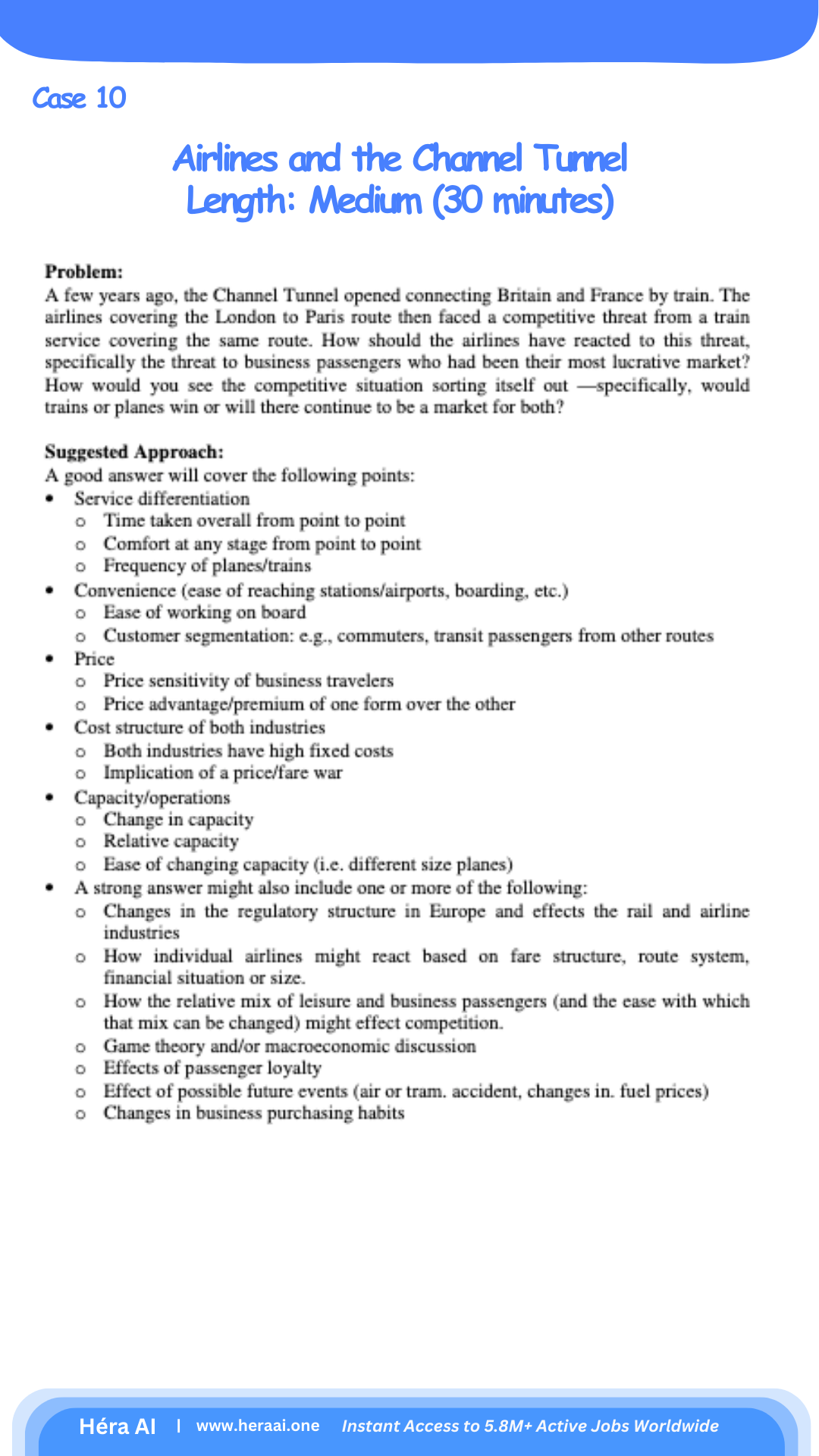
Case 10: Airlines and the Channel Tunnel — When a Superior Substitute Changes the Rules
The Channel Tunnel did not enter the London–Paris market on price. It entered on convenience, productivity, and total journey time — dimensions where airlines are structurally disadvantaged. The strategic response is not a fare war. It is a segmentation.
Case 10 is a competitive strategy case with a framing trap. The obvious response to a new competitor is defensive pricing — cut fares, increase frequency, match the threat. In this case, that response is wrong. The Channel Tunnel entered the London–Paris market not as a cheaper alternative but as a superior alternative on the dimensions that business travellers value most: door-to-door convenience, in-transit productivity, and schedule reliability. Competing on price against a structurally superior product on those dimensions destroys value without restoring share.
The more important analytical move is recognising that this is not a winner-takes-all market. Airlines and rail serve meaningfully different customer segments with meaningfully different deciding factors. City-centre point-to-point business travellers prefer rail. Passengers connecting to onward long-haul flights need airlines. Loyal corporate frequent flyers can be retained through programme investment. Leisure travellers split by price and preference. A single strategic response applied to all of these segments simultaneously is a strategy for none of them.
The case tests whether candidates can identify the correct competitive metric (door-to-door time, not in-air speed), segment the market before recommending, name the price war trap, and identify the durable advantages that rail cannot replicate. These four analytical moves — in sequence — produce a recommendation that is both credible and actionable.
Competitive Dimension Analysis: Who Wins — and Why
The first analytical step is to map every relevant competitive dimension and determine where each mode holds a genuine advantage. The instinctive framing — airlines are faster — holds for in-air time only. On every other dimension that business travellers value, the picture is more complex.
The metric reframe that defines the entire case: 'Airlines are faster in the air. But the customer does not experience the journey as time in the air. They experience it as time from leaving their office to sitting in their meeting. On that metric — door-to-door — rail is competitive or superior on the London–Paris route. The strategic implication follows directly: airlines cannot defend their position by emphasising flight duration. They must defend it by emphasising what happens at the edges of the journey that rail cannot replicate — specifically, the connection to an onward global network.'
Customer Segmentation: Five Segments, Five Different Outcomes
The London–Paris route is not a single market. It is five overlapping markets with different deciding factors, different competitive outcomes, and different implications for airline strategy. A recommendation that treats all passengers identically will be wrong for all of them.
Strategic Response Options: What Works and What Destroys Value
The case offers several possible airline responses. Not all of them are viable — and the most tempting one (aggressive fare competition) is the one that interviewers are specifically testing whether candidates will recommend. The table below evaluates each option against the structural realities of the competitive situation.
The price war analysis that separates strong answers from average ones: 'Fare competition looks like an obvious response, but it is a structural trap. Both airlines and rail carry high fixed costs and low marginal costs — which means neither side can absorb sustained price reductions without significant margin erosion, and neither can easily exit capacity in the short term. A fare war initiated by airlines would force rail to respond, eroding profitability on both sides without changing the fundamental competitive position. Rail would still win on convenience; airlines would have simply paid a large financial cost to confirm that. The recommendation should name this dynamic explicitly and explain why differentiation — not price matching — is the correct response.'
The 5-Step Framework
The meta-lesson that Case 10 is designed to teach — applicable to every substitute threat case: Competition is rarely about who is faster or cheaper. It is about which value proposition best fits each customer's definition of convenience. When a substitute enters on non-price dimensions — comfort, reliability, productivity, friction reduction — the incumbent's response cannot be purely defensive or purely price-based. The correct response is to identify which customer segments the substitute cannot serve well, concentrate the incumbent's advantages on those segments, and stop subsidising the segments where the structural disadvantage is permanent. Strong responses focus on differentiation and segmentation. Weak responses focus on defending everything with a price cut.