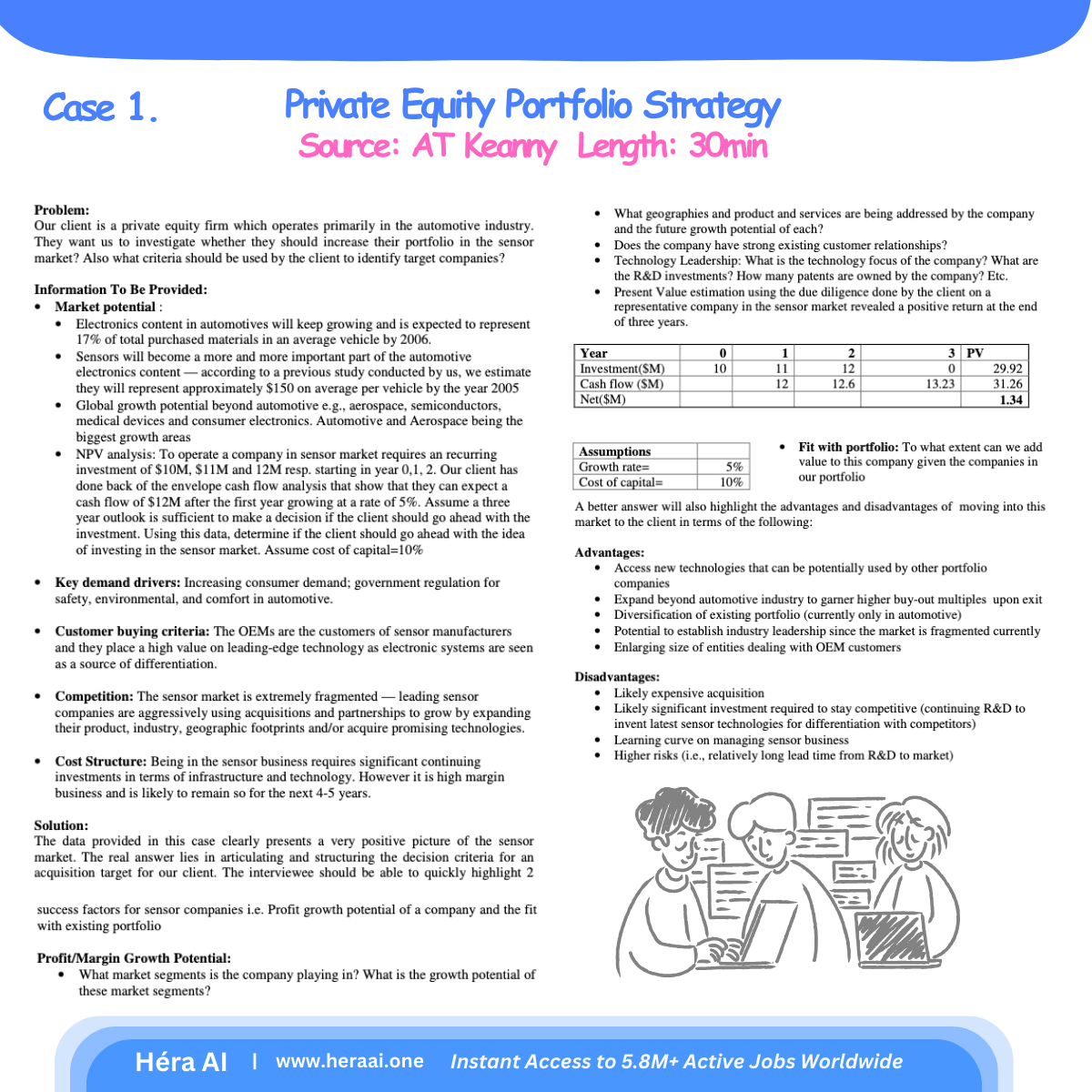
Case 1: PE Portfolio Strategy — A Positive NPV Does Not Automatically Mean Go
Day 1 of 30. An AT Kearney-style private equity case in the automotive sensor market. The math is the starting point. The investment recommendation requires three layers of thinking that the NPV model cannot provide.
Case 1 establishes the foundational principle that runs through every case in this 30-day series: data supports the recommendation; it does not make it. The case is a PE portfolio strategy decision — whether to invest in a business operating in the automotive sensor market. The surface question is whether the NPV is positive at a 10% cost of capital. The real question is what a positive NPV means for an actual investment decision.
The automotive sensor market is growing at approximately 5% annually, driven by structural factors — electrification, autonomous driving requirements, and OEM safety mandates. The market is fragmented, meaning no single player has locked up a dominant position. These two facts — structural growth and fragmentation — make the market attractive on a surface read. The deeper analysis requires three layers of thinking that sit above the financial model.
PE strategy cases test a specific analytical maturity: the ability to move from 'the NPV is positive' to 'here is what the NPV means, here are the assumptions that drive it, here are the conditions under which the investment thesis holds, and here is what would have to be true for the investment to succeed.' That sequence — calculation to interpretation to recommendation — is the consulting skill that Day 1 is designed to introduce.
Three Layers of Thinking Above the NPV Model
The NPV calculation is the starting point of the analysis, not the conclusion. Every PE strategy case requires three distinct analytical layers, each answering a different question about the investment decision.
The principle that Day 1 establishes for the entire 30-case series: 'Running an NPV analysis is relatively straightforward. Explaining what the result means for a real investment decision is not. Consulting is not about perfect calculations — it is about using data to support a clear, defensible recommendation. The NPV tells you whether the investment creates value under your assumptions. Strategy tells you whether the assumptions are right and whether the investment fits the broader portfolio. Both are required.'
What PE Strategy Cases Are Really Testing
The 5-Step Framework
The meta-lesson that Case 1 is designed to establish — foundational for every case in this series: A positive NPV does not automatically mean go. Especially in PE-style investment cases, the real value comes from asking: Does this opportunity fit the firm's broader strategy? What risks matter most in a fragmented competitive landscape? What would have to be true for this investment to succeed? Those questions do not live in a financial model — they come from structured thinking. This is the principle that governs every case that follows in this 30-day series.