

Most candidates know Python. Fewer can explain their code under pressure. Here's the difference — and how to close it before your next technical screen.
Recruiters are not impressed by GitHub repos, bootcamp certificates, or the phrase 'strong Python skills.' What passes a technical screen in 2026 is something more specific: the ability to explain your reasoning under pressure. Why did you choose that data structure? What happens if this function receives an unexpected type? What does Python actually do with that try-except block?
The five skill areas below are not exhaustive Python knowledge — they are the specific domains that separate candidates who fumble under questioning from those who don't. Each one has a surface-level answer that gets you partway through a screen, and a deeper answer that actually gets you hired.
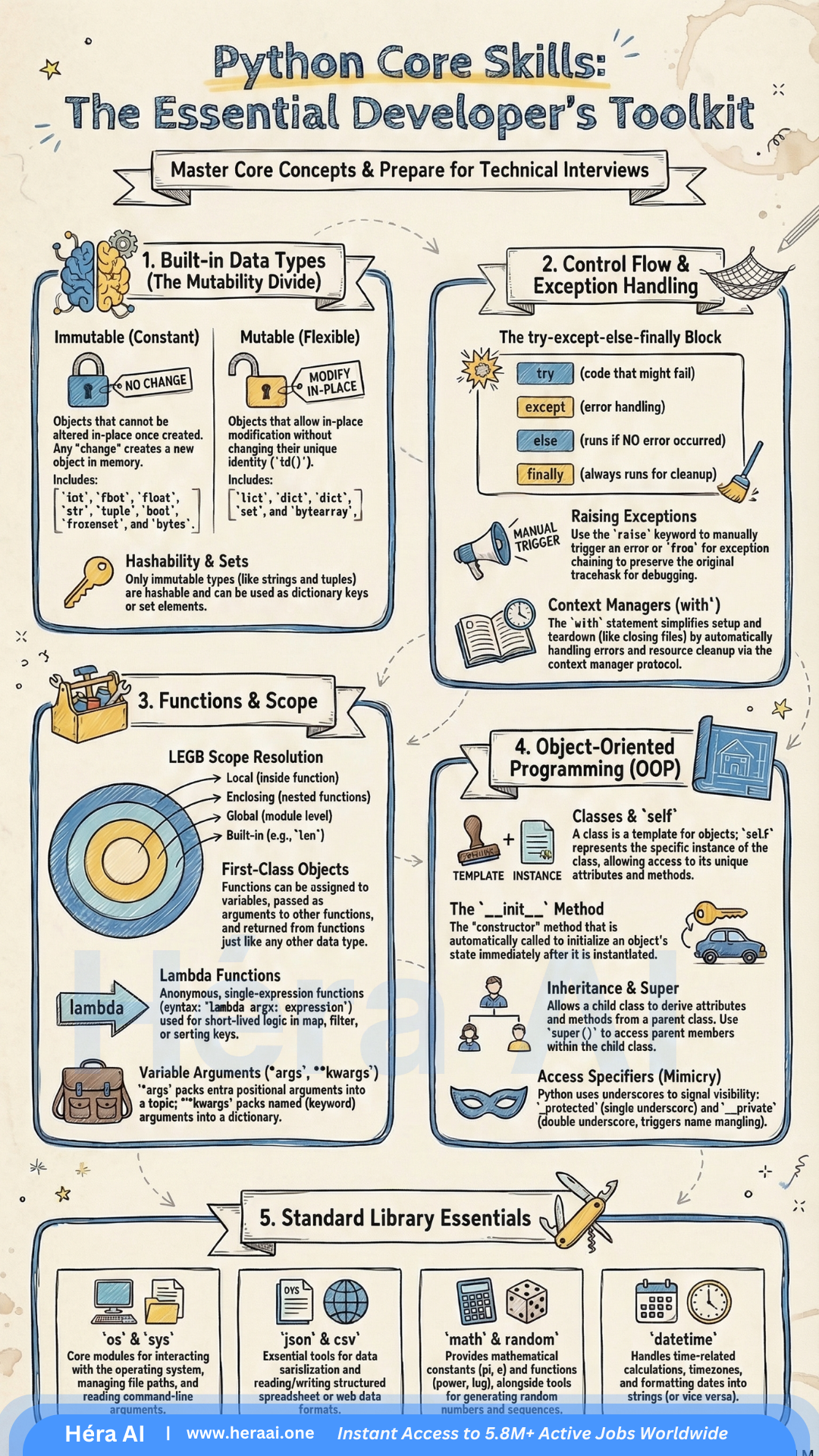
The Five Skills at a Glance — What's Really Being Tested
Before going deep on each skill, it's worth mapping what interviewers are actually evaluating. The questions aren't about definitions. They're designed to expose whether you understand trade-offs, can predict behaviour, and have built things that work in the real world.
| # | Skill Area | The Real Interview Trap | What's Actually Being Tested |
|---|---|---|---|
| 01 | Built-in Data Types | Why can't a list be a dictionary key? | Predicting behaviour from mutability rules — not reciting type lists |
| 02 | Control Flow & Exceptions | Do you know the else block in try-except? | Writing intentional, production-aware error handling — not reactive patching |
| 03 | Functions & Scope | Trace this closure: what value does the nested function return? | LEGB mastery + first-class functions + API design instincts |
| 04 | Object-Oriented Design | Why would you use inheritance here, and what are the risks? | Systems thinking — encapsulation, extension, and trade-off reasoning |
| 05 | Standard Library Fluency | Which stdlib modules did you use in your last project, and why? | Engineering maturity — using what exists before building from scratch |
The meta-skill beneath all five: Technical interviews in 2026 are judgment tests, not memory tests. The strongest candidates don't just answer the question — they volunteer the trade-off. 'I used a tuple here because it's immutable and hashable, which matters because...' That instinct to lead with why signals the engineering maturity that senior tracks are looking for.
01 — Built-in Data Types: It's About Mutability, Not Memorisation
Most candidates can list Python's built-in types. Fewer can predict what happens when those types interact with the language's fundamental mechanisms — and that distinction is exactly what interviewers are probing when they ask about data types.
The core question is always some version of: 'Can you reason about behaviour from first principles?' The most commonly used probe is the dictionary key question, because it requires understanding the relationship between mutability, hashability, and Python's internal dictionary implementation.
✓ Immutable (hashable → valid dict key)
- • int, float, complex
- • str
- • tuple
- • frozenset
- • bytes
- • bool
✗ Mutable (not hashable → invalid dict key)
- • list
- • dict
- • set
- • bytearray
- • Custom objects (default)
- • array.array
Interview principle: Immutable types are hashable because their value cannot change after creation — so a consistent hash is always producible. Mutable types cannot guarantee a stable hash, which would break dictionary lookup integrity. The reasoning chain interviewers want to hear: mutable types can change their content after creation → a consistent hash cannot be guaranteed → Python's dict requires stable hashes for key lookup → mutable types cannot be dictionary keys.
Career hack from HéraAI analysis: In interviews, always lead with why you chose a data structure — not just what it does. 'I used a frozenset here because the collection won't change and I need to use it as a dictionary key later' signals the kind of forward-thinking that distinguishes a mid-level candidate from a senior one.
02 — Control Flow & Exception Handling: Stop Writing Fragile Code
The try-except block is one of the most underused tools in a junior developer's arsenal, and one of the most incorrectly used in a mid-level one. The pattern most candidates know — try and except — is the minimum. The full four-block structure is what interviewers use to filter candidates who write intentional code from those who write reactive code.
The context manager signal: In behavioral interviews, describing a time you used a with statement for resource cleanup — file handles, database connections, network sockets — signals production awareness. The with statement implements the context manager protocol (enter and exit), which guarantees cleanup even if an exception is raised. This is the preferred pattern over try/finally for resource management.
03 — Functions & Scope: The One Most Candidates Skip
LEGB is four letters that appear in more Python interview questions than any other single concept. Python resolves variable names in exactly one order: Local → Enclosing → Global → Built-in. If you can't trace through a closure and explain precisely which value a nested function will use — without running the code — you will fail live coding screens at the mid-level and above.
Functions & Scope — What Strong Candidates Know
Interview technique: When asked to write a function, proactively mention scope and argument design. 'I'm using **kwargs here to keep the API flexible — callers can pass any additional parameters without breaking the function signature' signals the kind of API-level thinking that senior interviewers reward.
04 — Object-Oriented Programming: Think in Systems, Not Scripts
OOP questions in Python interviews are not about knowing what a class is. Every candidate knows what a class is. The interview is probing whether you understand why OOP exists — what problems it solves, when it creates more complexity than it resolves, and what the specific Python implementation details mean for how you design systems.
| Concept | What It Is | What the Interview Is Actually Probing |
|---|---|---|
| self | The instance reference | self is the specific object being operated on — not the class. Every instance method receives it as the first argument automatically. Candidates who can't articulate this distinction haven't built enough with classes under pressure. |
| init | The constructor | Called automatically when a class is instantiated. Sets up the object's initial state. Confusing init with new (which creates the object before init runs) is a common senior-level probe. |
| super() | Parent class accessor | Calls the parent class method without hardcoding the parent's name. Critical for clean inheritance chains — especially in multiple inheritance where Method Resolution Order (MRO) determines which parent is called. |
| _name | Protected convention | Signals 'internal use' to other developers. Not enforced by Python — it's a documentation convention. The underscore says 'you can access this, but you shouldn't unless you know what you're doing.' |
| __name | Name mangling | Becomes _ClassName__name internally. Prevents accidental override in subclasses. This is the one interviewers use to separate candidates who've read about access control from those who've debugged it in production. |
Design instinct that interviewers notice: When asked to design a system in an interview, default to OOP and explain your encapsulation decisions explicitly. 'I'm keeping this attribute private with a double underscore because it should only be modified through the update() method — direct access would bypass the validation logic' demonstrates exactly the architectural awareness that distinguishes a systems designer from a script writer.
05 — Standard Library Fluency: The Mark of a Self-Sufficient Developer
Knowledge of Python's standard library is a proxy for production experience. Candidates who reach for the right built-in module before writing a custom implementation signal two things: they've built enough real systems to know what already exists, and they understand that shipping fast and reliably matters more than writing everything from scratch.
Portfolio documentation signal: In your portfolio projects, document which standard library modules you used and why you chose them over third-party alternatives. 'I used pathlib.Path instead of os.path because the object-oriented interface is cleaner for complex path operations and it's the recommended modern pattern' demonstrates engineering maturity in a way that raw code does not.
Judgment, Not Memory
The five skill areas in this article share a common thread: they are all domains where the surface-level answer is easy to produce and insufficient to pass. Knowing that a tuple is immutable is the entry point. Understanding why that immutability matters for hashability, dictionary keys, and memory behaviour — and being able to articulate that reasoning without prompting — is what gets you hired.
Mastering these five areas doesn't just prepare you for interviews. It changes how you write code in practice: with more deliberate data structure selection, more intentional error handling, more thoughtful API design, and a clearer instinct for when to use what the language already provides rather than building it again. At HéraAI, the Interview Cheatsheet Vault is built to develop exactly this kind of depth — not just answers to specific questions, but the reasoning fluency that holds up when the interviewer pushes back.
This article is part of the Interview Cheatsheet Vault series from HéraAI — Instant Access to 6.6M+ Active Jobs Worldwide.